Imperfect Guardians
Table of Contents Show
Introduction
Professor David Strauss attributes the U.S. Supreme Court’s reactionary jurisprudence to a breakdown of elite consensus. He observes that lawyers and judges disagree about the proper “victims” of our political process: Are they Black, Brown, and LGBTQ+ people or, instead, Whites, Christians, and gun owners? Under such elite “polarization,” Strauss worries the jurisprudential approach that emerged from Carolene Products allows for judicial intervention on behalf of groups loaded with political power. Even then, he insists on the classic liberal defense of the courts: that courts serve as an important if imperfect check against the majoritarian domination of minorities.
In this Essay, we identify as critical to such defenses the unstated conjecture that elites are more enlightened than popular majorities—the conjecture that, for all of its limitations, juristocracy is still preferable to “crude” majoritarianism. The corresponding portrayal of ordinary people as relatively bigoted, irresponsible, or ignorant—read: unable to self-govern—animates liberal politics in the United States more broadly. We argue that confidence in the comparatively reactionary character of ordinary, working-class, and poor people in the United States is in no way proportional to the evidence. That confidence reflects less a grounded finding, and more ideology or faith in the need for elite rule. To allow these commitments to go untested is particularly dangerous in the face of the authoritarian politics of hyper-concentrated wealth and power that has become a feature of contemporary life. Such discourse diverts attention from the fundamentally undemocratic nature of the U.S. state and allows governing elites to blame “the people” for problems elites have a disproportionate hand in creating.
We focus on a recent example: the dominant narrative that emerged among liberal commentators in the immediate aftermath of the 2024 presidential election. Attempting to explain Donald Trump’s return to power, this time with a popular victory, pundits and journalists quickly converged on the idea that Americans were simply more reactionary than progressive “groups” would like to believe. This explanation—woefully undersupported by the available evidence—has been used to explain (and vindicate) the relative quiescence of elected Democratic officials in response to the onslaught of the second Trump administration. In turn, unelected judges have been identified as the last and only bulwark against an ongoing democratic backslide.
To be clear, ours is not an argument to forgo the courts. The judiciary is a terrain of state power worthy of contestation. Courts may provide limited tactical venues against authoritarian gestures, as the recent months have demonstrated.[1] The lawsuits filed against the Trump administration by the American Association of University Professors or on behalf of disappeared and incarcerated students engaged in pro-Palestine advocacy are important,[2] just as lawsuits have been in other moments[3] and contexts.[4] These trials put a recalcitrant administration on trial—literally and figuratively—alongside protest and public outcry. Nonetheless, it is hard to imagine courts paving roads to popular emancipation or mitigating harm at scale. That is not and cannot be the place of courts, given their social composition and their function. Nor should it be.
A sober and grounded view must be developed: one that attends to the facts and the many contradictions of law the second Trump administration has put bright lights on. An ideological defense of courts—as opposed to a tactical assessment—easily collapses into a defense of elite or minoritarian rule. The dangers of such a defense are now undeniable. Any defense of elite rule entails defending the status quo, itself a product, in our view, of elite rule.
I. A Familiar Defense
Now is a complicated time for liberals to talk about courts. Owing significantly to the most recent few elections—and the Federalist Society’s dogged activism—the right has potentially captured the Supreme Court for a generation or more.[5] Emboldened Republican-appointed justices, to say nothing of Fifth Circuit judges, have accelerated the dismantling of the modern administrative state,[6] bludgeoned environmental regulation and labor protections,[7] and delimited federal- and state-level protections afforded to workers, women, and people of color.[8] The Supreme Court has been one of many important staging grounds for a long-gestating counterrevolution to the many revolutions and rights struggles of the twentieth century.[9] This latest chapter of the Court’s antidemocratic gestures is arguably among its more brazen.[10]
There is a larger political context to consider. Since returning to office, Donald J. Trump has displayed a stunning disregard for Congress, the courts, the administrative state, and really anyone who stands in his way. Some have dubbed this moment a constitutional crisis,[11] while others have invoked autocracy, fascism,[12] authoritarianism,[13] or techno-feudalism.[14] Some have emphasized this as a moment of rupture while others highlight continuity.[15]
Whatever you call it, and whether you think of it as sudden or long-gestating, an aspect of neoliberalism and capitalism or a departure, this is a turbo-charged antidemocratic and antisocial politics of destruction, plunder, and privatization.[16] The Trump administration has ignored innumerable statutory and constitutional constraints, fired personnel and impounded federal funds in flagrant violation of core constitutional principles—like Congress’s power of the purse[17]—and gutted legislation like the Impoundment Control Act,[18] the Administrative Procedure Act,[19] and the Civil Service Reform Act.[20] The administration has intensified attacks against public education, academic freedom, faculty governance, and universities, as it has fueled repression against protest and immigrants in a way that recalls the McCarthy era.[21] The administration has taken aim at the infrastructure of the liberal and left political ecosystem, simultaneously threatening law firms, nonprofits, news media, and solidarity movements.[22] While the administration has largely relied on executive power, Congress’s recent One Big Beautiful Bill Act significantly cut into Medicaid, food assistance, and student debt programs, while legislating $75 billion extra for immigrant deportation and incarceration capacity as well as massive tax cuts for corporations and the wealthiest people.[23] It has been called “the largest transfer of wealth from the poor to the rich in a single law in U.S. history.”[24]
Against such head-spinning conditions, the narrative that courts are imperfect but necessary guardians of democracy is simultaneously under pressure and in revival. The idea was buckling under the Supreme Court’s theatrical coziness with right-wing causes and the owners of jets and country clubs.[25] But a defense has emerged amidst the early days of the second Trump administration and its refusal to abide by the rule of law.
For almost half a century, a sentiment pervaded among liberals that courts, and even the Supreme Court, for all their limits, are our last and only bulwark against democratic backsliding.[26] This narrative of courts is traceable to the Warren Court’s jurisprudence and John Hart Ely’s 1980 theorization in Democracy and Distrust.[27] Since then, liberals have tended to understand courts as essential protectors of democracy, and correlatively, as defenders against what one might think of as democratic excess, or unjust majoritarian domination of minorities.[28]
Courts as defenders against democratic excess is Strauss’s subject. The characterization of courts as impartial guardians rests on an empirical conjecture: that judicial elites remain, for all their failings, more enlightened—which is to say, less bigoted—than popular majorities, or ordinary working-class and poor people. Central to Strauss’s thinking is a recognition that elite opinion is fractured: that federal courts are as or more disposed to regard White Christians as victims of wrongful persecution than they are Black people. Nonetheless, Strauss dismisses limiting judicial power and urges us to identify “some value” in our “inevitable” juristocracy.[29] The policies of the Court, the implication seems to be, leave us better off than the policies of the people.
Strauss emphasizes discontinuity, observing that courts today are less protective of groups liberals would typically regard as “victims.” But it is important not to lose sight of the tremendous continuity in liberal thought as to the comparative enlightenment of judicial and other elites. As Strauss recounts, the legal academy has long championed the Warren Court as integral to the modest but real advances in racial justice of the mid-twentieth century.[30] Even the more reactionary Rehnquist and Roberts Courts are celebrated in the story of advancement of gay rights during the early twenty-first century.[31] In the wake of Obergefell v. Hodges, for example, one law professor wrote that only recently could “gay people and couples . . . emerge from the shadows,” and that “[c]ourts ha[d] been as essential to that progress as air is to life.”[32]
Such narratives tend to place courts in a vacuum. They sideline the role of social movements and the broader political and economic context in which social change takes place.[33] But rather than revisit the long-standing debates around courts within larger struggles for emancipation,[34] we attend to a recent example of relative optimism about elites among liberals—one concerning the 2024 federal election—before turning to questions of democracy and the courts. The election results and the surrounding discourse are necessary to unpack to understand our concern with contemporary defenses of elite rule. We read Strauss’s defense of courts in the context of a time of elites embattled from below and within. These conflicts and shifting alliances are everywhere you look, from the battles within each party, to Silicon Valley, Wall Street, and mainstream media.[35] Such conflicts about the state and future of our society are not limited to the halls of power but extend to our streets, schools, workplaces, and more.[36]
II. Losing Touch
When Trump was first elected president in 2016, Democrats won substantial majorities of the popular vote.[37] In 2024, third-time candidate Trump managed both a resounding Electoral College victory and a healthy margin in the popular vote, securing 77.3 million votes over Democratic presidential candidate Kamala Harris’s 75 million and sweeping all seven swing states.[38] This time, liberal publications like The New York Times were unable to blame the outcome on the antidemocratic Electoral College. Instead, they declared that Americans had shifted rightward.[39] Liberal commentators in turn spouted stories of electoral failure on the grounds that the party had lost touch with “working class” Americans.[40] These figures argued that Democrats were simultaneously attending to “groups” like the American Civil Liberties Union (ACLU) or Justice Democrats and preferring trans athletes and immigrants over the “kitchen-table” issues of real Americans like the price of eggs.[41]
This narrative spread like a virus among Democratic Party officials and pundits attempting to explain the defeat. On powerful niche interests, Representative Seth Moultan of Massachusetts remarked, “Democrats spend way too much time trying not to offend anyone rather than being brutally honest about the challenges many Americans face. . . . I have two little girls, I don’t want them getting run over on a playing field by a male or formerly male athlete.”[42] On the rightward shift, Eric Levitz wrote in Vox: “[T]here is considerable evidence that voters grew more right-wing in their attitudes toward immigration.”[43] The New York Times surmised voters “blamed the Biden administration for failing to acknowledge the chaos at the border and promptly take aggressive steps to address it.”[44]
Within this echo chamber for liberal elites, the story of Trump’s return to office became that Americans were growing increasingly right-wing while the Democratic Party was beholden to “woke” non-governmental organizations and their out-of-touch agendas.[45] To win future elections, it followed, Democratic Party candidates would need to align their positions with the views of “ordinary” Americans, rejecting the “rigid mores and vocabulary of college-educated elites.”[46]
Class, no doubt, is a tectonic force in U.S. politics. But one irony was that this story often centered on trans people and immigrants—constituencies hardly associated with concentrated wealth or weighty political power. While anti-trans politics have been central to right-wing culture wars for at least a decade, the views of the public seem to be far less cruel or transphobic.[47] Another irony: The shifting common sense on racial and immigrant justice was the result of a decade of protest and historic mass movements in which tens of millions of people participated in thousands of towns and cities, across rural and urban landscapes alike.[48] Far from niche, these protests are a zeitgeist of our times.
Perhaps the most perverse irony was this: While it was true that the Democrats had been profoundly limited in their pursuit of a materialist agenda for working-class and poor people, White or otherwise, there was far more evidence that the roadblock was the corporatist composition of the party, not the left, the ACLU, immigrants, or trans people. But the party’s critical role in dismantling the post-war social welfare state over decades at the behest of the increasingly powerful donor class generally went unmentioned.[49] Harris forged her economic agenda surrounded by Silicon Valley executives—with whom she had developed deep ties as a California politician—and Wall Street.[50]
The speed with which the narrative about overly powerful left-leaning “groups” like the ACLU and Black Lives Matter tanking the election for Democrats gained acceptance was curious. To put it charitably, evidence is mixed on whether the 2024 election is explained principally by either a rightward shift within the electorate or a negative reaction to Democrats’ concern for vulnerable populations like trans people and migrants. On issue after issue, the party’s 2024 platform had shifted to the right from the 2020 platform[51]—when Biden won.[52] Harris ran what was in many ways a conspicuously Republican-friendly campaign as she stressed her commitment to a “most lethal” military and her law-and-order bona fides.[53] In the campaign’s final weeks, she even went on tour with former Republican House member Liz Cheney to tout Cheney’s endorsement.[54]
Meanwhile, the claim that “moderate” or “swing” voters were negatively affected by Democrats’ embrace of trans people rested in significant part on the Trump campaign’s now-infamous “Kamala is for they/them” advertisement, where Trump contrasted himself, insisting, “President Trump is for you.”[55] The advertisement focused almost entirely on Harris’s support for public funding of gender-affirming surgery for transgender people in prison and immigrant detention, tapping into long-stoked resentment for affording public goods to incarcerated people rather than to the public at large.[56] Even assuming the ad was a success, in other words, it is entirely unclear what that would suggest about public attitudes towards trans people in general.
Similarly, on immigration, the story has as much to do with Democratic officials and pundits pushing discourse to the right as opposed to finding it there. Democratic presidents going back at least to Bill Clinton have acquiesced to or even embraced a “secure borders” framing of immigration that conflates immigrants with security threats. Recall that Barack Obama’s historic number of deportations led immigrant justice organizations to dub him “Deporter-in-Chief.”[57] A theme of Democrats’ 2024 campaign was their embrace of a draconian “border security” bill.[58] Harris even suggested she was to the right of Trump on immigration on expanding the border wall.[59]
Liberal outlets simultaneously exaggerated the rightward shift by the electorate and diminished the rightward shift in the Democratic Party. In a piece headlined “Support for Trump’s Policies Exceeds Support for Trump,” The New York Times pronounced, “A little more than half of the country expresses some desire to see Mr. Trump follow through with his . . . threat to . . . deport[] everyone living in the United States without authorization.”[60] Digging into that poll, support for “mass deportation” quickly dissipates based upon framing: There is dramatically less support for deportation of people who entered the country unlawfully as children or where deportation would require family separation.[61] These attitudes are traces of past struggles,[62] whether the Dreamers’ protests of 2010 or broader popular outrage, including among conservatives in Texas, to Trump’s family separation policy in his first term.[63] More recent polls suggest Trump’s deportation policies are not popular.[64] That Immigration and Customs Enforcement (ICE) agents are wearing masks in public and that ICE lawyers are withholding their names in deportation proceedings suggest the agency knows as much.[65] Even before Trump took office, public opinion concerning “mass deportation” was much more complicated than The Times and other liberal outlets let on.
Beyond those examples, a more fundamental difficulty with the powerful “groups” narrative is that while Donald Trump saw his vote total increase between the 2020 and 2024 elections by just over three million votes (from 74.2 million to 77.3 million), Kamala Harris garnered six million fewer votes than did Joe Biden in the previous election (75 million to Biden’s 81.3 million).[66] Basic arithmetic suggests the 2024 election was at least as much about nonparticipation as it was voters shifting from Biden to Trump.
Worries about nonparticipation, especially among younger voters and Arab and Muslim voters, swirled around the Harris campaign in its final weeks.[67] This was in significant part because of Harris’s refusal to break from President Biden’s support for Israel’s continuing military intervention into Gaza[68]—a policy that was deeply unpopular both among Democrats and Independents (and even to some extent Republicans).[69] Post-election polling suggests those worries were well-founded. In one poll, a plurality of Biden 2020 voters who did not vote for Harris cited “[e]nding Israel’s violence in Gaza” as the decisive issue.[70] Here, the story is less about the left capturing the party and more about a disconnect between significant constituencies within the presumptive base of the party and the party’s leadership.
Our aim is not to establish that the Democrats’ defeat in 2024 was attributable primarily to disaffection and disengagement. Rather, we identify a mismatch between the popularity of and confidence in the “groups” explanation among liberal elites and the evidence ready at hand. There is at least as much if not more evidence to suggest a popular rejection of or malaise with the very state of U.S. politics—a rejection of both candidates and both parties.
The “groups” narrative echoes an outline that has become sufficiently familiar to feel like a script—of the party punching left to avoid introspection about the dealignment between working people in the country, their needs and desires, and the party’s role in immiserating them or at least not standing in immiseration’s way. The “groups” narrative attempts to blame the Democratic Party for being the party of the left when far more evidence suggests the problem is instead that the Democrats are the party—or at least a party—of capital.
III. Protest Within Repression
The questionable commitment among Democratic officials and pundits to the existence of an increasingly right-leaning American public undergirds the return of enthusiasm for courts among liberal elites. Drawing implicitly on arguments articulated by John Hart Ely almost a half-century ago, the suggestion is that elected Democrats are beholden to a public supposedly in the thralls of Trumpian populism, leaving unelected officials, most notably judges, as the remaining “bulwark” against democratic decline. In the weeks and months following his inauguration, Democratic officials pled helplessness in response to Trump’s wave of unlawful, strikingly reactionary executive action. Minority Leader Hakeem Jeffries wrung his hands, remarking, “What leverage do we have? . . . They control the House, the Senate and the presidency; it’s their government.”[71] By this time, House and Senate Democrats had already provided critical votes in the passage of the Laken Riley Act, a draconian law requiring detention of undocumented persons merely charged with various crimes.[72] While Democrats have paraded a wish for people in the streets, they have often participated hand-in-hand in relentless repression.
In the streets, meanwhile, protesters took bold action. Large crowds blocked highways in cities like Los Angeles and Chicago in opposition to President Trump’s threats of mass deportation (notably receiving limited coverage in major liberal press outlets).[73] On a smaller scale, but significant in its militancy and numerosity, in Seattle, Minneapolis, and elsewhere, ordinary people put their bodies on the line against ICE carrying out raids and deportations.[74]
Nonetheless, there was widespread lament that the sweeping protests in response to Trump’s first election had failed to emerge.[75] As early as March and again in June, however, political scientist Eric Chenoweth published findings that protests in the early months of Trump 2.0 were “more numerous and frequent,” with even “twice as many street protests than took place during the same period eight years ago.”[76] Over ten thousand protests took place between inauguration and May 30 during nationwide days of anti-Trump action (Hands Off on April 5; No Kings on April 19; May Day on May 1). These included weekly protests at Tesla dealerships, mobilization against immigrant raids and the arrest of Mahmoud Khalil, and more. These actions received limited coverage in mainstream press outlets.[77]
The eventual “scale and scope of mobilization”[78] was all the more remarkable given the escalation of repression in the prior year-and-a-half by Democratic officials and the administrators of elite liberal institutions against the pro-Palestinian student movement.[79] This repression took place on the heels of the 2020 George Floyd protests, where many of the largest and most enduring protests haunted Democratic cities that whole summer, and Democratic mayors and governors unleashed police, tanks, rubber bullets, and gas in ways that echoed the hot summers of the 1960s.[80] Simultaneously, Democrats in municipal, state, and federal government made promises they did not keep of working to rein in police power, contributing to feelings of failure and cooptation from a profoundly militant and popular rebellion.[81] The streets’ relative “quiet” was plausibly attributable, at least in part, to the suppression of and hostility toward protests of the last several years by Democratic officials. Which brings us to this, from The New York Times, published in early February, just one week, ironically, prior to the initial “No Kings” protest.[82]
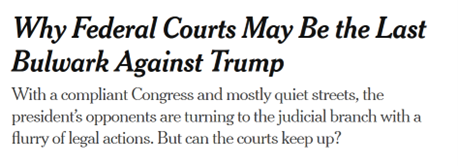
Headline text: “Why Federal Courts May Be the Last Bulwark Against Trump”
Regular text: “With a compliant Congress and mostly quiet streets, the president’s opponents are turning to the judicial branch with a flurry of legal actions. But can the courts keep up?”
Confronted with an inert and occasionally right-tilting Democratic congressional delegation and what they saw at the time as a comparatively quiet protest movement, The Times, like so many elite liberal voices, identifies the federal courts, and, ultimately, the U.S. Supreme Court, as our last and only hope.
Given what we have said up to now, we hope one at least begins to see the sheer amount of ideology contained in this image. Confronted with evidence supporting the thesis that their 2024 losses were at least partially attributable to being too conservative and to a public feeling hopeless about the options, Democratic leadership in Congress insisted that “elections have consequences” and adopted a strategy of acquiescence.[83] In making such arguments, they suggest implicitly that the public deserves what it gets. The protest movement’s comparatively sluggish start, having been battered and disowned by Democratic and other liberal elites in cities and universities across the country, is read as acquiescence. Rather than a natural occurrence, liberal elites have in many ways produced the conditions in which the federal courts are, at least allegedly, our last and only hope, our critical if imperfect guardians. In turn, the conjecture that elites get it right more often than popular will looks epistemically uncertain at best and ideologically driven at worst.
IV. Enforcing the Deficit
Racism, patriarchy, and transphobia are undoubtedly in the water. More than elite opinions, these are background conditions.[84] It is remarkably perverse to blame working-class and poor people for these long-arc historical problems, which constitute the terms of our political, economic, and legal order. There are astounding structural impediments that prevent ordinary people from having collective influence on law or policy.[85] In contrast, the line between organized money and law and policy is fluorescent. There is a more straightforward relationship between organized wealth and the shape of our law and policy than there is between popular opinion and law and policy.
A core conundrum is the popular dissatisfaction with the state of affairs, our prevailing institutions, the realities of life and work, people and planet.[86] This is why many read Trump’s election not as a rightward shift but a rejection of the available options.[87] Simultaneously, there is a lack of clarity on any available path to meaningfully take on the structures of power and the ruling elite: Trump, the Democrats, UnitedHealthcare, or otherwise.[88]
The ideas that the people are reactionary, the people are stupid, the people are irresponsible, the people do not have the right information, and the people get what they deserve are widespread. Embedded within such ideas is a fundamental gesture of elite political discourse: that the people need to be governed not by themselves, but by an enlightened few. This is discursive architecture for a normative worldview that justifies minoritarian rule by political and economic elites. At a time when democracy is in significant peril, these ideas should be handled with circumspection.
From Congress to the courts to the executive, these institutions are far more responsive to business and the billionaire and billionaire-adjacent class than they are to “the people.”[89] As a product of this stranglehold and astounding levels of inequality, we are under authoritarian threat, even the threat of fascism,[90] like many places in the world.[91]
There are elements of truth in ideas like “Americans are reactionaries,” of course. One variation is that Americans are generally not well-informed. Levels of education among the public are low in relation to the country’s power on the global stage.[92] To the extent it is true, there could be two ways to understand the claim. Either there is something inherently deficient about ordinary Americans—the working class and the poor—that makes them incapable of reasoning or being well-informed. Or there is something about the social conditions in which Americans operate that produces a lack of information or critical analytic capability.
Consider two essential conditions. First, education has been commodified and privatized, gutted as a public entitlement central to democracy.[93] The cost of higher education has become exorbitant—a source of indebtedness and immiseration rather than ascendancy in an economy devoted to upward distribution of wealth.[94] This is a story about race, class, and democracy. Organizing and activism against public education took shape in response to Brown and desegregation, fueled in part by the White Citizen Councils, an organization like today’s Tea Party and Oath Keepers, composed of small business owners and the petty bourgeoisie and professional classes.[95] That history itself complicates Strauss’s account of elite consensus in the mid-twentieth century against segregation.
Second, the billionaire class and media monopolies have consolidated media outlets. The production and circulation of information for profit within financialized capitalism has led to decreased coverage, amounting to a destruction of local media and countless journalism jobs.[96] This has led to decreased coverage of local news and a rightward shift in content.[97] The reliance on ad revenue to fuel media creates incentives to produce degraded content or clickbait: “the sensational, the dramatic, and the garish,” as well as misinformation and pure entertainment.[98] Congress’s recent slashing of $1.1 billion federal funding for NPR and PBS at Trump’s behest is just the latest of problems gestating for decades.[99]
To the extent there is truth in the claim that Americans are ill-informed, neoliberalism and elite rule are central to the story.
The neoliberal turn has continued to function at the margins of the legal academy.[100] Even the left—ourselves here included—tends to focus on critiques of liberalism when it is neoliberalism that shapes and justifies our political arrangements.[101] The Department of Government Efficiency (DOGE) itself is a byproduct of neoliberal logic on steroids: a commitment to market order that advances privatization, commodification, and criminalization over the social, the public, the democratic, or the redistributive.[102]
We should be wary of a convenient pattern within elite discourse of downplaying the role of economic and political elites in producing the immiserating conditions in which we live. Working-class and poor people are certainly not equally or more responsible than the political and economic elites who have hoarded political and economic power within this dystopic gilded age.[103] When something does not happen in Congress, it is not itself evidence of lack of popular will. It is suggestive of the law or policy being unpopular among big business and the billionaire class.[104] This is not conjecture, conspiracy, or fantasy. A growing body of research across disciplines establishes that preferences of ordinary people rarely take shape in law and policy due to the disproportionate power the wealthy, the corporations, and even the police hold.[105]
Consider Biden’s efforts to pass Green New Deal-inflected climate legislation as part of his Build Back Better Plan of 2020 and 2021.[106] A watered-down portion made it into law in August 2022 as part of the Inflation Reduction Act. But it was not “the people” who blocked the bolder legislation that combined commitments to the environment with infrastructure and jobs. Polls showed that an overwhelming majority of Americans thought the federal government should play a larger role in addressing climate change and that the government was doing too little to address air and water quality and the welfare of nonhuman forms of life. An overwhelming majority prioritized the development of alternative energy sources—wind and solar for example—over fossil fuels.[107] One poll even showed that three quarters of Americans support U.S. participation in international efforts to reduce the effects of climate change.[108] Other polls showed that an overwhelming majority wanted the federal government to build infrastructure.[109] What blocked Biden’s plan was West Virginia’s Joe Manchin, the then-chair of the Senate Committee on Energy and Natural Resources, a Democratic swing vote essential to break the Republican blockade. Manchin “received more campaign donations from the oil, coal and gas industries than any other senator,” reported The Times.[110] He owned millions in stock in a coal brokerage firm he founded in 1988, now run by his son.[111]
This, too, is only a partial story. But it should illustrate the unfairness of blaming the impossibility of bold climate legislation on a backward people without attending to the fossil fuel industry’s stranglehold on climate legislation and both parties. A similar story could be told about gun regulation and gun manufacturers. Poll after poll suggests that, by and large, Americans would prefer greater regulation of guns and gun manufacturers.[112] The issue is less the people and more the gun manufacturers and the organized power of the National Rifle Association.[113]
Various recent surveys have suggested large majorities of the public support legal access to abortion,[114] universal healthcare,[115] a higher minimum wage,[116] paid sick and parental leave,[117] greater regulation of guns and the environment,[118] and greater taxation of millionaires and billionaires.[119] Year after year, a larger plurality of Americans prefers stronger and broader unionization.[120] But these preferences rarely take shape in durable law or policy. It is less that these are unpopular policies than there are very powerful economic and political interests that have occluded those preferences from cohering in law. This creates a problem for how we think about legislation and democracy. It should also make it hard to blame Congress’s inability to legislate on the many intersecting crises of our time on “the people.”
Will the courts save us? In the context of an undemocratic structure, the question transmorphs. The pressure to justify the democratic legitimacy of the courts has arguably dissipated with the rise of neoliberalism and its adherence to private market ordering over social democratic governance. Nonetheless, several law faculty, including one of us, have drawn attention to the undemocratic nature of the Supreme Court.[121] Strauss’s concern, too, is democracy.
Strauss returns to the democratic legitimacy of the courts in a moment ripe for reassessing just how weak democracy is. If the question of the mid-twentieth century was focused on the proper justification of courts in a democracy, the plain question now is whether we live in a democracy at all. In turn, the issue is less the need for courts to protect minorities from overly powerful and bigoted majorities and more that our system is one of minoritarian rule, one in which the courts are centrally implicated.
Even beyond the federal courts, there are the courts that most Americans find themselves in front of.[122] Housing court. Immigration court. Criminal court. Family court. Traffic court. These courts provide infrastructure essential to neoliberal law and policy: the law of deportation, eviction, incarceration, family separation, and debt collection. These processes immiserate, exploit, dispossess, and criminalize people in ways that constitute our political economy, and attempt to defang resistance thereto. This is “the law of the land” in a way we less often consider. Ostensibly adjudicating the fairness of state and private action against ordinary people, courts typically rubber-stamp the more powerful party, whether the landlord or the prosecutor or the debt collector.
Focusing on these courts and their enmeshed relationships with police, sheriffs, and ICE, you begin to see that courts, rather than being central to producing or advancing democracy, or protecting the rights of discrete and insular minorities, do something very different. More often than not, in material and discursive ways, they produce and attempt to justify the conditions that make democracy impossible.[123]
Copyright © 2026 Amna A. Akbar* and Ryan D. Doerfler**
* Benjamin N. Berger Professor of Criminal Law, University of Minnesota Law School.
** Professor of Law, Harvard Law School. Thanks to the Brennan Center for Justice for the invitation to participate in the Jorde Symposium, to the students at California Law Review for their attentive edits, and to our research assistants: Ethan Bent, Gabriel Colburn, John McNutt, Miriam Lee, and Shaw Mettler.
[1]. E.g., Edgar Sandoval, Harvard Professors Sue Trump Administration over Threat to Cut Funding, N.Y. Times (Apr. 12, 2025), https://www.nytimes.com/2025/04/12/us/politics/harvard-professors-trump-lawsuit-funding.html [https://perma.cc/3BTP-E8AC]; Ana Ley, Columbia Student Who Was Arrested at Citizenship Interview Is Freed, N.Y. Times (May 2, 2025), https://www.nytimes.com/2025/04/30/nyregion/columbia-student-mohsen-mahdawi-freed.html [https://perma.cc/9KTM-UBRW].
[2]. E.g., Am. Ass’n of Univ. Professors v. Rubio, No. 25-cv-10685, 2025 WL 1235084 (D. Mass. Apr. 29, 2025); President & Fellows of Harvard Coll. v. U.S. Dep’t of Health & Hum. Servs., No. 25-cv-10910, 2025 WL 2528380 (D. Mass. Sep. 3, 2025); Öztürk v. Hyde, 136 F.4th 382 (2d. Cir. 2025); Khalil v. Joyce, 780 F. Supp. 3d 476 (D.N.J. Apr. 29, 2025); see also Christian Farias, A Federal Trial Reveals the Sprawling Plan Behind Trump’s Attacks on Pro-Palestinian Students, New Yorker (July 21, 2025), https://www.newyorker.com/news/the-lede/a-federal-trial-reveals-the-sprawling-plan-behind-trumps-attacks-on-pro-palestinian-students [https://perma.cc/4MTU-85PK]; Zach Montague, Trump’s Student Arrests, and the Lawsuit Fighting Them, Tread New Ground, N.Y. Times (July 22, 2025), https://www.nytimes.com/2025/07/22/us/politics/trump-student-arrests-immigration-trial.html [https://perma.cc/Z4TV-7TEQ].
[3]. For a history of lawyers working with abolitionist movements and relying tactically on the courts to free enslaved people in the nineteenth century, see generally Daniel Farbman, Resistance Lawyering, 107 Calif. L. Rev. 1877 (2019).
[4]. See generally Eloise Lawrence, When We Fight, We Win: Eviction Defense as Subversive Lawyering, 90 Fordham L. Rev. 2125 (2022) (discussing eviction defense litigation in the context of housing justice organizing).
[5]. Nina Totenberg, The Supreme Court Is the Most Conservative in 90 Years, Nat’l Pub. Radio (July 5, 2022), https://www.npr.org/2022/07/05/1109444617/the-supreme-court-conservative [https://perma.cc/RY6J-FNLJ] (“‘The problem for the American left,’ and more centrist conservatives too, is that ‘they are stuck with’ this court ‘for the next quarter century.’” (quoting Professor Tom Goldstein)). See generally Andy Kroll, Andrea Bernstein & Ilya Marritz, We Don’t Talk About Leonard: The Man Behind the Right’s Supreme Court Supermajority, ProPublica (Oct. 11, 2023), https://www.propublica.org/article/we-dont-talk-about-leonard-leo-supreme-court-supermajority [https://perma.cc/9WNT-RR65] (discussing the role of the Federalist Society in increasingly conservative court influence).
[6]. See Trump v. Wilcox, 145 S. Ct. 1415, 1415 (2025) (granting an application from the Trump administration staying a lower court injunction against the termination of a National Labor Relations Board (NLRB) commissioner on the grounds that “for cause” removal protections contained in the National Labor Relations Act are “likely” unconstitutional because the NLRB wields “considerable executive power”).
[7]. See Charlie Savage, Weakening Regulatory Agencies Will Be a Key Legacy of the Roberts Court, N.Y. Times (June 28, 2024), https://www.nytimes.com/2024/06/28/us/politics/supreme-court-regulatory-agencies.html [https://perma.cc/JQ5W-DSJC]; Stephen I. Vladeck, The Fifth Circuit Won by Losing, Atlantic (July 7, 2024), https://www.theatlantic.com/ideas/archive/2024/07/how-fifth-circuit-won-losing/678918/ [https://perma.cc/822Y-9XRJ]; see, e.g., West Virginia v. EPA, 597 U.S. 697, 723–24, 735 (2022) (applying the major questions doctrine to invalidate Clean Air Act regulations); Nat’l Fed’n of Indep. Bus. v. OSHA, 595 U.S. 109, 113 (2022) (staying workplace safety regulations requiring COVID-19 vaccines because the agency “exceed[ed] its statutory authority”).
[8]. E.g., Students for Fair Admissions, Inc. v. Pres. & Fellows of Harvard Coll., 600 U.S. 181, 230 (2023) (barring race-based affirmative action for higher education); Dobbs v. Jackson Women’s Health Org., 597 U.S. 215, 302 (2022) (holding there is no constitutional right to abortion).
[9]. For compelling takes of this counterrevolution, see Melinda Cooper, Counterrevolution: Extravagance and Austerity in Public Finance 298–302 (2024); Quinn Slobodian, Globalists: The End of Empire and the Birth of Neoliberalism 263–86 (2018).
[10]. See Michael J. Klarman, The Supreme Court, 2019 Term—Foreword: The Degradation of American Democracy—and the Court, 134 Harv. L. Rev. 1, 178–231 (2020) (chronicling antidemocratic Supreme Court cases).
[11]. Statement of Law Professors and Law Teachers, We Are in a Constitutional Crisis (Apr. 7, 2025), https://www.acslaw.org/wp-content/uploads/2025/04/We-Are-in-a-Constitional-Crisis-Statement-of-Law-Professors-and-Law-Teachers-4.7.25-1.pdf [https://perma.cc/BX2B-S78L]; see also Jamal Greene, I’m a Legal Scholar. We’re in a Constitutional Crisis — And This Is the Moment It Began, MSNBC (Apr. 26, 2025), https://www.msnbc.com/top-stories/latest/trump-constitutional-crisis-supreme-court-rcna203088 [https://perma.cc/VAT9-BBEW].
[12]. Alberto Toscano, Late Fascism: Race, Capitalism and the Politics of Crisis, at ix-xii (2023).
[13]. Klarman, supra note 10, at 11–106.
[14]. Yanis Varoufakis, Technofeudalism: What Killed Capitalism 119–48 (2024).
[15]. Matthew Karp, Maxed Out, New Left Rev. SideCar (May 23, 2025), https://newleftreview.org/sidecar/posts/maxed-out [https://perma.cc/FTF8-STG9].
[16]. For a range of accounts documenting and analyzing the early months of the second Trump administration, see Melinda Cooper, Trump’s Antisocial State, Dissent (Mar. 18, 2025), https://www.dissentmagazine.org/online_articles/trumps-antisocial-state/ [https://perma.cc/5KJV-2MKA]; Evan Osnos, Donald Trump’s Politics of Plunder, New Yorker (May 26, 2025), https://www.newyorker.com/magazine/2025/06/02/donald-trumps-politics-of-plunder [https://perma.cc/PS3M-3QNX]; Eli Murray, June Kim & Jeremy White, The DOGE Playbook Targeting Federal Agencies, N.Y. Times (Mar. 27, 2025), https://www.nytimes.com/interactive/2025/03/27/us/politics/doge-playbook-musk-cuts.html [https://perma.cc/28PU-RSAP].
[17]. U.S. Const. art. I, § 8, cl. 1.
[18]. 2 U.S.C. §§ 601–688.
[19]. 5 U.S.C. §§ 551–559.
[20]. 5 U.S.C. §§ 1101–1105.
[21]. See Kenan Malik, Just Like McCarthy, Trump Spreads Fear Everywhere Before Picking Off His Targets, Guardian (Mar. 30, 2025), https://www.theguardian.com/commentisfree/2025/mar/30/just-like-mccarthy-trump-spreads-fear-everywhere-before-picking-off-his-targets [https://perma.cc/C5JB-5L5A]. For helpful histories of McCarthy-era repression, see also Ellen Schrecker, Immigration and Internal Security: Political Deportations During the McCarthy Era, 60 Sci. & Soc’y 393 (1996); Michelle Chen, Radical Defence: The American Committee for Protection of Foreign Born and the Movement for Deportation Resistance and Immigrants’ Rights, 9 J. Migration Hist. 106 (2023); Nina Farnia, Imperialism and Black Dissent, 75 Stan. L. Rev. 397 (2023).
[22]. E.g., Kevin Freking & Mary Clare Jalonick, Congress Approves Trump’s $9 Billion Cut to Public Broadcasting and Foreign Aid, Associated Press (July 18, 2025), https://apnews.com/article/pbs-npr-budget-cuts-trump-republicans-b0044285659ab708e23eb2dc2f3eabfa [https://perma.cc/V6JN-S83P]; Zach Montague, Judges Appear Receptive to Blocking Trump’s Orders Targeting Big Law Firms, N.Y. Times (Apr. 23, 2025), https://www.nytimes.com/2025/04/23/us/politics/big-law-firms-trump.html [https://perma.cc/77BY-DMNB].
[23]. One Big Beautiful Bill Act, Pub. L. No. 119–21, 139 Stat. 72 (2025); Camilo Montoya-Galvez, Trump’s ‘Big, Beautiful Bill’ Gives ICE Unprecedented Funds to Ramp Up Mass Deportation Campaign, CBS News (July 10, 2025), https://www.cbsnews.com/news/ice-funding-big-beautiful-bill-trump-deportations/ [https://perma.cc/S267-LLPT]; Cory Turner, What Borrowers Should Know About Student Loan Changes in the One Big Beautiful Bill, Nat’l Pub. Radio (July 24, 2025), https://www.npr.org/2025/07/24/nx-s1-5477646/student-loan-repayment-forgiveness-trump [https://perma.cc/RXK5-HW9N]; David Dayen, Republicans Are Cutting Medicare. Not Only Medicaid, Medicare, Am. Prospect (July 3, 2025), https://prospect.org/politics/2025-07-03-republicans-cutting-medicare-not-only-medicaid/ [https://perma.cc/HG8Q-ZA3S]; Steven Rattner, How Bad Is This Bill? The Answer in 10 Charts, N.Y. Times (July 3, 2025), https://www.nytimes.com/interactive/2025/07/03/opinion/domestic-policy-bill-in-charts.html [https://perma.cc/8E26-LT6G]; William Brangham & Azhar Merchant, How Businesses and Manufacturers Will Benefit from Trump’s Big Bill, PBS News (July 3, 2025), https://www.pbs.org/newshour/show/how-businesses-and-manufacturers-will-benefit-from-trumps-big-bill [https://perma.cc/HA6Y-M4EC].
[24]. Bobby Kogan, The House Republicans’ Bill Guts Basic Needs Programs for the Most Vulnerable Americans to Give Tax Breaks to the Rich, Ctr. for Am. Progress (May 12, 2025), https://www.americanprogress.org/article/the-house-republicans-budget-bill-guts-basic-needs-programs-for-the-most-vulnerable-americans-to-give-tax-breaks-to-the-rich/ [https://perma.cc/Z5VQ-TGGR]; Heidi Shierholz, The Radical Republican Budget Bill Steals from the Poor to Give Tax Cuts to the Rich, Econ. Pol’y Inst. (July 2, 2025), https://www.epi.org/blog/the-radical-republican-budget-bill-steals-from-the-poor-to-give-tax-cuts-to-the-rich/ [https://perma.cc/97E5-X6BN]; Jonathan Chait, The Largest Upward Transfer of Wealth in American History, Atlantic (May 22, 2025), https://www.theatlantic.com/ideas/archive/2025/05/big-beautiful-transfer-of-wealth/682885/ [https://perma.cc/PK7R-LXD5].
[25]. Abbie VanSickle & Steve Eder, Where Clarence Thomas Entered an Elite Circle and Opened a Door to the Court, N.Y. Times (July 12, 2023), https://www.nytimes.com/2023/07/09/us/clarence-thomas-horatio-alger-association.html [https://perma.cc/BC65-UGGX] (chronicling Justice Thomas’s relationships with a number of extremely wealthy men through the Horatio Alger Association, many of whom had business before the Court); Justin Elliott, Joshua Kaplan & Alex Mierjeski, Justice Samuel Alito Took Luxury Fishing Vacation with GOP Billionaire Who Later Had Cases Before the Court, ProPublica (June 20, 2023) https://www.propublica.org/article/samuel-alito-luxury-fishing-trip-paul-singer-scotus-supreme-court [https://perma.cc/QHE9-EE5H] (noting that Justice Alito did not disclose a 2008 private flight and luxury fishing trip provided by billionaire hedge fund manager and Republican donor, Paul Singer).
[26]. See, e.g., Noah Feldman, The Last Bulwark, N.Y. Rev. Books (May 15, 2025), https://www.nybooks.com/articles/2025/05/15/the-last-bulwark-noah-feldman/ [https://perma.cc/W3DP-EF57]; Mattathias Schwartz, Why Federal Courts May Be the Last Bulwark Against Trump, N.Y. Times (Feb. 9, 2025), https://www.nytimes.com/2025/02/09/us/trump-federal-courts-lawsuits.html [https://perma.cc/YFE4-9SR5].
[27]. John Hart Ely, Democracy and Distrust: A Theory of Judicial Review (1980).
[28]. See Ryan D. Doerfler & Samuel Moyn, The Ghost of John Hart Ely, 75 Vand. L. Rev. 769 (2022), for a discussion as to how Ely influenced liberal legal thought to faultily view courts as a counter-majoritarian influence necessary for preserving democracy.
[29]. David A. Strauss, Polarization, Victimization, and Judicial Review, 113 Calif. L. Rev. 2155 (2026).
[30]. See, e.g., Ronald J. Krotoszynski Jr., A Remembrance of Things Past?: Reflections on the Warren Court and the Struggle for Civil Rights, 59 Wash. & Lee L. Rev. 1055, 1055–56 (2002) (“[T]he Warren Court oversaw a judicial revolution that helped to speed the end of American apartheid in the Deep South.”). See generally Morton J. Horwitz, The Warren Court and the Pursuit of Justice, 50 Wash. & Lee L. Rev. 5 (1993) (crediting the Warren Court with many developments of the Civil Rights movement).
[31]. E.g., Douglas NeJaime, Constitutional Change, Courts, and Social Movements, 111 Mich. L. Rev. 877 (2013).
[32]. Garrett Epps, The U.S. Supreme Court Fulfills Its Promises on Same-Sex Marriage, Atlantic (June 26, 2015), https://www.theatlantic.com/politics/archive/2015/06/same-sex-marriage-supreme-court-obergefell/396995/ [https://perma.cc/NC2C-M65A]; see also Marc Spindelman, Obergefell’s Dreams, 77 Ohio St. L.J. 1039, 1040–41 (2016) (“[A]fter Obergefell, homosexuality and same-sex intimacies are constitutionally insiders of the first, indeed noble, rank.”); Jane S. Schacter, Obergefell’s Audiences, 77 Ohio St. L.J. 1011, 1011 (2016) (stating that, in deciding Obergefell, the Court “resolved one of the most high-profile social and cultural debates of the day”); Mark Joseph Stern, People of the Year: Anthony & the Supremes, Advocate (Nov. 5, 2015), https://www.advocate.com/current-issue/2015/11/05/people-year-anthony-supremes [https://perma.cc/XD7R-SWSV] (“It may have been Kennedy who wrote that the Constitution grants gay couples ‘equal dignity in the eyes of the law.’ But it is the Supreme Court of the United States that made that judgment a constitutional command.”).
[33]. Derrick Bell and Mary Dudziak observed that the Supreme Court’s decision in Brown could only be understood within the crucible of the Cold War. Derrick A. Bell, Jr., Comment, Brown v. Board of Education and the Interest-Convergence Dilemma, 93 Harv. L. Rev. 518, 523–25 (1980); Mary Dudziak, Brown as a Cold-War Case, 91 J. Am. H. 32, 35 (2004). Many within the U.S. government viewed segregation as an obstacle in battling communists for the hearts and minds of the third world. The U.S. government filed an amicus brief in support of desegregation on these grounds. Bell, supra note 33, at 34; see also Gregory Biker & Justin Driver, Brown and Red: Defending Jim Crow in Cold War America, 74 Stan. L. Rev. 447 (2022).
[34]. See Gerald N. Rosenberg, The Hollow Hope (3d ed. 2023) for an argument that courts are a limited tool for social progress.
[35]. E.g., Julie Carr Smyth & Nicholas Riccardi, Internal Conflicts and Power Struggles Have Become Hallmarks of the Modern GOP, Associated Press (Oct. 11, 2023), https://apnews.com/article/republicans-house-leadership-chaos-states-infighting-bb5d9287214cd5aa0a1fdf03b56bebcb [https://perma.cc/66M5-9FAP]; Andrew Prokop, The Three-Way Battle for the Democratic Party, Vox (July 17, 2025), https://www.vox.com/politics/419913/democratic-agenda-abundance-zohran-mamdani-project-2029 [https://perma.cc/D4AP-TS2J]; Anna Cooban, Billionaires Are Turning on Trump, CNN (Apr. 7, 2025), https://www.cnn.com/2025/04/07/business/bill-ackman-criticize-trump-tariffs-intl [https://perma.cc/5SRA-W844].
[36]. E.g., Reuters, Workers in Boeing’s Defense Division Are Preparing to Strike. Here’s Why., Fast Co. (July 28, 2025), https://www.fastcompany.com/91375409/workers-boeings-defense-division-preparing-strike-heres-why [https://perma.cc/3889-P3XW]; National Teacher Union President on Trump’s Efforts to Defund Public Education, WBUR: Here and Now (July 25, 2025), https://www.wbur.org/hereandnow/2025/07/25/aft-teachers-union-trump [https://perma.cc/Q35J-UZD2].
[37]. Eileen J. Leamon & Jason Bucelato, Fed. Election Comm’n, Federal Elections 2016, at 5 (2017) (reporting Hillary Clinton won approximately 65.8 million votes to Donald Trump’s 62.9 million); Eileen J. Leamon & Jason Bucelato, Fed. Election Comm’n, Federal Elections 2020, at 5 (2022) [hereinafter Federal Elections 2020] (reporting Joe Biden won approximately 81.3 million votes to Donald Trump’s 74.2 million).
[38]. 2024 Presidential Election Results, Associated Press (June 24, 2025), https://apnews.com/projects/election-results-2024/?office=P [https://perma.cc/F8L5-HJ8C].
[39]. Matthew Bloch, Keith Collins, Robert Gebeloff, Marco Hernandez, Malika Khurana & Zach Levitt, Election Results Show a Red Shift Across the U.S. in 2024, N.Y. Times (Dec. 17, 2024), https://www.nytimes.com/interactive/2024/11/06/us/politics/presidential-election-2024-red-shift.html [https://perma.cc/D8LD-8JXV]; see also Zach Levitt, Keith Collins, Robert Gebeloff, Malika Khurana & Marco Hernandez, See the Voting Groups that Swung to the Right in the 2024 Vote, N.Y. Times (Dec. 17, 2024), https://www.nytimes.com/interactive/2024/11/06/us/elections/trump-america-red-shift-victory.html [https://perma.cc/CT2P-G8J4].
[40]. E.g., Ezra Klein, Opinion, The Book That Predicted the 2024 Election, N.Y. Times (Nov. 9, 2024), https://www.nytimes.com/2024/11/09/opinion/ezra-klein-podcast-patrick-ruffini.html [https://perma.cc/9LTU-KTTG]; Ezra Klein, Opinion, Democrats Need to Face Why Trump Won, N.Y. Times (Mar. 18, 2025), https://www.nytimes.com/2025/03/18/opinion/ezra-klein-podcast-david-shor.html [https://perma.cc/5AXK-GNJF]; Adam Jentleson, Opinion, When Will Democrats Learn to Say No?, N.Y. Times (Nov. 16, 2024), https://www.nytimes.com/2024/11/16/opinion/democrats-interest-groups-majority.html [https://perma.cc/PUS2-KSHB]; Matthew Yglesias, A Common Sense Democrat Manifesto, Slow Boring (Nov. 12, 2024), https://www.slowboring.com/p/a-common-sense-democrat-manifesto [https://perma.cc/FDP6-PL32].
[41]. See Jentleson, supra note 40.
[42]. Reid J. Epstein, Lisa Lerer & Nicholas Nehamas, Devastated Democrats Play the Blame Game, and Stare at a Dark Future, N.Y. Times (Nov. 7, 2024), https://www.nytimes.com/2024/11/07/us/politics/democrats-kamala-harris.html [https://perma.cc/A993-7ZWV].
[43]. Eric Levitz, There’s a Very Popular Explanation for Trump’s Win. It’s Wrong., Vox (Jan. 17, 2025), https://www.vox.com/politics/395344/why-trump-won-2024-election-harris-democratic-turnout [https://perma.cc/5K4S-XWRT].
[44]. Miriam Jordan, Voters Were Fed Up over Immigration. They Voted for Trump., N.Y. Times (Nov. 6, 2024), https://www.nytimes.com/2024/11/06/us/trump-immigration-border.html [https://perma.cc/5HZR-NQYX].
[45]. E.g., Jentleson, supra note 40; Philip Elliott, The Democrats Begging Their Party to Ditch the Activist Left, Time (Nov. 7, 2023), https://time.com/6332506/democrats-2024-activist-left-elections/ [https://perma.cc/78S4-C2UY].
[46]. Jentleson, supra note 40.
[47]. E.g., Americans Are Divided on Issues Related to Transgender People, but Often Don’t Want the Federal Government Involved, Data for Progress (Mar. 27, 2025), https://www.dataforprogress.org/blog/2025/3/27/americans-are-divided-on-issues-related-to-transgender-people-but-often-dont-want-the-federal-government-involved [https://perma.cc/6K9V-FQPZ].
[48]. E.g., Larry Buchanan, Quoctrung Bui & Jugal K. Patel, Black Lives Matter May Be the Largest Movement in U.S. History, N.Y. Times (July 3, 2020), https://www.nytimes.com/interactive/2020/07/03/us/george-floyd-protests-crowd-size.html [https://perma.cc/6NG9-3KB3]; ACLED, A Year of Racial Justice Protests: Key Trends in Demonstrations Supporting the BLM Movement (May 25, 2021), https://acleddata.com/report/year-racial-justice-protests-key-trends-demonstrations-supporting-blm-movement [https://perma.cc/8YMW-D9DS]; see also Erica Chenoweth, The Future of Nonviolent Resistance, 31 J. Democracy 69, 69 (July 2020) (“The year 2019 saw what may have been the largest wave of mass, nonviolent antigovernment movements in recorded history.”); Alexandra Yoon-Hendricks & Zoe Greenberg, Protests Across U.S. Call for End to Migrant Family Separations, N.Y. Times (June 30, 2018), https://www.nytimes.com/2018/06/30/us/politics/trump-protests-family-separation.html [https://perma.cc/6R7H-FKBK].
[49]. For one account of this history, see Lily Geismer, Left Behind: The Democrats’ Failed Attempt to Solve Inequality (2022).
[50]. Kate Kelly, Noam Scheiber & Kenneth P. Vogel, Harris’s Brother-in-Law, a Corporate Executive, Emerges as a Close Advisor, N.Y. Times (Aug. 4, 2024), https://www.nytimes.com/2024/08/04/us/politics/kamala-harris-tony-west.html [https://perma.cc/5C83-ZJN2]; Andrew Duehren & Lauren Hirsch, How Wall St. Is Subtly Shaping the Harris Economic Agenda, N.Y. Times (Oct. 15, 2024), https://www.nytimes.com/2024/10/14/business/harris-economic-plan-wall-street.html [https://perma.cc/DMJ9-4886]; Daisuke Wakabayashi, Stephanie Saul & Kenneth P. Vogel, How Kamala Harris Forged Close Ties with Big Tech, N.Y. Times (Jan. 20, 2021), https://www.nytimes.com/2020/08/20/technology/kamala-harris-ties-to-big-tech.html [https://perma.cc/8FLP-FL3Y]; see also Matt Stoller, Opinion, It’s Unclear What Kamala Harris Thinks About Corporate Power. But the Signs Are Worrisome, N.Y. Times (Aug. 7, 2024), https://www.nytimes.com/2024/08/07/opinion/kamala-harris-google-antitrust.html [https://perma.cc/8KHM-T9FZ].
[51]. Rebecca Shneid, The Changes to the Democrats’ Criminal Justice Platform You May Have Missed, Time (Aug. 24, 2024), https://time.com/7014604/changes-to-democrats-criminal-justice-platform/ [https://perma.cc/AZ5N-JUEX] (criminal justice); Christian Paz, The Major Political Transformation Flying Under the Radar at the DNC, Vox (Aug. 21, 2024), https://www.vox.com/2024-elections/368138/dnc-immigration-border-security-latino-voters [https://perma.cc/RQQ8-XVQW] (immigration); Blaise Malley, The Democrats Just Erased All Their Progress on Foreign Policy, New Republic (Aug. 21, 2024), https://newrepublic.com/article/185051/democratic-party-2024-platform-just-erased-progress-foreign-policy [https://perma.cc/PS2L-2Y63] (foreign policy).
[52]. In analyzing why Biden did not win in the predicted landslide in 2020, Mike Davis noted that the only places the well-resourced campaign “struck fire” was “where it converged with existing popular movements willing to take matters in hand,” like in Georgia and Arizona. Mike Davis, Trench Warfare: Notes on the 2020 Election, 126 New Left Rev. (Nov./Dec. 2020), https://newleftreview.org/issues/ii126/articles/mike-davis-trench-warfare [https://perma.cc/NCV6-X5HQ]. For other scholarly studies supporting the idea that the racial justice mobilization lent power to Democratic voter turnout, see Bouke Klein Teeselink & Georgios Melios, Weather to Protest: The Effect of Black Lives Matter Protests on the 2020 Presidential Election, 47 Pol. Behav. 1829 (2025); Oliver Engist & Felix Schafmeister, Do Political Protests Mobilize Voters? Evidence from the Black Lives Matter Protests, 193 Pub. Choice 293 (2022); Neal Caren, Kenneth T. Andrews & Micah H. Nelson, Black Lives Matter and the 2020 Presidential Election, 24 Soc. Movement Stud. 273 (2025).
[53]. Nick Turse, What Kamala Harris Meant by “Most Lethal Fighting Force” in Her DNC Speech, Intercept (Aug. 27, 2024), https://theintercept.com/2024/08/27/kamala-harris-dnc-military-lethal/ [https://perma.cc/7AWR-C6XC]; Nik Popli, Why Democrats Want a Prosecutor-in-Chief Now, Time (Aug. 23, 2024), https://time.com/7014492/kamala-harris-prosecutor-trump-dnc/ [https://perma.cc/P5Y9-4JW4].
[54]. See Anthony Zurcher, Will the Harris-Cheney Show Persuade Anti-Trump Republicans?, BBC (Oct. 22, 2024), https://www.bbc.com/news/articles/cglkl648nwzo [https://perma.cc/7G2U-LVBA].
[55]. Donald J. Trump, Kamala Is for They/Them. I Am for You., YouTube (Nov. 1, 2024), https://www.youtube.com/watch?v=VVU7pYq3WHw.
[56]. Such resentment tracks a range of tropes, like the welfare queen and the terrorist. Scholars have persuasively argued these constructs arose within the forging of a neoliberal frontlash or counterrevolution to the twentieth-century successes of the emancipatory, redistributive, and decolonial movements around the world. Arun Kundnani, What Is Anti-Racism? And Why It Means Anti-Capitalism 241–45 (2023).
[57]. Latino USA, Obama Leaves Office as ‘Deporter-in-Chief’, Nat’l Pub. Radio (July 20, 2017), https://www.npr.org/2017/01/20/510799842/obama-leaves-office-as-deporter-in-chief [https://perma.cc/7F8M-ZM6K]; Daniel Denvir, How the Bipartisan War on Immigrants Explains Politics as We Know It, Democratic Socialists of Am. (Mar. 7, 2020), https://www.dsausa.org/democratic-left/4583/ [https://perma.cc/MB5X-JPDC]; see also Reid J. Epstein, NCLR Head: Obama ‘Deporter-in-Chief’, Politico (Mar. 4, 2014), https://www.politico.com/story/2014/03/national-council-of-la-raza-janet-murguia-barack-obama-deporter-in-chief-immigration-104217 [https://perma.cc/36VY-HY8Y].
[58]. Sahil Kapur & Kate Santaliz, Senate Republicans Block Border Security Bill as They Campaign on Border Chaos, NBC News (May 23, 2024), https://www.nbcnews.com/politics/congress/senate-republicans-block-border-security-bill-campaign-border-chaos-rcna153607 [https://perma.cc/6RMB-W94K]; see also Kenichi Serino, WATCH: Harris Blames Trump for Killing Bipartisan Border Bill, PBS News (Sep. 11, 2024), https://www.pbs.org/newshour/politics/watch-harris-blames-trump-for-killing-bipartisan-border-bill [https://perma.cc/5UQK-VN6H].
[59]. Gabe Winant, Exit Right, Dissent (Nov. 8, 2024), https://www.dissentmagazine.org/online_articles/exit-right/ [https://perma.cc/75HH-6VJT].
[60]. Jeremy W. Peters & Ruth Igielnik, Support for Trump’s Policies Exceeds Support for Trump, N.Y. Times (Jan. 18, 2025), https://www.nytimes.com/2025/01/18/us/politics/trump-policies-immigration-tariffs-economy.html [https://perma.cc/VRA6-E5L5].
[61]. See id.
[62]. See Cornel West, The Role of Law in Progressive Politics, 43 Vand. L. Rev. 1797, 1799 (1990).
[63]. See Silky Shah, Unbuild Walls: Why Immigrant Justice Needs Abolition 68–69, 101–10, 154–62 (2024). For an account of these struggles and this outrage, see Simon Romero & Jonathan Martin, Republicans Dislike Separating Families. But They Like ‘Zero Tolerance’ More, N.Y. Times (June 20, 2018), https://www.nytimes.com/2018/06/20/us/politics/republicans-family-separation.html [https://perma.cc/K6XQ-FN9Z].
[64]. Ariel Edwards-Levy, Americans Largely Oppose Trump’s Ramp Up of Deportations, CNN Poll Finds, CNN (July 20, 2025), https://www.cnn.com/2025/07/20/politics/cnn-poll-trump-deportations [https://perma.cc/FPG6-38Q7]; Lydia Saad, Surge in U.S. Concern About Immigration Has Abated, Gallup (July 11, 2025), https://news.gallup.com/poll/692522/surge-concern-immigration-abated.aspx [https://perma.cc/G2MN-XA6C]; Support Rises for Giving Most Undocumented Immigrants a Pathway to Legal Status vs. Deportations, Quinnipiac University National Poll Finds; More Than 9 in 10 Voters Say Politically Motivated Violence in the U.S. Is a Serious Problem, Quinnipiac Univ. Poll (June 26, 2025), https://poll.qu.edu/poll-release?releaseid=3926 [https://perma.cc/AL2N-Q3PJ]; Aaron Blake, Trump’s Mass Deportation Is Backfiring, CNN (July 13, 2025), https://www.cnn.com/2025/07/13/politics/deportations-backfiring-trump-analysis [https://perma.cc/K9RH-TXT4].
[65]. Michael Sainato, ICE Chief Says He Will Continue to Allow Agents to Wear Masks During Arrest Raids, Guardian (July 20, 2025), https://www.theguardian.com/us-news/2025/jul/20/ice-agents-masks [https://perma.cc/LE9X-4SKY]; Debbie Nathan, ICE Lawyers Are Hiding Their Names in Immigration Court, Intercept (July 15, 2025), https://theintercept.com/2025/07/15/ice-lawyers-hiding-names-court/ [https://perma.cc/4KBH-EZGS].
[66]. Federal Elections 2020, supra note 37, at 5; 2024 Presidential Election Results, supra note 38.
[67]. E.g., Sarah Akaaboune, Young Muslim and Arab-American Voters Say Kamala Harris Isn’t Addressing Their Concerns on Gaza, Teen Vogue (Sep. 13, 2024), https://www.teenvogue.com/story/young-muslim-arab-american-voters-kamala-harris-gaza [https://perma.cc/T6QL-AV3M]; Hamed Aleaziz, Inside the Harris Campaign’s Push to Win Back Muslim and Arab Voters, N.Y. Times (Oct. 22, 2024), https://www.nytimes.com/2024/10/22/us/politics/harris-muslim-arab-voters.html [https://perma.cc/5FXU-9CKT]; Riley Beggin, Some Pro-Palestinian Voters Say They Can’t Vote for Harris. Will It Make a Difference?, USA Today (Oct. 16, 2024), https://www.usatoday.com/story/news/politics/elections/2024/10/16/election-2024-israel-gaza-uncommitted-voters/75504844007/ [https://perma.cc/5RDY-9YRR].
[68]. Katie Rogers & Erica L. Green, Why Harris Remains Unlikely to Break from Biden on Israel and Gaza, N.Y. Times (Oct. 18, 2024), https://www.nytimes.com/2024/10/18/us/politics/harris-israel-gaza-war-biden-trump.html [https://perma.cc/W8Y3-QJEF] (noting that “advisers stress[ed] that [Harris wa]s” “aligned with Mr. Biden’s” approach to Gaza).
[69]. E.g., Support for a Permanent Ceasefire in Gaza Increases Across Party Lines, Data For Progress (May 8, 2024), https://www.dataforprogress.org/blog/2024/5/8/support-for-a-permanent-ceasefire-in-gaza-increases-across-party-lines [https://perma.cc/J9WZ-NVYH] (reporting that 42 percent of Democrats, 41 percent of Independents, and 29 percent of Republicans thought the United States should decrease military aid to Israel in an April 2024 survey); Gary Langer, Views Are Divided on Israel-Hamas War; More Trust Trump than Biden to Handle It, ABC News/IPSOS Poll (2024) https://www.langerresearch.com/wp-content/uploads/1232a1Israel-Hamas.pdf [https://perma.cc/86KG-Y2HM] (finding among respondents in an April 2024 survey that 40 percent of Democrats, 43 percent of Independents, and 29 percent of Republicans believed the United States was providing too much support to Israel).
[70]. IMEU Survey - Biden-non Harris Sample: January 2025 Toplines, YouGov 7–8 (2025), https://www.imeupolicyproject.org/s/IMEU_Jan_2025_Biden-non_Harris_toplines-mw53.pdf [https://perma.cc/TX6U-VQV9] (reporting that 43 percent of those who voted for Biden and not Harris listed “[e]nding Israel’s violence in Gaza” as a relevant factor for their decision, and 29 percent listed it as the “[most] important” factor “in deciding” not to vote for Harris).
[71]. Barbara Sprunt, Democrats Face Pressure to Fight Trump Agenda, but Have Limited Power in the Minority, Nat’l Pub. Radio (Feb. 19, 2025), https://www.npr.org/2025/02/14/nx-s1-5293166/trump-democrats-congress-agenda [https://perma.cc/M7TY-WCEY].
[72]. Laken Riley Act, 8 U.S.C. § 1226(c). Twelve Democrats in the Senate and forty-six in the House voted for the Act. Mary Ellen McIntire, These 12 Democrats Voted for the GOP Immigration Bill Dubbed the Laken Riley Act, Roll Call (Jan. 20, 2025), https://rollcall.com/2025/01/20/democrats-senate-laken-riley-act/ [https://perma.cc/34FN-D7MH]; Ximena Bustillo & Deirdre Walsh, Congress Clears GOP-led Immigration Enforcement Bill, with Democrats on Board, Nat’l Pub. Radio (Jan. 22, 2025), https://www.npr.org/2025/01/22/nx-s1-5253926/congress-laken-riley-act [https://perma.cc/25HC-ATTT].
[73]. Josh DuBose, Protests Against Mass Deportations Erupt in Southern California, Other U.S. Cities, KTLA (Feb. 2, 2025), https://ktla.com/news/local-news/protests-against-mass-deportation-erupt-in-southern-california-other-u-s-cities/ [https://perma.cc/YH66-U682]; Maia Davies, Which Other US Cities Have Joined LA’s Protests over Immigration Raids, BBC (June 11, 2025), https://www.bbc.com/news/articles/cj09604yrpzo [https://perma.cc/MS8Z-ZP3D]. The New York Times, for example, seems to have only made a brief mention of the Los Angeles highway shutdown in its coverage. See Sara Ruberg, Thousands Protest Trump Policies Across the U.S., N.Y. Times (Feb. 5, 2025), https://www.nytimes.com/2025/02/05/us/politics/trump-protests-50501-project-2025.html [https://perma.cc/5EDL-KFEB].
[74]. Madison McVan, Hundreds Protest ICE, Other Federal Law Enforcement Action in Minneapolis, Minn. Reformer (June 3, 2025), https://minnesotareformer.com/2025/06/03/hundreds-protest-ice-in-minneapolis/ [https://perma.cc/KNE6-US63]; Scott Greenstone, Seattle Protestors Block ICE Vans from Leaving Immigration Court, OPB (June 10, 2025), https://www.opb.org/article/2025/06/10/seattle-protesters-block-ice-vans-from-leaving-immigration-court/ [https://perma.cc/T2WX-9YRQ].
[75]. Elena Moore, With Fewer Protesters and a Renewed Focus, Activists Plan for a Second Round of Trump, Nat’l Pub. Radio (Jan. 20, 2025), https://www.npr.org/2025/01/20/nx-s1-5258481/trump-protest-peoples-march-womens-march-inauguration-presidency-policies-agenda [https://perma.cc/42SZ-72DA] (noting fifty thousand protestors participated in the People’s March at the National Mall in 2025 to oppose the Trump administration’s agenda, but in 2017, approximately five hundred thousand people came to the Washington, D.C. Women’s March to protest Trump).
[76]. Erica Chenoweth, Jeremy Pressman & Soha Hammam, Resistance Is Alive and Well in the United States, Waging Nonviolence (Mar. 19, 2025), https://wagingnonviolence.org/2025/03/resistance-alive-well-us/ [https://perma.cc/6AEX-2YVU]; Erica Chenoweth, Jeremy Pressman & Soha Hammam, The Resistance Is Alive and Well – and Our Research Shows It, Guardian (Mar. 28, 2025), https://www.theguardian.com/commentisfree/2025/mar/28/protest-research-trump-musk [https://perma.cc/F6TJ-JAB3].
[77]. Erica Chenoweth, Soha Hammam, Jeremy Pressman & Christopher Wiley Shay, American Spring? How Nonviolent Protest in the US Is Accelerating, Waging Nonviolence (June 12, 2025), https://wagingnonviolence.org/2025/06/american-spring-nonviolent-protest-accelerating/ [https://perma.cc/5MWW-F4R5]; Michael Wilson, Michael Rothfeld & Ana Ley, How a Columbia Student Activist Landed in Federal Detention, N.Y. Times (Mar. 17, 2025), https://www.nytimes.com/2025/03/16/nyregion/mahmoud-khalil-columbia-university.html [https://perma.cc/XN3U-5A7V].
[78]. Chenoweth et al., supra note 77.
[79]. See, e.g., Isabelle Taft, How Universities Cracked Down on Pro-Palestinian Activism, N.Y. Times (Nov. 25, 2024), https://www.nytimes.com/2024/11/25/us/university-crackdowns-protests-israel-hamas-war.html [https://perma.cc/P9UK-6AD9]; StudentNation, The Crackdown on Campus Protests Is Happening Everywhere, Nation (Apr. 26, 2024), https://www.thenation.com/article/activism/gaza-solidarity-encampments-campus-crackdown-palestine/ [https://perma.cc/2P7A-ZR6P]; Steve Holland, Biden Breaks Silence on College Protests over Gaza Conflict, Reuters (May 2, 2024), https://www.reuters.com/world/us/biden-breaks-silence-college-protests-over-gaza-conflict-2024-05-02/ [https://perma.cc/27QB-JGM3] (“Destroying property is not a peaceful protest. It’s against the law. Vandalism, trespassing, breaking windows, shutting down campuses, forcing the cancelling of classes and graduations -none of this is a peaceful protest.” (quoting Biden criticizing pro-Palestine protests)); Madeline Halpert, Democrats Reject Gaza Protesters’ Demand to Give Speaking Slot to Palestinian, BBC (Aug. 22, 2024), https://www.bbc.com/news/articles/c3w65xg7vy4o [perma.cc/MXK7-HMMH].
[80]. See Amna A. Akbar, Demands for a Democratic Political Economy, 134 Harv. L. Rev. F. 90, 96–97 (2020). See generally Elizabeth Hinton, America on Fire: The Untold History of Police Violence and Black Rebellion Since the 1960s (2021) (chronicling the rebellions of the 1960s).
[81]. See, e.g., Naomi Murakawa, Say Their Names, Support Their Killers: Police Reform After the 2020 Black Lives Matter Uprisings, 69 UCLA L. Rev. 1430 (2023) (providing a critical account of the Democratic Party’s superficial to opportunistic response to contemporary racial justice protests); Tobi Haslett, Magic Actions, N+1 (Summer 2021), https://www.nplusonemag.com/issue-40/politics/magic-actions-2/ [https://perma.cc/DSN6-ALL6].
[82]. Schwartz, supra note 26.
[83]. See, e.g., Anthony Zurcher & Christal Hayes, Top Democrat Schumer Backs Republican Spending Bill to Avert Shutdown, BBC (Mar. 14, 2025), https://www.bbc.com/news/articles/cdx2j8n7xz1o [https://perma.cc/E62T-NBDC] (explaining decision by key Democrats to support Republican spending bill); Katie Glueck, Resist or Coexist? Democrats Rethink Their Approach to Trump and G.O.P., N.Y. Times (Jan. 16, 2025), https://www.nytimes.com/2025/01/16/us/politics/democrats-resist-trump-administration.html [https://perma.cc/SM78-6MNJ] (explaining that more Democrat politicians are considering “coexisting” with Trump because of his 2024 victory in the popular vote); Sahil Kapur, Democrats’ Playbook for Trump 2.0: Tune Out the Noise and Focus on Economic Issues, NBC News (Jan. 28, 2025), https://www.nbcnews.com/politics/congress/democrats-playbook-trump-tune-noise-focus-economic-issues-rcna189180 [https://perma.cc/9JCG-ZGNA] (noting that “Democrats are crafting a new playbook for [Trump’s] second administration that departs from the noisy resistance of his first presidency” and retreating from immigration and transgender rights); Kayla Epstein, What Should Democrats Do Now? Everyone Has a Different Answer, BBC (Apr. 26, 2025) https://www.bbc.com/news/articles/czjnw42p8lro [https://perma.cc/CD5B-WM9B] (highlighting that many voters feel Democratic politicians are not doing enough to resist Trump, while simultaneously noting that some Democratic politicians think the party should abandon certain issues, like transgender rights).
[84]. See, e.g., Destin Jenkins & Justin Leroy, Introduction: Old Histories of Racial Capitalism, in Histories of Racial Capitalism 1, 1–3 (Destin Jenkins & Justin Leroy eds., 2021) (racial capitalism); Kundnani, supra note 56 (same); Catharine A. MacKinnon, Feminism, Marxism, Method, and the State: An Agenda for Theory, 7 Signs 515, 515–16 (1982) (patriarchy).
[85]. See Aziz Rana, Constitutional Collapse, New Left Rev. SideCar (Mar. 21, 2025), https://newleftreview.org/sidecar/posts/constitutional-collapse [https://perma.cc/R2M7-MAQZ].
[86]. E.g., Jeremy M. Jones, Confidence in U.S. Institutions Down; Average at New Low, Gallup (July 5, 2022), https://news.gallup.com/poll/394283/confidence-institutions-down-average-new-low.aspx [https://perma.cc/QL2H-24WC]; Madeleine Aggeler, Trust in U.S. Institutions Has Never Been Lower—Here’s Why That Matters, Guardian (June 11, 2024), https://www.theguardian.com/us-news/ng-interactive/2024/jun/11/trust-us-institutions [perma.cc/M5KF-VTAJ]; Claudia Deane, Americans’ Deepening Mistrust of Institutions, Pew Charitable Trs. (Oct. 17, 2024), https://www.pewtrusts.org/en/trend/archive/fall-2024/americans-deepening-mistrust-of-institutions [https://perma.cc/MZ8B-YUTH].
[87]. Stephanie Kaloi, Chris Hayes Says Trump’s Win Is a ‘Rejection of the Status Quo’—Even for Kamala Harris Voters, Wrap (Nov. 6, 2024), https://www.thewrap.com/chris-hayes-trumps-win-is-a-rejection-of-the-status-quo/ [https://perma.cc/357J-4TLP].
[88]. See Amna A. Akbar, Malm and Mangione, N+1 (Jan. 16, 2025), https://www.nplusonemag.com/online-only/online-only/malm-and-mangione/ [https://perma.cc/L6JF-Q6LX].
[89]. E.g., Jonathan Weisman & Rachel Shorey, Fueled by Billionaires, Political Spending Shatters Records Again, N.Y. Times (Nov. 3, 2022), https://www.nytimes.com/2022/11/03/us/politics/midterm-money-billionaires.html [https://perma.cc/QMZ9-NPSZ]; Elizabeth Bumiller, The Trump Billionaires Who Run the Economy and the Things They Say, N.Y. Times (Apr. 19, 2025), https://www.nytimes.com/2025/04/19/us/politics/trump-musk-billionaires-economy.html [https://perma.cc/M33U-X3DU]; Abbie VanSickle, Clarence Thomas, in Financial Disclosure, Acknowledges 2019 Trips Paid by Harlan Crow, N.Y. Times (June 7, 2024), https://www.nytimes.com/2024/06/07/us/supreme-court-disclosures-gifts.html [https://perma.cc/PGS2-LRVA]; Jamelle Bouie, Samuel Alito Joins the Supreme Court’s Billionaires’ Club, N.Y. Times (June 27, 2023), https://www.nytimes.com/2023/06/27/opinion/samuel-alito-clarence-thomas-ethics.html [https://perma.cc/K2BR-RDBD].
[90]. For left takes and debates on fascism past and present—including fascism “as a process”—see generally Toscano, supra note 12, at 11–13, 35–37, 146–49.
[91]. See Rachel Beatty Riedl, Paul Friesen, Jennifer McCoy & Kenneth Roberts, Democratic Backsliding, Resilience, and Resistance, 77 World Pol. 151 (2025); Max Fisher, How Democracy Is Under Threat Across the Globe, N.Y. Times (Aug. 19, 2022), https://www.nytimes.com/2022/08/19/world/democracy-threat.html [https://perma.cc/3STA-K2AY]; Global State of Democracy Report 2021: Building Resilience in a Pandemic Era, Inst. for Democracy and Electoral Assistance, https://www.idea.int/gsod-2021/global-report/ [https://perma.cc/F873-E4PX].
[92]. See International Educational Attainment, Nat’l Ctr. for Educ. Stats. (May 2024), https://nces.ed.gov/programs/coe/indicator/cac/intl-ed-attainment [https://perma.cc/T8T7-7Y5R]; International Context: Are U.S. Schools Behind the World?, Ed100 (Sep. 2025), https://ed100.org/lessons/international [https://perma.cc/65DR-RMSD]; Brian Kennedy, Most Americans Think U.S. K-12 STEM Education Isn’t Above Average, but Test Results Paint a Mixed Picture, Pew Rsch. Ctr. (Apr. 24, 2024), https://www.pewresearch.org/short-reads/2024/04/24/most-americans-think-us-k-12-stem-education-isnt-above-average-but-test-results-paint-a-mixed-picture/ [https://perma.cc/SU4D-MREK].
[93]. For accounts of the gutting and privatization of public education, see Samuel E. Abrams, Education and the Commercial Mindset (2016); Pauline Lipman, The New Political Economy of Urban Education: Neoliberalism, Race, and the Right to the City (2011); Fanna Gamal, The Miseducation of Carceral Reform, 69 UCLA L. Rev. 928, 955–62 (2022); Joanne Barkan, Milton Friedman, Betsy Devos, and the Privatization of Public Education, Dissent (Jan. 17, 2017), https://www.dissentmagazine.org/online_articles/betsy-devos-milton-friedman-public-education-privatization/ [https://perma.cc/ZZ84-A6QN].
[94]. E.g., Student Loan Debt Series, Nat’l Conf. of State Legislatures (May 12, 2025), https://www.ncsl.org/education/student-loan-debt-series [https://perma.cc/EKZ3-9AA3]; Ron Lieber, Some Colleges Will Soon Charge $100,000 a Year. How Did This Happen?, N.Y. Times (Apr. 5, 2024), https://www.nytimes.com/2024/04/05/your-money/paying-for-college/100k-college-cost-vanderbilt.html [https://perma.cc/5ZSH-PWN7].
[95]. E.g., Stephanie R. Rolph, Introduction, in Hodding Carter III, The South Strikes Back, at ix (2022); Kate Zernike & Megan Thee-Brenan, Poll Finds Tea Party Backers Wealthier and More Educated, N.Y. Times (Apr. 14, 2010), https://www.nytimes.com/2010/04/15/us/politics/15poll.html [https://perma.cc/577W-6VZS]; Jacques Billeaud & Lindsay Whitehurst, Oath Keepers Founder Stewart Rhodes’ Path: From Yale to Jail, Associated Press (Sep. 26, 2022), https://apnews.com/article/oath-keepers-founder-jan-6-trial-4372b311695c401255c6881111ff4f41 [https://perma.cc/WYG8-3MUW].
[96]. “[T]he U.S. has lost almost one-third of its newspapers and nearly two-thirds of its newspaper journalists since 2005.” Viktor Pickard, Taking Media Out of the Market, LPE Blog (Jan. 31, 2024), https://lpeproject.org/blog/taking-media-out-of-the-market/ [https://perma.cc/Q79D-F64P]; see Viktor Pickard, Democracy Without Journalism? Confronting the Misinformation Society 1–5 (2020); Kate Vinton, These 15 Billionaires Own America’s News Media Companies, Forbes (June 1, 2016), https://www.forbes.com/sites/katevinton/2016/06/01/these-15-billionaires-own-americas-news-media-companies/ [https://perma.cc/T6LK-Q3XZ]; Kate Conger & Lauren Hirsch, Elon Musk Completes $44 Billion Deal to Own Twitter, N.Y. Times (Oct. 27, 2022), https://www.nytimes.com/2022/10/27/technology/elon-musk-twitter-deal-complete.html [https://perma.cc/KNL6-SP5A].
[97]. Gregory J. Martin & Joshua McCrain, Local News and National Politics, 113 Am. Pol. Sci. Rev. 372 (2019); Edmund L. Andrews, Media Consolidation Means Less Local News, More Right Wing Slant, Insights by Stan. Bus. (July 30, 2019), https://www.gsb.stanford.edu/insights/media-consolidation-means-less-local-news-more-right-wing-slant [https://perma.cc/9ERH-MGGY].
[98]. Pickard, supra note 96, at 18.
[99]. Elena Shao & Benjamin Mullen, Where Congress’s Cuts Threaten Access to PBS & NPR, N.Y. Times (July 18, 2025), https://www.nytimes.com/interactive/2025/07/18/business/media/house-rescission-vote-pbs-npr.html [https://perma.cc/6L6P-G6M9]; Kevin Freking & Mary Clare Jalonick, Congress Approves Trump’s $9 Billion Cut to Public Broadcasting and Foreign Aid, Associated Press (July 18, 2025), https://apnews.com/article/pbs-npr-budget-cuts-trump-republicans-b0044285659ab708e23eb2dc2f3eabfa [https://perma.cc/DMJ8-3NHY].
[100]. Scholars associated with the Law and Political Economy movement have produced important work to redress this gap. E.g., Jedediah Britton-Purdy, David Singh Grewal, Amy Kapczynski & K. Sabeel Rahman, Building a Law-and-Political-Economy Framework: Beyond the Twentieth-Century Synthesis, 129 Yale L.J. 1784 (2020); David Singh Grewal & Jedediah Purdy, Introduction: Law and Neoliberalism, 77 L. & Contemp. Probs. 1 (2014); Zohra Ahmed, The Right to Counsel in a Neoliberal Age, 69 UCLA L. Rev. 442 (2022).
[101]. For a particularly astute read, see Corinne Blalock, Neoliberalism and the Crisis of Legal Theory, 77 L. & Contemp. Probs. 71 (2014).
[102]. For formulations of neoliberalism, see David Harvey, A Brief History of Neoliberalism 2–4 (2005); Quinn Slobodian, Crack Up Capitalism: Market Radicals and the Dream of a World Without Democracy, at xx (2023).
[103]. See Kate Andrias & Benjamin I. Sachs, Constructing Countervailing Power: Law and Organizing in an Era of Political Inequality, 130 Yale L.J. 546, 549–50, 562–63 (2021).
[104]. See, e.g., Martin Gilens & Benjamin I. Page, Testing Theories of American Politics: Elites, Interest Groups, and Average Citizens, 12 Persps. on Pol. 564, 576–77 (2014) (“[T]he preferences of economic elites . . . have far more independent impact upon policy change than the preferences of average citizens do. To be sure, this does not mean that ordinary citizens always lose out; they fairly often get the policies they favor, but only because those policies happen also to be preferred by the economically-elite citizens who wield the actual influence.”).
[105]. Id.
[106]. See Jeff Berardelli, How Joe Biden’s Climate Plan Compares to the Green New Deal, CBS News (Oct. 5, 2020), https://www.cbsnews.com/news/green-new-deal-joe-biden-climate-change-plan/ [https://perma.cc/Y439-MNTL] (explaining that Biden’s proposed climate plan includes many “concepts” in the Green New Deal, although it is significantly narrower and cheaper).
[107]. Brian Kennedy, Alec Tyson & Cary Funk, Americans Divided Over Direction of Biden’s Climate Change Policies, Pew Rsch. Ctr. (July 14, 2022), https://www.pewresearch.org/science/2022/07/14/americans-divided-over-direction-of-bidens-climate-change-policies/ [https://perma.cc/Y79G-AU3W]; As Economic Concerns Recede, Environmental Protection Rises on the Public’s Policy Agenda, Pew Rsch. Ctr. (Feb. 13, 2020), https://www.pewresearch.org/politics/2020/02/13/as-economic-concerns-recede-environmental-protection-rises-on-the-publics-policy-agenda/ [https://perma.cc/8VRJ-FTYH]; Cary Funk & Meg Hefferon, U.S. Public Views on Climate and Energy, Pew Rsch. Ctr. (Nov. 25, 2019), https://www.pewresearch.org/science/2019/11/25/u-s-public-views-on-climate-and-energy/ [https://perma.cc/WZ45-ECGJ].
[108]. Alec Tyson, Cary Funk & Brian Kennedy, What the Data Says About Americans’ Views of Climate Change, Pew Rsch. Ctr. (Aug. 9, 2023), https://www.pewresearch.org/short-reads/2023/08/09/what-the-data-says-about-americans-views-of-climate-change/ [https://perma.cc/38X6-G9LP].
[109]. Frank Newport, American Public Opinion and Infrastructure Legislation, Gallup (July 2, 2021), https://news.gallup.com/opinion/polling-matters/351815/american-public-opinion-infrastructure-legislation.aspx [https://perma.cc/7SFB-BY33]. For more recent data, see Rachael Yi & Megan Brenan, More Americans Think U.S. Doing Too Little on Environment, Gallup (Apr. 17, 2025), https://news.gallup.com/poll/659390/americans-think-doing-little-environment.aspx [https://perma.cc/RTP4-M6JB].
[110]. Coral Davenport, This Powerful Democrat Linked to Fossil Fuels Will Craft the U.S. Climate Plan, N.Y. Times (Oct. 18, 2021), https://www.nytimes.com/2021/09/19/climate/manchin-climate-biden.html [https://perma.cc/TC66-5URW].
[111]. Id.
[112]. Ariel Edwards-Levy, CNN Poll: Most Americans Want Stricter Gun Control, but They’re Divided on Whether Guns Make Public Places Safer, CNN (May 26, 2023), https://www.cnn.com/2023/05/26/politics/cnn-poll-gun-laws/index.html [https://perma.cc/KQ4F-EHAA] (announcing that overall, 64 percent of Americans support “stricter gun control laws” and that this number has been at least 60 percent in every CNN Poll since 2016); National Survey of Gun Policy, Johns Hopkins Ctr. for Gun Violence Sols. (July 21, 2023), https://publichealth.jhu.edu/center-for-gun-violence-solutions/research-reports/americans-agree-on-effective-gun-policy-more-than-were-led-to-believe [https://perma.cc/2PEZ-YEEY] (announcing the Johns Hopkins national survey, which shows supermajorities in favor of several specific gun control measures); Katherine Schaeffer, Key Facts About Americans and Guns, Pew Rsch. Ctr. (July 24, 2024), https://www.pewresearch.org/short-reads/2024/07/24/key-facts-about-americans-and-guns/ [https://perma.cc/B5U4-Q69E] (discussing Pew’s findings on a variety of gun-related questions, including that 58 percent of Americans support “stricter gun laws” and 61 percent say it is “too easy to obtain a gun”).
[113]. See Stephen Gutowski, Why Can’t Democrats Pass Gun Control?, Atlantic (Sep. 24, 2021), https://www.theatlantic.com/ideas/archive/2021/09/nra-broken-so-why-cant-democrats-pass-gun-control/620190/ [https://perma.cc/3P26-VXFD] (explaining how the NRA mobilizes gun owners against certain politicians and pieces of legislation with advertisements and mailers, rather than influencing Congress through direct contributions).
[114]. Public Opinion on Abortion, Pew Rsch. Ctr. (June 12, 2025), https://www.pewresearch.org/religion/fact-sheet/public-opinion-on-abortion/ [https://perma.cc/97BX-ZD2A] (showing that according to Pew’s studies, 63 percent of U.S. adults believe abortion should be “legal in all/most cases”; this number has remained stable for the last several years, and since at least 1995, it has been higher than the number of adults who believe it should be illegal “in all/most cases”); Abortion, Gallup (May 2025), https://news.gallup.com/poll/1576/abortion.aspx [https://perma.cc/D9QZ-PTDD] (showing Gallup has found that 85 percent of Americans believe that abortion should at least be legal “under certain circumstances”).
[115]. Gabriela Schulte, Poll: 69 Percent of Voters Support Medicare for All, Hill (Apr. 24, 2020), https://thehill.com/hilltv/what-americas-thinking/494602-poll-69-percent-of-voters-support-medicare-for-all/ [https://perma.cc/6EAG-LNPA] (announcing a Hill-HarrisX poll that found that 69 percent of Americans support “providing Medicare to every American”); Megan Brenan, Majority in U.S. Still Say Gov’t Should Ensure Healthcare, Gallup (Jan. 23, 2023), https://news.gallup.com/poll/468401/majority-say-gov-ensure-healthcare.aspx [https://perma.cc/7UH8-MVBY] (showing Gallup has found that 57 percent of Americans believe that it is the federal government’s responsibility to ensure that all Americans have access to healthcare; however, 53 percent prefer that the nation’s healthcare system be based on private insurance rather than a government-run system).
[116]. Amina Dunn, Most Americans Support a $15 Federal Minimum Wage, Pew Rsch. Ctr. (Apr. 22, 2021), https://www.pewresearch.org/short-reads/2021/04/22/most-americans-support-a-15-federal-minimum-wage/ [https://perma.cc/AH2G-PBAD] (showing Pew has found that 62 percent of U.S. adults support raising the federal minimum wage to fifteen dollars an hour, and among the 38 percent who oppose the measure, 71 percent favor increasing the minimum wage to a number below fifteen dollars an hour).
[117]. Juliana Menasce Horowitz, Kim Parker, Nikki Graf & Gretchen Livingston, Americans Widely Support Paid Family and Medical Leave, but Differ over Specific Policies, Pew Rsch. Ctr. (Mar. 23, 2017), https://www.pewresearch.org/social-trends/2017/03/23/americans-widely-support-paid-family-and-medical-leave-but-differ-over-specific-policies/ [https://perma.cc/4QU8-2R3M] (showing Pew has found that 85 percent of Americans believe that workers should receive paid leave to address “their own serious health conditions,” 82 percent believe mothers should receive paid leave following the birth or adoption of their child, and 69 percent support fathers receiving paid leave following the birth or adoption of their child).
[118]. For public opinion on guns, see supra sources accompanying note 112; Brian Kennedy & Alec Tyson, How Americans View Climate Change and Policies to Address the Issue, Pew Rsch. Ctr. (Dec. 9, 2024), https://www.pewresearch.org/science/2024/12/09/how-americans-view-climate-change-and-policies-to-address-the-issue/ [https://perma.cc/3F84-B5QP] (finding that large majorities of Americans support several climate policies, including planting a trillion trees to absorb climate emissions (89 percent), providing a tax credit to businesses for developing carbon capture/storage (79 percent), and requiring power plants to eliminate all carbon emissions by 2040 (61 percent)).
[119]. Andy Cerda, Most Americans Continue to Favor Raising Taxes on Corporations, Higher-Income Households, Pew Rsch. Ctr. (Mar. 19, 2025), https://www.pewresearch.org/short-reads/2025/03/19/most-americans-continue-to-favor-raising-taxes-on-corporations-higher-income-households/ [https://perma.cc/K95P-VJED] (announcing that Pew has found that 63 percent of U.S. adults support raising taxes on “large businesses and corporations” and that 58 percent support raising taxes on household income over $400,000).
[120]. Lydia Saad, More in U.S. See Unions Strengthening and Want It That Way, Gallup (Aug. 30, 2023), https://news.gallup.com/poll/510281/unions-strengthening.aspx [https://perma.cc/25LH-KPCG] (showing in a 2024 Gallup poll that 70 percent of Americans approved of labor unions and finding in a 2023 Gallup poll that 43 percent would like labor unions to have more influence in the United States than they currently have).
[121]. E.g., Ryan D. Doerfler & Samuel Moyn, Democratizing the Supreme Court, 109 Calif. L. Rev. 1703 (2021).
[122]. Amna A. Akbar, Justice from Below, N+1 (2023), https://www.nplusonemag.com/issue-46/politics/justice-from-below/ [https://perma.cc/4WDQ-EF6A]; see also State Courts Play a Key Role in American Life, Pew Charitable Trs. (Oct. 17, 2024), https://www.pewtrusts.org/en/research-and-analysis/issue-briefs/2024/10/state-courts-play-a-key-role-in-american-life [https://perma.cc/Q3MU-FB75]; Federal Judicial Caseloads Statistics 2024, U.S. Cts., https://www.uscourts.gov/data-news/reports/statistical-reports/federal-judicial-caseload-statistics/federal-judicial-caseload-statistics-2024 [https://perma.cc/QKJ3-P4XP].
[123]. There is a growing body of work on such courts. See, e.g., Alexandra Natapoff, Criminal Municipal Courts, 134 Harv. L. Rev. 964 (2021); Daniel Wilf-Townsend, Assembly-Line Plaintiffs, 135 Harv. L. Rev. 1704 (2022); Shaun Ossei-Owusu, Kangaroo Courts, 134 Harv. L. Rev. F. 200 (2021); Kathryn A. Sabbeth, Eviction Courts, 18 U. St. Thomas L.J. 359 (2022); Tonya L. Brito, Kathryn A. Sabbeth, Jessica K. Steinberg & Lauren Sudeall, Racial Capitalism in the Civil Courts, 122 Colum. L. Rev. 1243 (2022); Lauren Sudeall & Daniel Pasciuti, Praxis and Paradox: Inside the Black Box of Eviction Court, 74 Vand. L. Rev. 1365 (2021); Matthew Clair & Amanda Woog, Courts and the Abolition Movement, 110 Calif. L. Rev. 1 (2022); Angélica Cházaro, Due Process Deportations, 98 N.Y.U. L. Rev. 407 (2023); Lina Foster, The Price of Justice: Fines, Fees and the Criminalization of Poverty in the United States, 11 U. Mia. Race & Soc. Just. L. Rev. 1 (2020).