Beyond District Lines: Rethinking the California Voting Rights Act’s Promise of Fair Representation
The California Voting Rights Act (CVRA) has reshaped local elections across the State of California. The CVRA spurred hundreds of cities, school districts, and other local governments to transition from at-large elections, where all voters in the local government’s territory vote for all members of the local government’s board, to district-based elections, where a local government’s territory is subdivided into election districts that each independently elect a member to the local government’s board. Although the CVRA attempts to address racial vote dilution, which is sometimes present in at-large elections, this Note finds that the CVRA creates unique incentives to adopt district-based elections, and that hundreds of California school districts have adopted district-based elections in the last twenty years. Existing literature found that CVRA-driven transitions to district-based elections created inconsistent effects, increasing descriptive representation of racial minorities in some jurisdictions while having no or even negative effects on minority representation in others. Drawing on data collected from school districts in the Bay Area, a recent hotbed of CVRA activity, this Note finds that although the CVRA has likely had a positive effect on Latine and Asian American Pacific Islander (AAPI) officeholding in Bay Area school districts, our findings align with existing literature that some Bay Area school districts see no or even negative changes in Latine and AAPI officeholding following CVRA-driven transitions to district-based elections. California currently constructively prohibits many other forms of elections that could better increase minority officeholding in places like the Bay Area beyond district-based elections. This Note argues that California law should be reformed to permit alternatives to district-based elections, such as cumulative voting, that might better improve minority officeholding. This Note further argues that the CVRA should be amended to remove current incentives to switch to district-based elections, which have discouraged the use of alternative election systems.
Table of Contents Show
Introduction
In 2001, the vast majority of local offices in California used at-large election systems.[2] Under typical at-large voting systems, all voters in a local government’s jurisdiction vote in the election for each seat on the local government’s governing board, such as a city council,[3] and a cohesive majority that votes together can outvote minorities and win every seat, resulting in overrepresentation.[4] Across many areas of California, different racial groups vote cohesively for different candidates, resulting in “racially polarized” voting.[5] In racially polarized areas, the use of at-large systems can deny racial minorities the ability to elect their favored candidates.[6]
The Federal Voting Rights Act (FVRA) prohibits any “standard, practice, or procedure” that “results in a denial or abridgement of the right . . . to vote on account of race or color” or language minority status,[7] prohibiting at-large election systems in some circumstances.[8] However, civil rights attorneys found it difficult to file and prevail in FVRA challenges to at-large elections in California.[9] This led the California legislature to enact the California Voting Rights Act in order to make it easier for plaintiffs to challenge at-large elections.[10]
The California Voting Rights Act (CVRA) prohibits the use of at-large voting when it “impairs the ability of a protected class to elect candidates of its choice or its ability to influence the outcome of an election.”[11] Under the CVRA, private individuals can sue local governments when they believe an at-large voting system negatively impacts a racial minority population’s ability to elect its candidates of choice or influence election outcomes.[12] Under Section 14028(a), the existence of racially polarized voting patterns that dilute a racial group’s ability to elect candidates and influence election outcomes compared to an alternative election system is sufficient to sustain a CVRA claim.[13] There is no required showing of racially discriminatory intent.[14]
The CVRA categorically exempts one type of election from its regulations: district-based elections.[15] In a district-based election, an electorate is divided into geographic units corresponding to a district, and each district elects one member to the elected body.[16]
The CVRA fundamentally changed the way local governments conduct elections in California. Hundreds of cities, school districts, and special districts across the state changed their election systems from at-large to district-based elections to remedy alleged violations or avoid litigation because district-based elections are not subject to CVRA suits.[17]
This Note argues that while the CVRA’s goal is to ensure racial minorities have descriptive representation[18] in local government, data from Bay Area school districts suggests that district-based elections may, under some circumstances, be an inadequate solution for achieving proportionate representation of racial minorities in local governments. This Note explores alternatives that may be more effective at increasing minority representation than the district-based election lawsuit immunity outlined in the CVRA.
This Note proceeds in three parts. Part I discusses different local election systems in California and their impacts on the voting power of racial minorities. Part I also reviews the history of the CVRA. Part II provides an empirical analysis on the impact of the CVRA on Latine and AAPI descriptive representation in Bay Area school boards. Part II demonstrates that representation of Latine and AAPI communities improved in the Bay Area, particularly in school districts that transitioned to district-based elections and whose electorates have grown more diverse, but a further analysis reveals that the CVRA has an inconsistent impact in many areas. Part III of this Note proposes changes to the CVRA that enable local governments to pursue election systems that best fit their local circumstances.
I. Background
Part I discusses impacts of at-large and district-based voting on racial minorities, as well as the history of the CVRA and its impacts on California school districts. This Part proceeds in two Sections. Part I.A discusses the impact of at-large and district-based voting systems on racial minorities and how the CVRA attempted to make it easier to challenge at-large election systems that dilute the electoral power of racial minorities. Part I.B uses records from the California State Board of Education to track the CVRA’s impact across the state between the CVRA’s passage and 2020.
A. Electoral Systems and Their Impact on Minority Political Power in Local Elections
Part I.A of this Note explores the structural differences between at-large and district-based election systems. Part I.A.1 discusses the at-large election systems that were dominant in California at the time the CVRA was enacted.[19] Part I.A.2 discusses the district-based election systems, which have become widespread across California as hundreds of local governments transitioned from at-large to district-based elections because of the CVRA.[20]
1. At-Large Elections
At-large voting is the most common method of electing local governments in the United States.[21] In a typical at-large election system, voters, regardless of where they live in a local government’s boundaries, can vote for all seats on a local government’s board, such as a city council.[22] Voters across the jurisdiction select from the same set of candidates, and candidates are elected to represent all voters in the jurisdiction.[23]
Initially popularized by reformers in the early twentieth century,[24] at-large election systems can result in distorted election outcomes, denying representation to those that fail to earn support from a plurality of the electorate.[25] A cohesive majority can vote as a bloc for a slate of candidates and effectively prevent any candidates preferred by voters in the political minority from being elected.[26] For example, in the city of Huntington Beach, California, two successive at-large city council elections resulted in Republican slates sweeping every seat up for election.[27] Accordingly, although the Democratic candidate, Kamala Harris, received 44 percent of the vote in Huntington Beach for the 2024 presidential elections, there were no registered Democrats elected to Huntington Beach’s own City Council.[28]
In addition to political minorities, at-large elections can have particularly harmful effects on the representation of marginalized communities and people of color.[29] If two racial groups prefer different candidates, and each group votes sufficiently cohesively, then potentially all of the majority racial group’s preferred candidates and none of the racial minority’s preferred candidates will get elected.[30]
At-large elections have long been recognized as a potential barrier to marginalized communities electing their preferred candidates.[31] In 1963, political scientists Edward Banfield and James Wilson observed that Black candidates in Detroit faced challenges under Detroit’s then-at-large election system.[32] Banfield and Wilson observed that successful Black candidates had to moderate to appeal to both to Black voters and conservative White voters without being “crushed between these two forces” in order to have “any chance of success.”[33] They noted, for example, that only one of nine Detroit councilmembers was Black and that the sole Black councilmember had “narrowly escaped” defeat in their last election.[34]
Local governments may also employ variations of at-large elections. For example, some cities and school districts like the City of Newport Beach[35] and the Shoreline Unified School District[36] require that candidates live in a particular district or area within their jurisdiction while candidates are elected using an at-large election system.[37] By doing so, elected officials would necessarily come from the geographic territory of the district they are elected in, whereas otherwise, some or all members could theoretically be residents of the same street or neighborhood.[38] Other local governments, such as California state trial courts (called superior courts), require candidates to run for designated seats in an at-large election within a county.[39] In addition, candidates for superior court positions must win either a majority of the vote or a runoff between the top two candidates.[40] An effect of having designated seats is to permit incumbents to file for separate seats and avoid running against each other.[41] Although these variants of at-large elections may serve various policy goals, the literature suggests that they may be more dilutive of racial minority voting power than traditional at-large elections.[42]
Racial minorities may be able to elect their candidates of choice in an at-large election under certain circumstances. However, this usually requires a high level of coordination between minority voters and often is only possible following strategic missteps by voters in the majority.[43]
2. District-Based Elections
In a typical district-based election, a political unit is subdivided into distinct geographic regions with roughly equal populations.[44] Each district elects a set number of members to the corresponding political body, though single-member districts are the most common.[45] Only residents of the district get a vote, and the candidate or candidates with the most votes win the election.[46] The California Assembly and Senate use district-based elections—specifically, single-member districts[47]—as does the U.S. House of Representatives.[48]
In some district-based elections, candidates must also receive a simple majority of the votes to be elected.[49] Otherwise, there will be a runoff election between the top two candidates.[50] California, for example, requires candidates to win either a majority in the primary or with a runoff between the top two candidates in elections for county boards of supervisors.[51] This election system is also used by city councils of some of California’s largest cities, such as Los Angeles[52] and, prior to 2017, San Diego.[53]
Since the Federal Voting Rights Act’s enactment in 1965, and especially after the FVRA’s amendments in 1982, district-based elections have remedied vote dilution arising from racially polarized at-large elections.[54] Because racial distributions are often not uniform within a jurisdiction, jurisdictions can sometimes be subdivided into districts where a racial group is a majority within the district, but is a minority jurisdiction-wide.[55] Section 2 of the FVRA can bar the use of at-large elections or multi-member districts and require drawing single-member districts.[56] Specifically, under Thornberg v. Gingles, a jurisdiction’s at-large or district-based election scheme violates the FVRA if (1) a racial minority is “sufficiently large and geographically compact to constitute a majority” of the electorate in a single-member district, (2) the racial minority is “politically cohesive,” and (3) the majority of the electorate “votes sufficiently as a bloc to enable it . . . usually to defeat the minority’s preferred candidate.”[57]
Gomez v. City of Watsonville applied Gingles to California local government elections, illustrating how voting rights laws may empower racial minorities by drawing districts in which a racial minority citywide may constitute a majority of a district’s electorate. In Gomez, the Ninth Circuit struck down Watsonville’s at-large election system under Gingles.[58] Watsonville elected six city councilmembers and its mayor through at-large elections. Watsonville’s election system resulted in a cohesive White majority that dominated city politics and shut out candidates backed by Latine voters.[59] Applying the Gingles test, the Ninth Circuit first held Latine voters were sufficiently numerous and compact, such that it was possible to draw two districts where Latine voters would constitute majorities of the districts’ respective electorates.[60] Secondly, Latine voters were politically cohesive.[61] Finally, the Ninth Circuit held that there was a history of racially polarized voting among the majority in Watsonville—noting that no Latine candidates had been elected despite eight Latine candidates running for council between 1971 and 1985.[62] The Ninth Circuit concluded that Watsonville’s election system violated the FVRA as it impermissibly diluted the power of Latine voters.[63]
Following the Gomez decision, Watsonville implemented a seven-district map that had two predominantly Latine districts—Districts 1 and 2.[64] In 1989, following a racially charged campaign in Watsonville, Latine voters elected one Latine candidate to the city council in District 2, who became the first Latine mayor of Watsonville two years later.[65] District-based elections activists also mobilized in other districts and helped elect three liberal White candidates preferred by the Latine community to the city council.[66]
The Watsonville case is illustrative of district-based elections’ potential as a remedy for racially polarized voting under an at-large election system. Watsonville was forced to replace an at-large election system, which deprived Latine voters of the ability to elect their candidates of choice, with a district-based election system that empowered Latine voters to elect their candidates of choice in four districts.[67] The success in Watsonville led to several challenges to at-large elections throughout California, particularly in the Central Valley, the Central Coast, where Watsonville is located, and Southern California.[68]
3. Adoption of the California Voting Rights Act of 2001
In 2002, the California Legislature passed the CVRA.[69] Governor Gray Davis signed it into law the following month.[70] The CVRA aimed to make it easier to challenge at-large election systems by “permit[ting] the filing of legal actions in state court against at-large methods of election without having to demonstrate the costly and difficult evidentiary standards required” by the FVRA.[71] The CVRA introduced new financial incentives for private litigants by permitting successful plaintiffs to recover attorney’s fees while prohibiting successful defendants from recovering in most CVRA suits.[72]
The CVRA prohibits local governments from using an at-large election system if it “impairs the ability of a protected class to elect candidates of its choice or its ability to influence the outcome of an election.”[73] The law’s definition of at-large elections includes traditional at-large voting and its variants, combinations of at-large and district-based elections, and residence district elections.[74] Any member of a protected class impacted by a CVRA violation has a right of action against local governments in which they reside.[75]
Like claims brought under the FVRA, violations of the CVRA are established primarily by showing that voting is racially polarized, which requires proof that (1) voters of a protected class vote cohesively for one set of candidates, and (2) voters in the majority vote cohesively enough to regularly defeat candidates preferred by voters of the protected class.[76] Plaintiffs also need not allege any intent to discriminate against members of the protected class.[77] Unlike the FVRA, plaintiffs suing under the CVRA do not need to demonstrate that “members of a protected class are geographically compact or concentrated” enough to constitute a majority of the electorate in a district to prove a violation.[78] This is important for plaintiffs in California because no racial group constitutes more than 50 percent of the state’s electorate.[79] In parts of California, it may be difficult to draw a district where a racial minority constitutes a majority of the electorate in a district.[80] In this scenario, a racial minority voter’s claims would be barred under the FVRA because plaintiffs would fail to meet the compactness requirement under Gingles.[81] But the CVRA would still provide a right of action where the FVRA failed because the CVRA statute explicitly removes the FVRA’s compactness requirement for proving violations of the CVRA.[82] Therefore, the CVRA together with California’s diversity can enable challenges to at-large elections where the challenge would otherwise be barred under the FVRA.[83]
Moreover, the CVRA explicitly provides that successful private plaintiffs may recover attorney’s fees and litigation costs.[84] Local governments found liable for CVRA violations have had to pay large awards in attorney’s fees and costs.[85]
B. Tracking CVRA-Driven Election System Changes in School Districts
California school district reorganization waivers provide a proxy for tracking CVRA-driven election changes in school districts.[86] Before 2021, California law required a county’s Committee on School District Organization and a school district’s voters to approve all changes to the school district’s election system.[87] However, school boards could request that the California State Board of Education waive both these requirements.[88] Between 2005 and 2022, many school districts feared litigation if their voters rejected the transition from at-large to district-based elections or if a school district-wide vote significantly delayed the transition to district-based elections.[89] In response, some school boards successfully petitioned for waivers of the district-wide election requirement.[90]
The State Board of Education’s agendas and minutes list all successful requests by school districts to waive requirements related to transitioning to district-based elections.[91] Over 90 percent of school districts’ waiver requests explicitly mention concerns about the CVRA or potential litigation arising from their at-large election systems as their bases for requesting waivers.[92] Accordingly, researchers have recognized that the State Board of Education agendas and minutes can provide a source of information regarding which school districts have transitioned to district-based elections, and when.[93]
To track the CVRA’s impact on school board election systems, we obtained records of CVRA waivers from the State Board of Education’s website. In particular, we examined agendas and minutes for meetings that took place between January 1, 2001, and January 1, 2023.[94] We reviewed the text of each school district’s waiver request, which typically included a brief statement explaining the district’s reason for requesting the waiver. Although not all school districts were seemingly motivated by the CVRA,[95] the vast majority explicitly mentioned the CVRA, concerns about current or future liability arising from the school district’s at-large election systems, or some combination thereof. For a handful of school districts whose waiver requests did not clearly indicate the districts’ motivation, we reviewed materials for the meeting in which the district authorized the waiver request.[96] We also coded each school district by the county in which it is principally located,[97] the year it requested the waiver, whether the CVRA was its reason for seeking the waiver, and whether the waiver was approved. Appendix I contains the results of our review and coding of the State Board of Education’s waiver request record.
Our analysis of the State Board of Education minutes shows that, since the CVRA took effect, the board has approved over two hundred waivers across California related to transitioning from at-large to trustee area elections.[98] We also found that CVRA-driven election changes and the spatial and temporal distribution of waiver approvals are not uniform, with waivers being clustered in particular geographic regions of the state and spiking in frequency during 2012 and 2019.[99]
1. Early CVRA Litigation and Activity (2005–2013)
Waiver records indicate that, before 2014, post-CVRA shifts to district-based elections were largely confined to the San Joaquin Valley.[100] This region of the state has racially polarized voting in all or part of its eight counties: Fresno, Kern, Kings, Madera, Merced, San Joaquin, Stanislaus, and Tulare counties.[101]
On June 3, 2004, Latine voters filed “the first major lawsuit” under the newly enacted CVRA: Sanchez v. City of Modesto.[102] The plaintiffs alleged that due to racially polarized voting, the at-large election system utilized by the Modesto City Council impermissibly diluted the voting power of the Latine community.[103] In Modesto’s election system, all constituents could vote for every seat on the city council, each of which had its own election.[104] This election system, combined with racially polarized voting patterns between White and Latine voters, meant Modesto’s White population was able to out-vote the Latine population in every single election.[105] As a result, despite having a 25.6 percent Latine population, Modesto only elected a single Latine City Council member between 1911 and 2004.[106] The trial court declared the CVRA unconstitutional under the U.S. Constitution and granted judgment for the defendants.[107] In October 2007, the California Court of Appeal reversed, holding that the CVRA was constitutional under the U.S. Constitution and remanding the case to the trial court.[108] Modesto’s petitions for review and certiorari of the California Court of Appeal ruling were denied.[109] Ultimately, Modesto settled, paying $3 million and transitioning to a district-based election system.[110]
On July 15, 2004, a second set of Latine voters brought another lawsuit under the CVRA: Gomez v. Hanford Joint Union High School District.[111] The plaintiffs alleged that Hanford Joint Union High School District’s (HJUHSD) at-large election system impermissibly reduced Latine voters’ ability to elect candidates of their choice.[112] According to the 2000 census, HJUHSD’s population was 39 percent Latine, but HJUHSD had not elected a Latine trustee in twenty years.[113] The city of Hanford, on the other hand, had previously seen success with district-based elections following a FVRA lawsuit; a similar switch from an at-large to a district-based election system led to the election of two Latine city council members.[114] The Gomez lawsuit settled on March 23, 2005, and HJUHSD agreed to transition to a district-based election system.[115] This lawsuit was the first of its kind to settle.[116]
State Board of Education minutes show that no districts requested waivers related to transitioning to district-based elections in 2006 and 2007 while Sanchez was being appealed.[117] Once the CVRA’s legitimacy was re-established in Sanchez, school districts resumed requesting waivers.[118] The Monterey Peninsula Community College District[119] sought a waiver in 2008.[120] Additionally, twenty-three school districts sought waivers between January 2009 and July 2011.[121] Following the release of census data in April 2011, an additional forty-nine school districts requested waivers in 2012.[122]
CVRA-related waivers were initially concentrated in the San Joaquin Valley, where the Lawyers’ Committee focused its early CVRA efforts.[123] Moreover, neighboring school districts observed other districts face CVRA lawsuits and transitioned to district-based elections voluntarily to avoid potential litigation themselves.[124] The CVRA’s impact in the Central Valley is apparent from the State Board of Education minutes.[125] Of the seventy-two school districts that requested waivers from January 2005 to December 2012, fifty-eight school districts, or 80.5 percent, were located in the San Joaquin Valley.[126]
2. CVRA Litigation Expansion (2014–Present)
In 2011, Malibu attorney Kevin Shenkman accepted a request from Black activist Darren Parker to sue the City of Palmdale for violating the CVRA.[127] After a lengthy trial and appeal, Shenkman prevailed on behalf of Black and Latine voters, and a court ordered Palmdale to pay Shenkman $4.6 million in litigation costs and attorney’s fees.[128] Following this lawsuit, Shenkman began pursuing CVRA claims against other jurisdictions.[129]
In 2016, after increasing CVRA litigation against local governments and subsequent lobbying by cities, the California Legislature enacted Assembly Bill 350 (AB 350).[130] AB 350 requires additional public hearings before the relevant governing body approves election districts; requires potential plaintiffs to first provide written notice of an alleged violation to the jurisdiction; and prohibits plaintiffs from filing suit for forty-five days after providing notice.[131] During these forty-five days, the jurisdiction can adopt a resolution “outlining its intention to transition from at-large to district-based elections, specific steps it will undertake to facilitate this transition, and an estimated timeframe for doing so.”[132] Plaintiffs cannot sue the jurisdiction for ninety days after the jurisdiction passes such a resolution.[133] The League of California Cities dubbed these waiting periods for plaintiffs a “safe harbor” period.[134] AB 350 significantly limits liability for jurisdictions that transition to district-based elections within this “safe harbor.”[135]
After AB 350’s adoption, Shenkman began sending out dozens of letters to local jurisdictions alleging violations of the CVRA.[136] The San Francisco Chronicle estimated that Shenkman’s firm sent demand letters to over 175 jurisdictions.[137] Many of Shenkman’s demand letters referenced his victory against Palmdale, the multimillion-dollar attorney’s fees award, and the fact that multiple Palmdale councilmembers were drawn into the same district under the court-imposed district map,[138] risking their chances of reelection.[139] Local governments sought to avoid litigation risk and potential attorneys’ fee awards.[140] Many jurisdictions thus agreed to transition to district-based elections during the “safe harbor” period to limit the fees they would have to pay.[141] Some jurisdictions opted to transition to district-based elections before receiving any demand letters to preemptively reduce their risk of litigation and further limit their costs.[142]
This Note’s empirical analysis of State Board of Education waiver records shows that, in 2014, the focus of waiver requests shifted to be primarily in Southern California. That year, ten of eighteen waiver requests approved came from school districts in Southern California, while six came from the San Joaquin Valley.[143] After AB 350 took effect, State Board of Education records demonstrated a sharp increase from eight waiver requests in both 2016 and 2017 to thirty-four waiver requests in 2018.[144] This increase in waiver requests correlated with an increase in the number of school districts being targeted with litigation.
In 2021, the California Legislature permitted county Committees on School District Organization to approve transitions to district-based elections without requiring a district-wide election. As a result, school districts no longer had to request that the State Board of Education waive the election requirement.[145] This change in the law made it easier and faster for school districts to transition to district-based elections.[146]
Table 1: State Board of Education Waiver Requests by Year (2013–2020)[147]
|
Year |
State Board of Education Waiver Requests |
|
2013 |
13 |
|
2014 |
19 |
|
2015 |
16 |
|
2016 |
8 |
|
2017 |
8 |
|
2018 |
34 |
|
2019 |
22 |
|
2020 |
44 |
In the late 2010s, the focus of CVRA activity—and Shenkman’s CVRA violation letters—began shifting north from Southern California.[148] In 2018, the Bay Area emerged as a hotspot for CVRA activity.[149] After a decade and a half of little to no CVRA activity in the Bay Area,[150] multiple school districts in the nine Bay Area counties[151] requested waivers from the State Board of Education to transition from at-large to district-based elections, often to head off potential CVRA litigation and the significant associated costs.[152]
II. Assessing the CVRA’s Impact
In Part II, this Note assesses the CVRA’s impacts and limitations using data on Latine and AAPI officeholding in Bay Area school districts, as well as the demographics of trustee areas drawn by school districts as part of their transitions to district-based elections. This analysis proceeds in three steps. First, in Part II.A, we discuss the limited existing literature evaluating the CVRA. In Part II.B, we analyze the CVRA’s impacts on the descriptive representation of Latine and AAPI communities in Bay Area school boards using a cohort-based approach.[153] In Part II.C, we examine the demographics of trustee areas drawn by school boards during their transitions to district-based elections. We then assess whether CVRA-driven election changes are creating new electoral districts in the Bay Area where Latine and AAPI communities have increased influence.
A. The Existing Literature
Empirical literature on voting rights broadly finds that local governments converting to district-based elections does not uniformly promote minority representation; the effects of district-based elections depend on the size and concentration of minority communities within the local government’s jurisdiction. One study on the FVRA revealed that the number of Black officeholders increased in southern cities that converted municipal elections from at-large to district-based elections. Black officeholders were primarily elected from majority-Black districts and were seldom elected at large or from majority-White districts.[154] Similarly, other analyses found that converting to district-based elections could increase minority representation in cities where the minority population is not a majority but is sufficiently large and concentrated.[155] However, some analyses have found little difference in minority officeholding between cities using at-large election systems and those using other systems.[156]
Existing research on the CVRA has similarly found inconsistent effects. One review found that city councils converting to district-based election systems increased descriptive representation of racial minorities by around 10 percent (or half a seat).[157] Another empirical study found that many school districts that adopted district-based elections experienced little change in Latine officeholding; however, school districts where the minority populations were large and segregated were more likely to see increases in minority descriptive representation.[158] This study showed that school districts that were less segregated or had smaller minority populations were more likely to see null or even negative changes to minority representation on their school boards.[159]
The San Francisco Chronicle published an analysis of the CVRA in 2024. The Chronicle found that the CVRA benefited Latine and Black officeholding in slightly over half of the local governments analyzed, while the other half saw no or even negative changes in Latine and Black officeholding.[160] The Chronicle examined 45 local governments—including cities, school districts, and special districts—that transitioned to district-based elections after being threatened with CVRA litigation.[161] Of the 218 elected seats in the Chronicle’s cohort, the number of Latine elected officials nearly doubled from 26 to 50, and the number of Black officials increased from 11 to 14.[162] However, these increases were not uniform throughout the cohort. Following their transitions to district-based elections, 22 local government boards became more diverse while 16 remained the same and seven became less diverse.[163]
In September 2025, the ACLU published an analysis finding that the CVRA increased Latine descriptive representation.[164] Specifically, the ACLU found that, between 2008 and 2021, CVRA-driven transitions to district-based elections increased Latine descriptive representation on school boards by 68 percent and descriptive representation on city councils by 53 percent.[165] School boards and city councils that remained at large only saw a 19 and 13 percent growth in Latine descriptive representation, respectively.[166]
B. The CVRA’s Impact on Representation on Bay Area School Boards
As we discussed in Part I, the Bay Area has recently emerged as a hotspot for CVRA-driven election changes.[167] In 2010, Oak Grove Elementary School District became the first school district in the Bay Area to request a waiver from the State Board of Education.[168] In 2013, Fairfield-Suisun Unified School District requested a waiver, becoming the second Bay Area school district to transition to district-based elections after the CVRA’s enactment.[169] Morgan Hill Unified School District requested a waiver and became the third.[170] Between 2018 and 2022, our analysis found an additional thirty-four Bay Area school districts requested waivers from the State Board of Education or their county committee on school district organization.[171] A thirty-fifth district—West Contra Costa Unified School District—entered into a stipulated judgment following nearly a year of CVRA litigation to transition to district-based elections.[172]
1. Methods
We used a cohort-based approach to assess the CVRA’s impact. We compared descriptive representation on school boards that transitioned to district-based elections to school districts whose elections remained at large through the 2024 elections.[173]
We limited our study to school districts in the Bay Area. The purpose of this was threefold. First, limiting the scope was necessary because time constraints and obstacles in acquiring records from certain areas made a statewide analysis of California logistically infeasible given the authors’ resources. Second, the vast majority of Bay Area school districts transitioned within the last ten years, making it more likely that records relating to each school district’s transition to district-based elections and each district’s elections will be available.[174] Third, the Bay Area is home to both Latine and AAPI communities who make up approximately one-fifth and one-fourth of the Bay Area’s electorate, respectively.[175] The ACLU has found that these two racial groups have emerged as the focus of CVRA litigation.[176] Accordingly, focusing our study on the Bay Area is likely to provide insights into the CVRA’s impacts on these two racial or ethnic groups.
We located the names of school board trustees elected[177] to Bay Area school boards in 2010 and 2025 from official statements of the vote.[178] These records, obtained from each county Registrar of Voters in the nine Bay Area counties, covered each school district’s two elections[179] preceding 20[180] and 2025.[181] We chose 2010 as the start date because it was the first year a Bay Area school district requested a waiver from the State Board of Education to transition to district-based elections.[182] We chose 2025 as the end date to compare how Latine and AAPI officeholding has changed in the year following the most recent elections.[183] We additionally obtained the names of uncontested school board trustees[184] from candidate rosters compiled during candidate filing. These rosters were obtained from each county Registrar of Voters in the nine Bay Area counties and covered each school district’s two elections preceding 2010 and 2025.[185] In Contra Costa and Napa counties, where the County Registrars’ Offices did not supply all the necessary candidate rosters, we obtained the names of some school board members from archived copies of school district websites and news accounts published before and after the elections. We used surname-matching to identify Latine and AAPI school board trustees[186] serving on school boards in each cohort.
The treatment cohort consisted of the thirty-eight school districts that transitioned from at-large to district-based elections between 2010 and 2022.[187] The control cohort consisted of eighty-seven school districts whose election systems remained at large from 2010 to 2024.[188] Thirty additional school districts that remained at large were excluded from the control cohort for multiple reasons.[189] We excluded from both cohorts six school districts that transitioned to district-based elections after the school district’s 2022 election but before its 2024 election. In those districts, only the 2024 election used district-based elections, leaving roughly half of each district’s board elected “at large.”[190]
We measured the rates of Latine and AAPI officeholding in Bay Area school boards in 2010 and 2025. To control for increases in the size of Latine and AAPI communities in the Bay Area between those years, we also compared the rate of Latine and AAPI officeholding to the respective community’s share of the electorate in each cohort using the Gallagher and Loosemore–Hanby[191] disproportionality indices. If demographic change alone was responsible for changes in representation, we hypothesized that officeholding would increase at a similar rate as the racial group’s share of the electorate. Thus, the disproportionality indices in both years would be relatively similar. By measuring both overall officeholding and disproportionality (when compared to the racial group’s share of the electorate) in both the treatment and control cohorts, we aimed to assess the extent to which Latine and AAPI officeholding in the Bay Area has correlated with CVRA-motivated election system transitions.
2. Post-CVRA Changes to Latine and AAPI Officeholding on Bay Area School Boards
Data from the U.S. Census Bureau that was adjusted by the California Statewide Database shows that Latine and AAPI communities have become a larger share of the electorate in the Bay Area since the first Bay Area school district was forced to transition to district-based elections in 2010.[192]
Table 2: Voting-Eligible Population (VEP) in the School District Cohorts[193] in 2010 and 20[194]
|
Total (%) |
Treatment Group (%) |
Control Group (%) |
||||
|
Year |
2010 |
2023 |
2010 |
2023 |
2010 |
2023 |
|
Latine VEP |
13.5 |
18.7 |
13.8 |
20.2 |
13.4 |
17.1 |
|
AAPI VEP |
20.8 |
28.0 |
18.1 |
26.4 |
23.9 |
30.1 |
At the same time, descriptive representation of Latine and AAPI communities has increased significantly since 2010 in both school boards that remained at large and switched to districts. Table 3 shows the change in descriptive representation on school boards in each cohort, as well as the associated Gallagher and Loosemore–Hanby disproportionality indices,[195] statistical measures of a political group’s vote share compared to the number of seats won.
Table 3: Share of Seats and Disproportionality Indices
|
Treatment Group |
|||
|
n=206 |
|||
|
Year |
2010 |
2025 |
Change |
|
Latine Trustees |
8.3% |
17.0% |
104.8% |
|
AAPI Trustees |
2.4% |
9.7% |
304.2% |
|
Gallagher Index |
0.130 |
0.079 |
-39.2% |
|
Loosemore– Hanby Index |
0.150 |
0.094 |
-37.3% |
|
Control Group |
|||
|
n=437 |
|||
|
Year |
2010 |
2025 |
Change |
|
Latine Trustees |
10.1% |
16.2% |
60.4% |
|
AAPI Trustees |
4.8% |
11.2% |
133.3% |
|
Gallagher Index |
0.156 |
0.105 |
-32.7% |
|
Loosemore– Hanby Index |
0.164 |
0.111 |
-32.3% |
|
Total |
|||
|
n=643 |
|||
|
Year |
2010 |
2025 |
Change |
|
Latine Trustees |
9.5% |
16.3% |
71.6% |
|
AAPI Trustees |
4.0% |
10.7% |
267.5% |
|
Gallagher Index |
0.142 |
0.118 |
-16.9% |
|
Loosemore– Hanby Index |
0.156 |
0.126 |
-19.2% |
Although the data indicates that descriptive representation of Latine and AAPI communities has increased since 2010 in both cohorts, descriptive representation has increased more in districts that transitioned from at-large to district-based elections. As a result, disproportionality has decreased significantly in both districts but particularly in school districts that transitioned to district-based elections. This data indicates that the CVRA, as the primary cause of the districts’ transition to district-based elections,[196] has generally been successful in increasing the descriptive representation of Latine and AAPI communities on Bay Area school boards.
To further understand the relationship between school boards’ transitions to district-based elections—a proxy for CVRA impact—and officeholding patterns in the Bay Area, we divided each cohort into demographic subsets. Specifically, we categorized school districts as majority White in both 2010 and 2023, majority White only in 2010, or majority non-White in both 2010 and 2023. This allowed us to assess the role of changing demographics in descriptive representation, in addition to adopting district-based elections. Table 4 shows the rate of Latine and AAPI officeholding in each subset of the two cohorts. Table 5 shows the disproportionality indices for each subset.
Table 4: Rates of Latine and AAPI Officeholding in Each Subset of Each Cohort
|
Number of Seats |
Year |
Latine Trustees (%) |
AAPI Trustees (%) |
|
|
Treatment Group, Majority White in both 2010 and 2023 |
138 |
2010 |
8.0 |
2.2 |
|
2025 |
14.5 |
9.4 |
||
|
Control Group, Majority White in both 2010 and 2023 |
293 |
2010 |
3.1 |
1.7 |
|
2025 |
9.2 |
8.2 |
||
|
Treatment Group, Majority White only in 2010 |
24 |
2010 |
4.2 |
0.0 |
|
2025 |
25.0 |
4.2 |
||
|
Control Group, Majority White only in 2010 |
57 |
2010 |
19.3 |
12.3 |
|
2025 |
22.8 |
12.3 |
||
|
Treatment group, Majority Non-White in both 2010 and 2023 |
44 |
2010 |
11.4 |
6.8 |
|
2025 |
22.7 |
13.6 |
||
|
Control group, Majority Non-White in both 2010 and 2023 |
87 |
2010 |
27.6 |
10.3 |
|
2025 |
34.5 |
20.7 |
Table 5: Disproportionality Index Values of Subsets of School Districts in Treatment and Control Cohorts
|
|
Number of Seats |
Year |
Gallagher Index[197] |
Loosemore–Hanby Index[198] |
|
Treatment Group, Majority White in both 2010 and 2023 |
138 |
2010 |
0.270 |
0.309 |
|
2025 |
0.150 |
0.157 |
||
|
Control Group, Majority White in both 2010 and 2023 |
293 |
2010 |
0.389 |
0.462 |
|
2025 |
0.266 |
0.317 |
||
|
Treatment Group, Majority White only in 2010 |
24 |
2010 |
0.227 |
0.272 |
|
2025 |
0.119 |
0.137 |
||
|
Control Group, Majority White only in 2010 |
57 |
2010 |
0.13 |
0.139 |
|
2025 |
0.173 |
0.211 |
||
|
Treatment Group, Majority Non-White in both 2010 and 2023 |
44 |
2010 |
0.076 |
0.073 |
|
2025 |
0.230 |
0.223 |
||
|
Control group, Majority Non-White in both 2010 and 2023 |
87 |
2010 |
0.261 |
0.259 |
|
2025 |
0.404 |
0.429 |
Our data shows that converting to district-based elections generally had limited effect on school districts that were already majority non-White in 2010.[199] For example, Latine and AAPI descriptive representation increased by roughly 11 and 7 percentage points, respectively, in school districts that were already majority non-White in 2010 and transitioned to district-based elections. However, similar school districts that remained at large saw Latine and AAPI descriptive representation increase by roughly 7 and 10 percentage points, respectively.[200] Both subsets, however, had marginal increases in disproportionality between 2010 and 2025, indicating that Latine and AAPI descriptive representation in those school districts generally has not kept pace with the growth of Latine and AAPI communities in those school districts overall.[201]
Similarly, school districts in the treatment and control cohorts that were majority White in both 2010 and 2023 also saw relatively similar changes in descriptive representation. In both subsets, Latine descriptive representation increased by roughly 6 percentage points and AAPI descriptive representation increased by roughly 7.[202]
The effects of transitioning to district-based elections in school districts that were majority White in 2010 but became majority non-White by 2023 were the most pronounced of all three subsets. While this subset of the control cohort saw a modest decrease in its disproportionality indices, a 3 percentage point increase in Latine descriptive representation, and no change in AAPI descriptive representation, the subset from the treatment group saw a significant decline in its disproportionality indices. The indices dropped by nearly half, as Latine representation increased sixfold while AAPI representation increased from 0 to 4.2 percent.[203] The majority White experimental subset also had the lowest disproportionality index scores of all subsets, suggesting that transitioning to district-based elections produced the most proportional results in school districts where Asian and Latine voters were not already a majority of the electorate but grew in size.[204]
C. Trustee Area Demographics as a Potential Barrier to Fair Representation
Having assessed the CVRA’s broader impacts on descriptive representation in recent elections, we now turn to the trustee areas that were drawn during each school district’s districting and, if applicable, redistricting processes. Specifically, we aim to determine whether school districts have drawn trustee areas that increase the ability of Latine and AAPI voters to influence election outcomes, as the CVRA envisioned.
Generally, when a local government decides to transition from at-large to district-based elections under the CVRA, the local government’s board controls the process and decides on a district map and accompanying election sequence.[205] School districts generally have significant discretion to draw trustee area lines as they see fit. AB 350 mandates that districts hold a minimum number of hearings before approving a map and finalizing the transition from at-large to district-based elections,[206] but those requirements are procedural. Aside from constitutional and FVRA requirements,[207] there were few requirements governing the maps themselves prior to 2024.[208] This left considerable discretion for school boards to consider a variety of factors, including potentially ensuring that each board incumbent received their own trustee area, so they would not have to run against a fellow board member.[209] A report documenting the 2021 redistricting process in California found that “many of the worst abuses” of the redistricting cycle occurred in school districts and that many school districts “were blatantly going for incumbency protection” in redrawing their district maps.[210]
The CVRA recognizes that district-based elections can empower racial minorities even if the minority does not constitute an outright majority of the electorate.[211] Shenkman and other CVRA plaintiffs’ attorneys have argued before the California Supreme Court that drawing districts where a racial minority is as little as 30 percent of a district’s electorate could be sufficient to empower the minority to influence election outcomes.[212] Even under the 30 percent threshold plaintiffs have put forward, we find that many school districts failed to create “influence districts”—trustee areas where Latine or AAPI voters constituted a significant enough share of the electorate to influence election outcomes—despite having considerable discretion to shape their trustee area maps.[213]
To assess the prevalence of influence districts in Bay Area school districts following their transitions to district-based elections, we obtained copies of the election district maps of each Bay Area school district drawn following the 2020 Census.[214] Many district maps provided by school districts included a page or table containing demographic estimates for each trustee area.[215] A handful of school districts seemingly did not provide public information on the demographics of their adopted maps;[216] we excluded these districts from the analysis. Using this data, we estimated how many influence districts resulted from Bay Area school districts’ transitions to district-based elections.
Of the 169 trustee areas in the treatment group school districts drawn following the 2020 Census, using demographics provided by their respective districts, only 15 trustee areas (8.9 percent) had Latine VEPs above 30 percent, and only 35 trustee areas (20.7 percent) had AAPI VEPs above 30 percent.[217] As table 6 shows, less than 30 percent of school districts have a single trustee area with Latine VEPs over 30 percent, and slightly above 40 percent of school districts have a single trustee area with AAPI VEPs over 30 percent. Over a third of the thirty-two districts in the treatment cohort that provided their trustee areas’ demographic information failed to create a single 30 percent Latine VEP or 30 percent AAPI VEP trustee area.[218]
Table 6: Number of School Districts that Transitioned to District-based Elections Between 2010 and 2020 with at least one 30 Percent Latine or AAPI VEP Trustee Areas
|
30%+ Latine VEP Trustee Area |
9 (28.1%) |
|
30%+ AAPI VEP Trustee Area |
14 (43.8%) |
These data indicate that district-based elections may not increase the electoral influence of Latine voters or AAPI voters in some school districts affected by the CVRA. Shenkman and the Pico Neighborhood Association argued that districts where a minority is as little as 30 percent of the electorate could potentially empower the community to elect candidates of choice.[219] Table 6 and Appendix V, however, indicate that many school districts are failing to draw even one trustee area that meets the 30 percent threshold that Shenkman and the Pico Neighborhood Association plaintiffs put forward to the California Supreme Court for increasing the political power of racial minorities under the CVRA. Only 28 percent of school districts that transitioned to district-based elections between 2010 and 2021 were able to draw a 30 percent Latine or more VEP trustee area, according to the demographic information made available with their adopted district maps. Similarly, only a little over 40 percent of districts drew a 30 percent AAPI or more VEP trustee area. Over a third of the school districts failed to do either. Accordingly, in many school districts, Latine voters and/or AAPI voters might not see an increased ability to elect candidates of choice under the new district lines after a school district transitions from at-large to district-based elections.
III. The Path Forward and Areas for Improvement
While the CVRA’s incentive to transition to district-based election systems has correlated with higher minority representation in local government, the above analysis demonstrates that AAPI and Latine representation has grown in some school districts, yet has failed to keep pace with demographic changes in others—particularly school districts that were majority non-White in both 2010 and 2023.[220] Our finding that many Bay Area school boards that have transitioned to district-based election systems failed to create Latine or AAPI influence districts,[221] even according to plaintiffs’ definition, suggests that the CVRA may not meaningfully increase AAPI and Latine voting power in some school districts. In Part III.A, we identify the nearly universal remedy of transitioning to district-based elections as one of the primary factors constraining the impact of the CVRA. In Part III.B, we explore alternative, non-district-based voting systems that could better afford racial minorities consequential representation in local government. In Part III.C, we discuss how requiring local governments that lose CVRA lawsuits to pay plaintiffs’ legal fees prevents local governments from implementing these alternatives, and we suggest reform in the cost allocation system to allow local governments to try novel election systems.
A. The Inadequacy of District-Based Election Systems
Because the CVRA exempts district-based elections from any scrutiny under its provisions, a local government that utilizes a district-based election system is not subject to the CVRA.[222] This exemption can ultimately constrain minority representation in certain contexts. Reliance on the FVRA to regulate district-based elections is problematic for two reasons. First, if a minority population is evenly dispersed throughout a locality, district-based elections may not increase the voting power of the minority group.[223] For example, in a city that is 60 percent White and 40 percent Latine with completely racially polarized voting, an at-large system would see the White voters elect their preferred candidate every time.[224] However, if that locality transitions to a district-based election system and the Latine population is uniformly distributed, each district may still be roughly 60 percent White and 40 percent Latine, in which case White voters could still elect their candidates of choice in every election. As seen under the City of Novato’s current map,[225] a transition to a district-based election system will have little impact on the ability of racial minorities to elect their candidates of choice and influence election outcomes.[226]
Additionally, the CVRA does not penalize local governments that transition to district-based election systems but choose to draw districts that happen to deny minority populations the ability to elect their candidates of choice—such as by favoring incumbents. This was the case with the City of Martinez in Contra Costa County in 2018, where upon transitioning from an at-large to a district-based election system, Martinez was sued.[227] Plaintiffs alleged the new districts were drawn to protect incumbents and impermissibly split the minority population such that they would not have the ability to elect their preferred candidate in any of Martinez’s four city council districts.[228] The map, shown below, was alleged to be “bizarrely-shaped, not compact and appears to be non-contiguous (or only contiguous in the sense that the portions of a district are connected by only an unpopulated highway); and, the districts split up the Latine community in a way that replicates Martinez’s prior dilutive at-large system.”[229] A Contra Costa Superior Court judge ruled that the map was not illegal, but called it “absurd” and “about as uncompact and barely contiguous as geographically possible.”[230]
Figure 1: Martinez City Council Election District Map (Enacted 2018)[231]
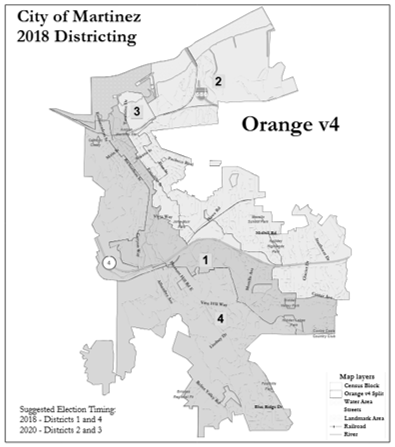
The Martinez City Council Election District Map showing the district lines for the four districts as enacted in 2018.
In response to intense criticism and public backlash, Martinez decided that an independent redistricting commission would conduct the mandatory redistricting following the 2020 Census.[232] The map produced by the commission, shown below, substantially diverged from the 2018 map, and drew multiple incumbent councilmembers into the same district, effectively causing two members of the Martinez City Council to leave office at the end of their terms or relocate to seek reelection in the districts they represent.[233]
Figure 2: Martinez City Council Election District Map (Enacted 2022)[234]
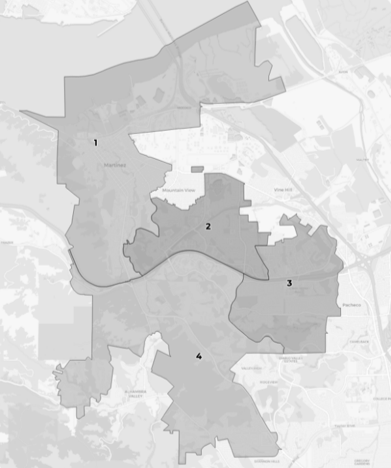
The Martinez City Council Election District Map showing the district lines for the four districts as enacted in 2022.
The CVRA tries to increase minority voting power by incentivizing local governments to transition to district-based elections, but the Martinez map—dilutive of minority voting power—demonstrates that district maps can fail to increase minority voting power. Accordingly, CVRA-motivated transitions to district-based elections may not protect minority voting rights if the districts are drawn in a way that does not improve representation. The fact that the map enacted in 2018 was dilutive of the Latine community’s vote but survived a legal challenge exemplifies how the CVRA does not always succeed in protecting the voting rights of minority communities. While the City of Martinez eventually adopted an independently drawn map that did not dilute Latine voting power in favor of protecting incumbent officials, such a change only followed significant public outcry.[235] Martinez’s example demonstrates that as local governments continue to transition to district-based election systems, the CVRA offers no guardrails to ensure that newly drawn districts will improve representation.
Recent debates around gerrymandering at the state level provide additional insight as to why district-based elections are a poor solution to ensuring fair maps that protect political minorities.[236] On August 29, 2025, after considerable political drama involving Texas state representatives fleeing to Illinois to prevent legislative action, Texas governor Greg Abbott signed into law a mid-decade redistricting map designed to provide the Republican Party an additional five seats in the U.S. House of Representatives.[237] In response, California put to the ballot a retaliatory redistricting plan which would see California redraw its maps to provide an additional five seats to Democrats in the U.S. House of Representatives.[238] If both maps survive legal challenges, the California redistricting will effectively cancel out the Texas redistricting, but it leaves a situation where Texas Democrats and California Republicans receive less proportional representation.[239]
While the complete history of gerrymandering and its negative effects on representation for political minorities are beyond the scope of this Note, suffice it to say that there are manifold issues caused by gerrymandering made possible by district-based elections.[240]
Furthermore, district-based elections in California historically—and currently—require that a district be geographically contiguous.[241] This prioritizes geographic proximity above any actual shared political interests in grouping the population into districts. While it may frequently be the case that minority communities are tightly geographically distributed, particularly where there was de jure and de facto segregation by systemic discrimination by policies such as mortgage redlining, it is not necessarily true that a minority community will always be concentrated in a geographic area.[242] District-based election systems may work to increase minority voting power where minority populations are effectively racially segregated.[243] However, when racial groups live relatively evenly dispersed throughout a whole political subdivision, geographically drawn districts are not likely to increase minority representation because such districts cannot unite the voting bloc in a single contiguous and compact district.[244] The City of Mission Viejo believed this to be the case in 2022, contending that “[s]ince minority residents live throughout [Mission Viejo], as opposed to one specific area, district voting does not remedy the issue of racial discrimination in the at-large voting system.”[245] In effect, district-based election systems often only work to increase minority representation where there is de facto segregation.[246]
B. Non-District Based Alternative Election Systems
Having identified the issues inherent with district-based election systems and their potential deleterious impacts on minority representation, we propose two potential alternative models of election systems and their advantages for ensuring minority representation in local governments. Under a cumulative voting system, every voter receives a number of votes equal to the number of seats up for election. Using this method, political minority groups can distribute votes in whichever manner they choose, including voting for a single candidate multiple times.[247] In a limited voting system, every voter receives a number of votes that is fewer than the number of seats up for election, and they may vote for up to that many candidates once each.[248] Both types of election systems exist within the at-large model allowing all voters in a political subdivision to vote in a single election for all members of an elected body.[249]
In a cumulative voting election system, every voter is able to cast a number of votes equal to the number of seats to be elected and distribute their votes however they choose, including voting for a single candidate multiple times.[250] In such a system, if minority communities can strategically coordinate their votes, they may be able to elect one or multiple of their chosen candidates even where a typical at-large system would have denied them any seats.[251]
For example, in a hypothetical community with completely racially polarized voting, a voting population that is 60 percent White and 40 percent Latine, and four members of a seven-seat board up for election, an at-large election system would elect all four candidates preferred by the White voters.[252] However, in a cumulative voting system, there would be the same four seats up for election, and every voter would still have the same four votes, but they would have the ability to vote for a single candidate multiple times. In such a case, a politically strategic minority group could elect one or two members of the board.[253]
Under this system generally, a strategically voting minority community would be able to elect a candidate of choice as long as they make up a portion of the population equal to or greater than 1/(1+S), where S is the number of seats to be filled.[254]
In an at-large system with completely racially polarized voting a minority population composing even 49.999 percent of the population would still be completely outvoted by the majority population. In a cumulative voting system electing two members, a minority population could elect a candidate of choice if they make up greater than 33.3 percent of the voting population, for three members greater than 25 percent of the population, for four members greater than 20 percent of the population, and for five members greater than 16.6 percent of the population.[255] In any of these cases, a minority population could elect a second candidate if they make up twice the population percentage to elect a single member.[256]
In a limited voting system, every voter can cast a number of votes that is less than the number of seats up for election, and they may vote for each candidate only once.[257] That is, a political minority is able to elect a candidate of choice when they constitute a portion of the population greater than V/(V+S), where V is the number of votes each voter is able to cast, and S is the number of seats up for election.[258]
In the same hypothetical four seat election discussed above, except under a limited voting system, a population that is 40 percent Latine would be able to elect two candidates of choice if each voter can vote once, and one candidate if each voter can vote two times.[259]
Transitioning from a traditional at-large voting system to a cumulative or limited voting system instead of a district-based election system would give racial minorities the power to elect their candidates of choice in every election where they vote cohesively and exceed the necessary portion of the population as described in the equations above.[260] Notably, a minority population’s ability to elect their candidates of choice would not be subject to the drawing of districts which, as discussed above, may be no better for minority representation than at-large systems.[261] Critically, these voting systems would not rely on the continued existence of de facto racially segregated communities in order to ensure that a marginalized community is able to have a meaningful impact on election outcomes.[262] Whether a minority community lives entirely in one neighborhood or spread through the entire political subdivision, its voting power is the same because their votes are not tied to a geographic district. However, this election system does require marginalized communities to engage in strategic voting; if voters are unable to coordinate which specific candidates to allocate their votes to, they may dilute the concentration of their own votes such that they do not actually elect any of their favored candidates.[263] While marginalized communities may sometimes not have the resources to strategically coordinate themselves in such a manner, an at-large election system does not guarantee even a strategic and well-organized minority group any representation.[264]
C. Legislative Constraints on the Use of Non-District-Based Election Systems
Having identified the inadequacies in district-based voting systems and some possible alternatives, we now shift to discussing why these alternative systems have not emerged. The answer is found in the legal procedure the CVRA outlines for bringing claims. As discussed earlier, when a local government body is sent a letter alleging a violation of the CVRA, it is exposed to paying the sender’s legal fees up to $30,000, even if it immediately reforms its election system to remedy the supposed violation.[265] When local governments receive such a letter, they are effectively left with three choices. First, they could fight the letter and subsequent lawsuit; if they win, the local government could keep its election system and pay its own legal fees, which can be immense; if they lose, they also have to pay the plaintiff’s reasonable legal fees in their entirety.[266] Second, they could transition to a district-based election system, pay the CVRA violation notice-sender $30,000, and never worry about another complaint because the CVRA does not regulate district-based elections.[267] Third, they could try to get permission from the state to transition to a non-district-based alternative election system such as those discussed above, pay the CVRA violation notice sender $30,000, and continue to worry about more CVRA complaints and litigation because no election systems other than district-based have a categorical carve-out from the CVRA.[268]
Confronted with these choices, local governments overwhelmingly chose the option with the least legal and financial risk, namely transitioning to district-based elections, regardless of whether that approach is the best for minority representation.[269] Some local governments have taken the third option and tried to implement alternative voting systems only to encounter even more legal obstacles.[270]
In one exceptional case, a local government recognized the inadequacy of a district-based election system, attempted to use a cumulative voting system, and was unable to make the transition due to the legal obstacles under California law. The City of Mission Viejo spent several years pursuing a transition to a cumulative voting system because it believed that the even dispersal of minority voters throughout Mission Viejo meant that district-based elections would not ensure minority representation.[271] Despite support from all parties involved, including the firm that sent the initial CVRA letter, the Secretary of State insisted that cumulative voting was impermissible.[272] As explained by then-Secretary of State Alex Padilla, the “Elections Code does not define any cumulative voting ballot tabulation methods by which testing and certification criteria could be developed by my office.”[273] So, in 2022 Mission Viejo instead transitioned to a district-based election system for its city council.[274] Despite the fact that the CVRA, a law intended to protect the right of minority voters to be able to elect their favored candidates, discourages novel voting systems, cities like Mission Viejo tried to adopt such a system anyway.[275] For their efforts, such cities received a swift rebuke from the State, because, as Secretary Padilla noted in his letter to Mission Viejo, existing provisions of California election law do not even comprehend anything beyond traditional at-large and district-based elections, and as a result constructively bans novel alternatives.[276] In effect, the CVRA encourages local governments to use district-based elections and creates a de facto ban on all other types of election.[277]
D. Proposed Reforms to the CVRA
With the major constraints on alternative voting systems identified, we now move to our proposals for reform to ensure that state law lives up to the CVRA’s goal of ensuring fair minority representation. First, we argue that the Elections Code needs to be updated to allow the Secretary of State to certify election equipment and methodologies used in cumulative and limited election systems. Second, we argue that district-based elections should not be exempted from CVRA regulations, and instead that all election systems should be subject to litigation if they prevent racial minorities from electing candidates of their choice.
1. Allow Alternative Election Systems
The first reform we propose is to update the state Elections Code to include standards by which the California Secretary of State can certify election equipment and methodologies used in alternative voting systems. The lack of such legislation has thwarted recent attempts to implement novel election systems, and for no apparent reason.[278] The Legislature has not expressed disapproval of other election systems. Indeed, the California Supreme Court held that the Legislature envisioned alternative election systems like cumulative voting as potential remedies to CVRA violations.[279] There is no data or literature suggesting that the lack of legislation in the area is any more than a mere oversight. Fixing this oversight would allow local governments to adopt systems that may be better suited to their local needs. This suggestion is not particularly radical; one scholar, Olivier Richomme, has used the CVRA as the basis to recommend wider adoption of alternative election systems, particularly proportional representation systems such as cumulative and limited voting.[280]
The establishment of the exact standards by which equipment and methodologies should be approved is a technocratic matter less concerned with the democratic processes and voting, and more concerned with the actual functionality and reliability of voting and tabulation equipment.[281] As such, we do not propose any particular certification standards, but rather identify an area where there is a clear legislative oversight that warrants action.
By implementing standards based on which the Secretary of State can approve the equipment used in alternative election systems, the legislature would give local governments more choices beyond traditional at-large or district-based election systems. The California Supreme Court noted that cumulative, limited, and single-transferable-vote systems are all permissible remedies under the CVRA.[282] The only current bar on their use is the lack of equipment certification standards in the Elections Code, which should be easily and noncontroversially remedied.
2. Remove the District-Based Carveout from the CVRA
The second reform we propose is to update the CVRA to expand its scope and regulate all types of election systems, including district-based election systems. Other scholars in the field have made the same recommendation.[283] As currently in force, the CVRA sometimes incentivizes local governments to uncritically adopt districts based elections even when district-based elections fail to meaningfully increase minority political power.[284] Thus, there are situations such as in Mission Viejo where, when compared to cumulative voting, district-based elections would unfairly dilute minority voting power, but the CVRA currently protects those local governments from litigation.[285] Accordingly, we believe it is critical to the aim of the CVRA to ensure fair minority representation that no election system is subject to different standards. If any election system is identified as impairing the ability of a protected class to elect its preferred candidates and a better alternative can be identified, that election system should be open to legal challenge under the CVRA regardless of if it is at-large, district-based, or otherwise.
Removing the CVRA carveout for district-based elections would not only allow voters to challenge discriminatory district-based election systems but also discourage local governments from uncritically transitioning to district-based election systems to head off potential litigation.[286] Such a move would allow local governments to develop real solutions tailored to promote descriptive representation. By removing arbitrary legal protections for district-based elections, the CVRA would align concerns around legal risk and fair representation, and local governments would not be given a perverse incentive to use a particular election system.
The California Legislature has actually already tried to do this. In 2014, the Legislature passed Senate Bill 1365 (SB 1365), which would have amended the CVRA to authorize actions against local governments using district-based elections that diluted minority voting power.[287] The bill, championed by then-State Senator, now-U.S. Senator Alex Padilla, was vetoed by Governor Jerry Brown.[288] In his veto message, Brown explained that “[w]hile there is progress to be made, the federal Voting Rights Act and the California Voting Rights Act already provide important safeguards to ensure that the voting strength of minority communities is not diluted.”[289] As explained above, the CVRA does not regulate district-based elections. Governor Brown was nominally correct that district-based election systems are regulated by the FVRA. Many local governments in the 2020 redistricting cycle, however, failed to conduct any analysis to determine if the FVRA applied to their jurisdiction, simply assuming—sometimes erroneously—that it did not.[290] The Supreme Court has recently further weakened the FVRA, this time to near-complete powerlessness.[291]
While Governor Brown’s veto was ill-advised even in 2014, the national political situation and federal protection of minority rights is substantially weaker than it was a decade ago and is under constant attack.[292] Accordingly, it is critical that California elections stop relying on federal law to provide protections, and pass legislation like 2014’s SB 1365 to ensure fairness in all types of election systems.
Conclusion
Minority representation in local governments has been on the rise since the passage of the CVRA in 2001. However, data from school districts in the nine Bay Area counties suggests that transitioning to district-based elections under the CVRA is not the sole reason for the increase in diversity.[293] Further, the inadequacy of state law, which effectively bans the use of alternative and novel election systems,[294] actively prevents local governments from taking additional steps to enact election systems that result in the best representation for everyone in a local subdivision.[295] State law should be reformed to reduce reliance on rapidly changing and increasingly inconsistent and inadequate federal law, and to ensure legislative oversight does not prevent local governments from enacting fair election systems. Reformed election laws should allow and encourage local governments to explore alternative election systems such as cumulative and limited voting, which enhance democratic legitimacy by providing minority communities the ability to elect their preferred candidates and influence election outcomes regardless of the geographical distribution of voters.[296]
Limited by practical constraints regarding available information about officeholders, this Note raises serious concerns with the CVRA but does not definitively quantify its effects. While this Note examines electoral trends in school board compositions in the Bay Area counties among Latine and AAPI communities, further research is necessary to understand the full impact of the CVRA across all forms of local government in all areas of the state and all racial minorities. A comprehensive demographic analysis of all local governments throughout California with more specifically detailed information about officeholder demographics would further be helpful in identifying exactly when the CVRA improves descriptive representation and when it does not. Additionally, in assessing the CVRA by measuring election outcomes, analysis would be bolstered by a survey not just of election results by the victor, but also the candidates they ran against and beat.
Copyright © 2026 Zachary Griggy* and Jonah Smith**
* J.D. Candidate, University of California, Berkeley, School of Law, Class of 2027; B.A. Political Science & B.A. Urban Studies, University of California, Irvine, 2023.
** J.D. Candidate, University of California, Berkeley, School of Law, Class of 2027; B.A. Political Science & Archaeology, Johns Hopkins University, 2024. The authors would like to thank Bernard Grofman and Jonathan Cervas for their thoughtful comments on early versions of this Note, Marek Kaminski for his advice developing the topic, and the California Law Review’s dedicated editors, especially Karina Sanchez, Maya Saidi Litvak, Spencer Feinstein, Taylor Thomas, Taja Hirata-Epstein, Anna Tropiano, Adam Opin, Michael John, Mollie Parkinson, César Nije, Elena Isabelle Fabian, and Natalie Noelle Heller.
Editor’s Note: For the full appendices, including source data, consult the .pdf version of this publication.
[1]. Throughout this Note we use the term “minority” to refer to any group of people who, as a group, represent less than half of the population of a given political subdivision. In some of the relevant areas of California, White voters constitute the “minority.” In others, Asian American, Black, Latine, and other racial groups may constitute the “minority.” In some instances, as relevant to election outcomes, the “minority” may be defined by a characteristic other than race, gender, or other protected attributes.
[1]. Throughout this Note we use the term “minority” to refer to any group of people who, as a group, represent less than half of the population of a given political subdivision. In some of the relevant areas of California, White voters constitute the “minority.” In others, Asian American, Black, Latine, and other racial groups may constitute the “minority.” In some instances, as relevant to election outcomes, the “minority” may be defined by a characteristic other than race, gender, or other protected attributes.
[2]. Pieter K. van Wingerden & Aria Fafat, Mapping the Revolution in California City Council Election Systems 3 (2024), https://roseinstitute.org/wp-content/uploads/2025/05/CA-City-Elections-Systems-Report_FINAL.pdf [https://perma.cc/7KCD-SN9V]; see also Loren Collingwood & Sean Long, Can States Promote Minority Representation? Assessing the Effects of the California Voting Rights Act, 57 Urb. Affs. Rev. 731, 732 (2021) (finding that 449 of 476 California cities used at-large elections at the time the CVRA was passed).
[3]. van Wingerden & Fafat, supra note 2, at 1. “At-large election” refers to an election format where all voters in a jurisdiction can vote for all seats on a local government jurisdiction’s governing board. See Cal. Elec. Code § 14026(a)(1)–(3). In many, but not all, at-large jurisdictions, all voters in the jurisdiction can also run for any seats up for election on the jurisdiction’s governing board. See van Wingerden & Fafat, supra note 2, at 1 (noting that some cities with at-large elections add a “rarely used” requirement that candidates live in particular areas or districts of the city to run for certain seats).
[4]. Jessica Trounstine, District vs At-Large Elections 6 (2024), https://effectivegov.uchicago.edu/primers/district-vs-at-large-elections [https://perma.cc/VN83-4G32].
[5]. See, e.g., 2020 Cal. Citizens Redistricting Comm’n, Report on Final Maps 41 (2021), https://wedrawthelines.ca.gov/wp-content/uploads/sites/64/2023/01/Final-Maps-Report-with-Appendices-12.26.21-230-PM-1.pdf [https://perma.cc/GN4W-PHHW] (finding racially polarized voting in part or all of sixteen out of fifty-eight California counties). See generally Christopher S. Elmendorf, Kevin M. Quinn & Marisa A. Abrajano, Racially Polarized Voting, 83 U. Chi. L. Rev. 587 (2016) (discussing judicial doctrines regarding racially polarized voting).
[6]. See Trounstine, supra note 4, at 6 (explaining that “[s]everal court cases . . . have found at-large systems to discriminate against Black voters by diluting their voting power under certain conditions”).
[7]. 52 U.S.C. § 10301(a).
[8]. See, e.g.,Gomez v. City of Watsonville, 863 F.2d 1407, 1419 (9th Cir. 1988) (striking down a California city’s at-large election system for violating the FVRA).
[9]. See Joaquin G. Avila, Eugene Lee & Terry M. Ao, Voting Rights in California: 1982–2006, 17 S. Cal. Rev. L. & Soc. Just. 131, 148–53 (2007) (“Section 2 [of the FVRA] has been ineffective in eliminating discriminatory at-large methods of elections in California.”).
[10]. Seeid. at 152.
[11]. Cal. Elec. Code § 14027.
[12]. Id. § 14032.
[13]. Id. § 14028(a).
[14]. Id. §§ 14027, 14028(a), (d).
[15]. Seeid. § 14026(a)–(b) (defining “at-large method of election” and “district-based elections”); id. § 14027 (regulating at-large but not district-based elections). Throughout this Note, we use the term “district-based elections” to encompass “by-district elections” and “trustee area elections.” All these terms refer to elections where a jurisdiction is subdivided into election districts. Only candidates living in the election district can run, and only voters residing in the election district can vote. Certain California state laws referring to “trustee area elections” speak to both district-based elections and a variant of at-large elections where candidates are required to reside in an election district but all voters in the jurisdiction can vote for contests involving all “residence districts.” We refer to this variant of at-large elections as “residence districts.”
[16]. California Elections Code Section 14029 provides that courts, upon finding a CVRA violation, “shall implement appropriate remedies . . . tailored to remedy the violation” and that remedies can include district-based elections. Although the California Supreme Court has held that the CVRA does not require jurisdictions or courts to select district-based elections as a remedy, local government jurisdictions have all adopted district-based elections to remedy alleged CVRA violations, as other remedies, discussed infra Part III.C, can be subject to further challenges under the CVRA whereas district-based elections cannot. See Pico Neighborhood Ass’n v. City of Santa Monica, 534 P.3d 54, 70 (Cal. 2023); Cal. Elec. Code §§ 14026–27.
[17]. See van Wingerden & Fafat, supra note 2, at 1–2.
[18]. Descriptive representation refers to the demographics of officeholding individuals approximately mirroring the demographics of the electorate. See Anne Phillips, Descriptive Representation Revisited, in The Oxford Handbook of Political Representation in Liberal Democracies 174, 174 (Robert Rohrschneider & Jacques Thomassen eds., 2020).
[19]. See Justin Levitt & Douglas Johnson, Quiet Revolution in California Local Government Gains Momentum 1 (2016), https://roseinstitute.org/wp-content/uploads/2016/11/CVRA-White-Paper.pdf [https://perma.cc/MW5Y-ZNY5] (“From statehood in 1850 to the passage of the CVRA in 2002, all but the very largest cities in California tended to use at-large council election systems.”); see also van Wingerden & Fafat, supra note 2, at 1 (finding only 7.6 percent of California cities used district-based elections before the CVRA’s passage).
[20]. See van Wingerden & Fafat, supra note 2, at 1 (finding that the number of California cities using district-based elections has increased from 36 to 229); see also infra Part I.B.1 (finding over two hundred school districts have transitioned to district-based elections).
[21]. Int’l City/Cnty. Mgmt. Ass’n, 2018 Municipal Form of Government Survey: Summary of Survey Results 10 (2019), https://icma.org/sites/default/files/2018%20Municipal%20Form%20of%20Government%20Survey%20Report.pdf [https://perma.cc/KXR5-DSQP].
[22]. See Trounstine, supra note 4, at 5.
[23]. See id.
[24]. Edward C. Banfield & James Q. Wilson, City Politics 140–41 (1963).
[25]. See U.S. Comm’n on C.R., The Voting Rights Act: Ten Years After 205 (1975).
[26]. See id. at 204–05.
[27]. Matthew Cunningham, GOP/Business “Unity” Candidates Sweep Huntington Beach Council Elections, OC Indep. (Nov. 11, 2022), https://ocindependent.com/2022/11/gop-business-unity-candidates-sweep-huntington-beach-council-elections/ [https://perma.cc/U785-JXX8] (reporting that Republicans won all four council seats up for election in 2022); Matthew Cunningham, Democrats Wiped Out in Huntington Beach City Council Election, OC Indep. (Nov. 6, 2024), https://ocindependent.com/2024/11/democrats-wiped-out-in-huntington-beach-city-council-election/ [https://perma.cc/X784-4HXR] (reporting that Republicans won all three council seats up for election in 2024 and defeated three Democratic incumbents); Noah Biesiada, Huntington Beach Appoints Andrew Gruel to City Council, Voice of OC (Mar. 18, 2025), https://voiceofoc.org/2025/03/huntington-beach-appoints-andrew-gruel-to-city-council/ [https://perma.cc/5KGY-MBWV] (reporting that the Huntington Beach filled a 2025 city council vacancy with a celebrity chef who has been a guest on Fox News).
[28]. See Cunningham, Democrats Wiped Out, supra note 27; Biesiada, supra note 27; Orange Cnty. Registrar of Voters, Certified Statement of the Votes Cast at the Presidential General Election Nov. 5, 2024 in the County of Orange, State of California 30 (2024), https://ocvote.gov/fileadmin/live/GEN2024/sov.pdf [https://perma.cc/Y957-MHKD] (reporting results of the 2024 presidential election in Huntington Beach).
[29]. See U.S. Comm’n on C.R., supra note 25, at 204–05; see, e.g.,Gomez v. City of Watsonville, 863 F.2d 1407, 1416–17 (9th Cir. 1988) (noting that “no Hispanic had ever been elected as mayor or city council member under the at-large system prior to the trial” despite eight Hispanic candidates running for council and one for mayor between 1971 and 1985 with near-unanimous support from Hispanic people in predominantly Hispanic precincts).
[30]. See U.S. Comm’n on C.R., supra note 25, at 204–05.
[31]. See Banfield & Wilson, supra note 24, at 307–08; Trounstine, supra note 4, at 6 (“The adoption of at-large systems typically flowed from two sources: efforts to dilute Black voters’ power in Southern cities after the Civil War and the municipal reform movement that sought to promote a citywide perspective in governance.”).
[32]. See Banfield & Wilson, supra note 24, at 307–08.
[33]. Id.
[34]. Id.
[35]. See Newport Beach, Cal., City Charter §§ 400–01 (2025), https://www.codepublishing.com/CA/NewportBeach/#!/NewportBeachCH.html#04.401 [https://perma.cc/ES7W-FFKG] (requiring city councilmembers to reside in their districts but providing that “one [councilmember] shall be elected from each of such districts by the voters of the City at large”).
[36]. Board Members, Shoreline Unified Sch. Dist., https://www.shorelineunified.org/page/board-members/ (last visited July 25, 2026) [https://perma.cc/R28K-KWAE].
[37]. For example, the Travis Unified School District’s residency trustee areas aim to ensure representation for residents of the Travis Air Force Base. The district’s five trustees are elected at large from two residency districts. One trustee must reside in Trustee Area 1, which consists solely of the Travis Air Force Base, ensuring residents of the base have representation on the school board. The remaining four trustees must reside in Trustee Area 2, which consists of the rest of the district’s territory. School Board, Travis Unified Sch. Dist., https://www.travisusd.org/board (last visited July 25, 2026) [https://perma.cc/5CF3-3G3P].
[38]. For example, when the Novato Unified School District adopted district-based elections in 2019, two school board members lived on the same street. See Novato Unified Sch. Dist., Conceptual Trustee Area - Scenario 7A (Griggy) 1 (2019), https://novato.agendaonline.net/public/Meeting/Attachments/DisplayAttachment.aspx?AttachmentID=435057&IsArchive=1 [https://perma.cc/RGP4-HXVX]. An article discussing CVRA-related organizing in the Hacienda la Puente Unified School District noted that the school district’s at-large elections resulted in the vast majority of board members coming from a wealthy area of the district and few trustees coming from working-class communities in the district. See Jessica Coreas, Bryan Coreas, Eugene Fujimoto, Enrique Ochoa, Gilda L. Ochoa, Maria Oropeza Fujimoto & Socorro Orozco, ¡Juntos Podemos![Together We Can!] Community Organizing, the California Voting Rights Act (CVRA) and the Struggle for School Transformation in a Southern California School District, 22 J. Latinos & Educ. 804, 807 (2020) (noting that all but three school board members since the 1970s came from the district’s affluent Hacienda Heights neighborhood).
[39]. See Cal. Elec. Code § 8200.
[40]. See id. §§ 8140–41.
[41]. For example, if two seats, A and B, are up for election and elected separately, one incumbent can file for seat A and the other for seat B.
[42]. See U.S. Comm’n on C.R., supra note 25, at 207.
[43]. See, e.g., Holloway v. City of Virginia Beach, 531 F. Supp. 3d 1015, 1077–78 (E.D. Va. 2021) (noting that a Black councilmember won in a 2012 residence district at-large election despite receiving only 17 percent of the vote from White voters because White voters split their remaining votes between three White candidates and that the councilmember subsequently lost her reelection bid in 2016 after only a single White candidate ran against her, and 70 percent of White voters backed the White candidate); Gomez v. City of Watsonville, 863 F.2d 1407, 1409 n.1 (9th Cir. 1988) (noting that one Hispanic candidate was elected to the Watsonville City Council after only two White candidates and three Hispanic candidates ran for three seats on the City Council).
[44]. Trounstine, supra note 4, at 5.
[45]. See id. (finding that most cities “tend to” use either “single-member districts or at-large elections”).
[46]. Seeid.
[47]. Cal. Const. art. IV, § 6.
[48]. 2 U.S.C. § 2c; seeAbout Congressional Districts, U.S. Census Bureau, https://www.census.gov/programs-surveys/geography/guidance/geo-areas/congressional-dist.html (last visited July 25, 2026) [https://perma.cc/UB6L-GZ43].
[49]. See Trounstine, supra note 4, at 5.
[50]. Id.
[51]. See Cal. Const. art. II, § 6 (providing that all county offices, including county supervisor offices, “shall be nonpartisan”); Cal. Elec. Code §§ 8140–41 (establishing a majority requirement for nonpartisan elections held during primary elections).
[52]. L.A., Cal., City Charter § 425 (1999).
[53]. See S.D., Cal., City Charter art. II, § 10 (2014) (requiring a runoff if no candidate wins a majority in the primary election for city offices). In 2016, San Diegans voted to require the top two candidates to advance to a runoff election, regardless of whether one candidate won a majority of the vote in a primary election. See S.D. Cnty. Registrar Of Voters, Sample Ballot and Voter Information: Presidential General Election: Tuesday November 8, 2016 66–68, 71–72 (2016), https://www.sandiego.gov/sites/default/files/voterpamphlet110816_2.pdf [https://perma.cc/3H3E-FPUB] (describing Measure K, a ballot measure to enact the proposed amendment); S.D. Cnty. Registrar of Voters, County of San Diego: Presidential General Election: Tuesday, November 8, 2016: Official Results - (San Diego County Portion Only) 19 (2016), https://www.sdvote.com/content/dam/rov/en/archive/201611bull.pdf [https://perma.cc/63CQ-ARU4] (reporting that Measure K received a majority of the vote and passed); S.D., Cal., City Charter art. II, § 10 (current statute text reflects the charter amendment enacted in Measure K).
[54]. See generally White v. Regester, 412 U.S. 755, 769 (1973) (noting that “[s]ingle-member districts were thought required to remedy ‘the effects of past and present discrimination against Mexican-Americans’”); Thornburg v. Gingles, 478 U.S. 30 (1986) (striking down several multimember election districts in North Carolina state legislature elections because the districts impaired minority voters’ ability to elect their candidates of choice in polarized voting); Gomez v. City of Watsonville, 863 F.2d 1407 (9th Cir. 1988) (striking down Watsonville, California’s at-large election system for violating the FVRA and remanding for implementation of an election system that complies with the FVRA). See also Paule Cruz Takash, Remedying Racial and Ethnic Inequality in California Politics: Watsonville Before and After District Elections 19 (1999) (noting that a district court judge oversaw the process of drawing Watsonville’s city council districts and that “all sides” approved Watsonville’s new council districts).
[55]. See Gomez, 863 F.2d at 1409, 1414 (noting that 60 percent of the voting age population citywide was non-Latine, but that under plaintiffs’ proposed district plan, there would be two districts where Latine voters were “a majority of the voters”).
[56]. See Gingles, 478 U.S. at 80 (affirming decision by district court concluding that multimember election districts impaired the ability of Black voters to elect candidates of choice and enjoining the districts from being used in future elections).
[57]. Id. at 50–51.
[58]. Gomez,863 F.2d at 1419.
[59]. See id. at 1409; see Takash, supra note 54, at 3 (noting that district elections “displaced [Watsonville’s] entrenched conservative and predominately White city council”).
[60]. Gomez, 863 F.2d at 1414.
[61]. Id. at 1414–16.
[62]. Id. at 1417.
[63]. Id. at 1419.
[64]. Takash, supra note 54, at 19–20.
[65]. Seeid. at 22–23, 26–27 (noting that Oscar Rios was elected to Watsonville City Council District 2 in 1989 and selected by the city council to serve as mayor in 1991).
[66]. Seeid. at 23–25 (describing three White candidates as being backed by district-based election activists and showing election results with those candidates winning).
[67]. See id. at 19–20, 23–25.
[68]. See Avila, Lee & Ao, supra note 9, at 148 n.98 (listing successful challenges to at-large elections including the Central Coast’s City of Salinas; the Central Valley’s Coalinga-Huron Unified School District and City of Dinuba; and Southern California’s City of San Diego and City of Oxnard).
[69]. S.B. No. 976—Polanco,in Cal. S., Senate Final History: History of All Senate Bills, Constitutional Amendments, Concurrent, Joint, and Senate Resolutions Introduced, at 698 (2002), https://clerk.assembly.ca.gov/sites/clerk.assembly.ca.gov/files/archive/-FinalHistory/2001/SFH_Vol_1.pdf [https://perma.cc/E27R-3X4F] (reporting that the Legislature passed the CVRA in June 2002).
[70]. Id. (reporting that the governor signed the CVRA in July 2002).
[71]. Avila, Lee & Ao, supra note 9, at 152 n.109.
[72]. See id. at 148–52 (explaining that Avila, Lee, and Ao found that high financial risk associated with FVRA claims, as well as previous attempts by local governments who prevailed in FVRA litigation to collect their litigation costs, resulted in no private litigants bringing FVRA claims in the late 1990s).
[73]. Cal. Elec. Code § 14027.
[74]. Id. § 14026.
[75]. Id. § 14032.
[76]. See id. § 14028(a)–(b); Thornburg v. Gingles, 478 U.S. 30, 50–51 (1986) (outlining the test for proving violations of Section 2 of the FVRA); Pico Neighborhood Ass’n v. City of Santa Monica, 534 P.3d 54, 63 (Cal. 2023) (“[T]he CVRA, like the [F]VRA, requires a plaintiff claiming vote dilution arising from an at-large voting system to establish the existence of racially polarized voting—i.e., that the protected class members vote as a politically cohesive unit, while the majority votes ‘sufficiently as a bloc usually to defeat’ the protected class’s preferred candidate.” (quoting Gingles, 478 U.S. at 56)).
[77]. Cal. Elec. Code § 14028; see also Sanchez v. City of Modesto, 145 Cal. App. 4th 660, 667 (2006) (noting that plaintiffs alleging a violation of the CVRA “do not need to . . . demonstrate an intent to discriminate on the part of voters or officials” (citing Cal. Elec. Code § 14028(d))).
[78]. Compare Cal. Elec. Code § 14028(c), with Gingles, 478 U.S. at 50 (requiring proof that a minority group is “sufficiently large and geographically compact to constitute a majority in a single-member district” to prevail in a claim arising under Section 2 of the FVRA).
[79]. Table S2901: Citizen, Voting-Age Population by Selected Characteristics, U.S. Census Bureau, https://data.census.gov/table/ACSST1Y2024.S2901?q=california (last visited July 25, 2026) [https://perma.cc/RV3H-P44L].
[80]. See Jason Fagone & Daniel Lempres, Hero or Opportunist? Pugilistic Malibu Lawyer Remakes California Voting, S.F. Chron. (Dec. 21, 2023) [hereinafter Fagone & Lempres, Hero or Opportunist?], https://www.sfchronicle.com/california/article/malibu-lawyer-elections-18533273.php [https://perma.cc/2LBJ-TUY9].
[81]. See id. (“One of [the CVRA’s] key ideas is that minority communities should matter even when they lack that size, and if drawing a district can take them from 20 percent to 40 percent, for example, that still makes elections more fair. It can also be hard in California for any one racial group to reach 50% because there are so many different ethnic communities here.”).
[82]. Cal. Elec. Code § 14028(c) (“The fact that members of a protected class are not geographically compact or concentrated may not preclude a finding of racially polarized voting, or a violation of [the CVRA], but may be a factor in determining an appropriate remedy.”).
[83]. Although the U.S. Supreme Court in Louisiana v. Callais, 146 S. Ct. 1131 (2026), recently “updat[ed]” its FVRA jurisprudence and the Gingles test in ways expected to make “success in [FVRA] suits nearly impossible,” see id. at 1176 (Kagan, J., dissenting); Nicholas Stephanopoulos, Some Thoughts About Callais, Election L. Blog (Apr. 29, 2026, at 12:12 PM), https://electionlawblog.org/?p=155758 [https://perma.cc/8WX5-H26B] (“[Callais] is the effective end of [FVRA] racial vote dilution claims.”), at least one California court has rejected applying Callais to CVRA claims, see Tentative Ruling and Proposed Statement of Decision at 14–22, Sw. Voter Registration Educ. Proj. v. City of Huntington Beach, No. 30-2024-01397379-CU-CR-NJC (Cal. Superior Ct. Orange Cnty. June 24, 2026), https://electionlawblog.org/wp-content/uploads/huntington-CVRA-order.pdf [https://perma.cc/LD8E-RLYM].
[84]. Cal. Elec. Code § 14030.
[85]. See Fagone & Lempres, Hero or Opportunist?, supra note 80 (noting “large awards” of $1.3 million, $1.37 million, $293,000, and $850,000). The CVRA also bars successful defendants from recovering fees unless a court finds the CVRA litigation to be “frivolous, unreasonable, or without foundation.” Cal. Elec. Code § 14030.
[86]. See, e.g., Erica Suzanne Silva, Representation Matters: Descriptive Representation, School Board Election Systems, and the California Voting Rights Act of 2001 56–57 (May 2019) (Ed.D. dissertation, University of Southern California) (ProQuest) (discussing California State Board of Education waivers and finding 171 districts had requested waivers to transition to district-based elections between the CVRA’s passage and 2018).
[87]. Cal. Educ. Code §§ 5019(2), 5020.
[88]. Id. § 33050.
[89]. See infra Appendix I.
[90]. See, e.g., Cal. State Bd. of Educ., November 2019 Agenda: Item #W-06 1–2 (2019), https://www.cde.ca.gov/be/ag/ag/yr19/documents/nov19w06.docx [https://perma.cc/G9VG-F7WD] (noting that at-large school districts faced “existing or potential litigation” under the CVRA and that six school districts were seeking waivers of the district-wide election requirement to “reduce the potential for litigation and to establish by-trustee-area elections as expeditiously as possible”); Cal. State Bd. of Educ., May 2017 Agenda: Item #W-09 1 (2017), https://www.cde.ca.gov/BE/ag/ag/yr17/documents/may17w09.doc [https://perma.cc/B68D-M77U] (noting the same, with two school districts seeking waivers); Cal. State Bd. of Educ., May 2012 Agenda: Item #W-18 2 (2012), https://www.cde.ca.gov/be/ag/ag//yr12/documents/may12w18.doc [https://perma.cc/GN54-LZK2] (with seven school districts seeking waivers); Cal. State Bd. of Educ., May 2012 Agenda: Item #W-19 2 (2012), https://www.cde.ca.gov/be//ag/ag/yr12/documents/may12w19.doc [https://perma.cc/52MV-QN9U] (with ten school districts seeking waivers).
[91]. See, e.g., SBE Agenda for July 2019, Cal. State Bd. of Educ. (2019), https://www.cde.ca.gov/be/ag/ag/yr19/agenda201907.asp [https://perma.cc/H65U-8FYG] (listing each waiver slated for discussion at the State Board of Education meeting and providing accompanying documentation);Cal. State Bd. of Educ.,Final Minutes: July 10, 2019 6–13 (2019), https://www.cde.ca.gov/be/mt/ms/documents/finalminutes10jul2019.docx [https://perma.cc/76BQ-BSVC] (listing each waiver discussed at the meeting, the number of votes cast for and against each waiver, and the passage or defeat of each waiver).
[92]. See infra Appendix I.
[93]. See, e.g., Silva, supra note 86, at 56–57 (determining that two school districts the author interviewed for her study sought waivers to transition to district-based elections and finding that, statewide, 171 school districts had sought waivers as of September 2018).
[94]. For State Board of Education meeting agendas, see Current & Past Agendas, Cal. State Bd. of Educ., https://www.cde.ca.gov/be/ag/ag/index.asp (last visited July 25, 2026) [https://perma.cc/X45F-QQJ7]. For State Board of Education meeting minutes, see Meeting Minutes, Cal. State Bd. of Educ., https://www.cde.ca.gov/be/ag/ms/index.asp (last visited July 25, 2026) [https://perma.cc/5EFH-BCKM].
[95]. The River Delta Joint Unified School District’s waiver request, for example, did not mention the CVRA. Instead, the District provided other considerations for transitioning to district-based elections, such as voter confusion arising from residents’ unfamiliarity with candidates from other parts of the school district. See Cal. State Bd. Of Educ., May 2020 Agenda: Item #W-08 attach. 2 at 1–2 (2020), https://www.cde.ca.gov/be/ag/ag/yr20/documents/may20w08.docx [https://perma.cc/BP9L-R7N6].
[96]. See, e.g., infra sources cited in Appendix I, Table 2018, Row 6 (reviewing a resolution the Cucamonga Elementary School District board passed authorizing the district to seek a waiver).
[97]. We did this because some school districts encompass parts of multiple counties. See, e.g., District Information, Shoreline Unified Sch. Dist., https://www.shorelineunified.org/page/district-information (last visited July 25, 2026) [https://perma.cc/4S9Z-MCLT] (“The district . . . straddles both coastal Marin and Sonoma counties.”). We coded school districts as being in the county listed in each district’s profile from the California Department of Education directory. See, e.g., District Profile: Shoreline Unified, Cal. Dep’t of Educ., https://www.cde.ca.gov/sdprofile/details.aspx?cds=21733610000000 (last visited July 25, 2026) [https://perma.cc/B679-LFD9] (listing the Shoreline Unified School District’s “county” as “Marin” under the heading “District Details”). To access the California Department of Education’s directory, see California School Directory, Cal. Dep’t of Educ., https://www.cde.ca.gov/schooldirectory/ (last visited July 25, 2026) [https://perma.cc/3UZZ-YG9N].
[98]. See infra Appendix I.
[99]. See infra Appendix I.
[100]. See infra Appendix I. When a school district requests a waiver from the State Board of Education, the school district provides a reason for seeking the waiver. Over 90 percent of waiver requests explicitly mention the CVRA and risk of litigation from at-large election systems as reasons for transitioning to district-based elections. See id.
[101]. See Cal. Citizens Redistricting Comm’n, supra note 5, at 41 (finding racially polarized voting in part or all of each county in the San Joaquin Valley); Community and Regional Planning Center: Our Community, Fresno State, https://socialsciences.fresnostate.edu/geography/crpc/scope.html [https://perma.cc/Z34B-HJTK] (“The San Joaquin Valley extends 250 miles from San Joaquin County in the North to Kern County in the South. There are 8 counties in the San Joaquin Valley: Fresno, Madera, Merced, Kern, Kings, Stanislaus, San Joaquin, and Tulare.”).
[102]. 145 Cal. App. 4th 660, 666 (2006); Thomas Rice, At-Large Elections Pose Litigation Risk Under CVRA, Best Best & Krieger LLP (Jan. 18, 2018), https://bbklaw.com/resources/at-large-elections-pose-litigation-risk-under-cvra [https://perma.cc/WB8U-W5PY].
[103]. Sanchez, 145 Cal. App. 4th at 666.
[104]. Id. at 667.
[105]. Id.
[106]. Id.
[107]. Id. at 670–71.
[108]. Id. at 666.
[109]. Sanchez v. City of Modesto, 145 Cal. App. 4th 660, 660(2006), cert. denied, 552 U.S. 974 (2007).
[110]. Rice, supra note 102.
[111]. Avila, Lee & Ao, supra note 9, at 153 n.110.
[112]. First Amended Complaint at 2, Gomez v. Hanford Joint Union High Sch. Dist., No. 04C0294 (Cal. Superior Ct. Kings Cnty. Dec. 8, 2004).
[113]. Bob Egelko, CALIFORNIA / Latinos Use Voting-Rights Law to Force District Elections / School Board in the Central Valley Had No Hispanic Trustees, SFGATE (Mar. 24, 2005), https://www.sfgate.com/education/article/CALIFORNIA-Latinos-use-voting-rights-law-to-2690363.php [https://perma.cc/W6WD-MWZ4].
[114]. Avila, Lee & Ao, supra note 9, at 153–54. The Section 5 lawsuit and subsequent switch to district-based elections resulted in two Latine individuals being elected to the Hanford City Council. Id. at 154; see also2001 Redistricting: Hearing Before the S. Comm. on Elections & Reapportionment, 2001–02 Leg., Reg. Sess. 21, 23 (Cal. May 22, 2001) (statement of Dolores Gallegos, Hanford City Councilmember) (“I am the first Hispanic female elected in the County of Kings. I am a product of Section 5 [of the FVRA], and I’m very proud to say that.”).
[115]. Egelko, supra note 113.
[116]. Id.
[117]. See infra Appendix I.
[118]. See infra Appendix I (showing one waiver request in 2008, nine in 2009, and eight in 2010).
[119]. Until 2011, some community college districts were required to seek waivers from the State Board of Education for CVRA-related election changes. See Staff of Assemb. Comm. on Elections & Redistricting, Report on Assemb. B. 684, 2011 Leg., Reg. Sess., at 3–4 (Cal. May 3, 2011), https://leginfo.legislature.ca.gov/faces/billAnalysisClient.xhtml?bill_id=201120120AB684 [https://perma.cc/5H9G-7BTF] (finding that the State Center Community College District sought a waiver from the State Board of Education to transition to district-based elections). In 2011, the state legislature gave the California Community Colleges Board of Governors the power to approve community college districts’ transitions to trustee-area elections. See Assemb. B. 684 § 1, 2011 Leg. (Cal. 2011), codified at Cal. Educ. Code § 72036.
[120]. Cal. State Bd. of Educ., Final Minutes: June 16, 2008 3 (2008), https://www.cde.ca.gov/be/mt/ms/documents/finalminutes0608.doc [https://perma.cc/9AGM-CPDX].
[121]. See infra Appendix I, Tables 2009, 2010, and 2011.
[122]. See infra Appendix I, Table 2012.
[123]. Mitchell Landsberg, Making Sure Minorities’ Votes Count, L.A. Times (Jan. 4, 2009), https://www.latimes.com/archives/la-xpm-2009-jan-04-me-madera4-story.html [https://perma.cc/4F2K-FYTB].
[124]. In another case brought by the Lawyers’ Committee in Madera County, a Superior Court judge ruled against the Madera Unified School District and forced the school district to implement district elections; subsequently, in neighboring Fresno County, all twenty-eight school districts that used at-large elections decided to transition to district-based elections to avoid potential litigation. Id.
[125]. See infra Appendix I (showing most school districts requesting waivers from the State Board of Education between 2005 and 2012 are in San Joaquin Valley counties and cited the CVRA and/or litigation risk arising from the school districts’ at-large election systems as reasons for requesting their waivers).
[126]. See infra Appendix I.
[127]. Fagone & Lempres, Hero or Opportunist?, supra note 80.
[128]. Id.
[129]. Id.
[130]. Cal. Elec. Code § 10010; Assemb. B. 350, 2015–16 Leg., Reg. Sess. § 1(e)(2), 2016 Cal Stat. ch. 737; see also Jason Fagone & Daniel Lempres, A Powerful California Law Is Reshaping How You Vote. Lawyers are Making Millions Off It, S.F. Chron. (Dec. 27, 2023), https://www.sfchronicle.com/projects/2023/california-voting-law/ [https://perma.cc/59SE-93DA] [hereinafter Fagone & Lempres, A Powerful California Law] (reporting that, following cities’ lobbying efforts, the legislature enacted a “safe harbor” for cities targeted under the CVRA).
[131]. Cal. Elec. Code §§ 10010(e)(1), (2); Assemb. B. 350, 2015–16 Leg., Reg. Sess. § 1(e)(2) (Cal. 2016).
[132]. Cal. Elec. Code § 10010(e)(3)(A).
[133]. Id. § 10010(e)(3)(B). The jurisdiction and prospective plaintiffs can agree to extend the safe harbor period by up to an additional ninety days for additional outreach and public hearings. Id. § 10010(e)(3)(C) (“A political subdivision and the prospective plaintiff who first sends a notice . . . may enter into a written agreement to extend the [90-day] time period described in subparagraph (B) for up to an additional 90 days in order to provide additional time to conduct public outreach, encourage public participation, and receive public input.”).
[134]. Youstina N. Aziz, Douglas Johnson & James L. Markman, The California Voting Rights Act: Recent Legislation & Litigation Outcomes 4–5 (2018), https://www.cacities.org/Resources-Documents/Member-Engagement/Professional-Departments/City-Attorneys/Library/2018/Spring-Conference-2018/5-2018-Spring;-Aziz-Johnson-Markman-California-Vot.aspx [https://perma.cc/Z2Y8-HM3H]. If the local government transitions to district-based elections within AB 350’s time limits, plaintiffs may only demand reimbursement for up to $30,000 plus inflation for the work product used to support the written notice. Cal. Elec. Code § 10010(f)(3); AB 350 & California Voting Rights Act Lawsuits, Berliner Cohen LLP (Nov. 30, 2017), https://www.berliner.com/articles/flurry-recent-california-voting-rights-activity [https://perma.cc/XU92-F7F6].
[135]. See Assemb. B. 350, 2015–16 Leg., Reg. Sess. § 1, 2016 Cal. Stat. ch. 737, § 1 (codified at Cal. Elec. Code § 10010(f)); Fagone & Lempres, A Powerful California Law, supra note 130.
[136]. Fagone & Lempres, A Powerful California Law, supra note 130.
[137]. Fagone & Lempres, Hero or Opportunist?, supra note 80.
[138]. Fagone & Lempres, A Powerful California Law, supra note 130.
[139]. Id.
[140]. See Fagone & Lempres, Hero or Opportunist?, supra note 80 (“[A]lmost every agency gives in, paying [plaintiffs’ attorneys like] Shenkman and switching to district elections — it’s cheaper than getting sued.”).
[141]. Id.; Fagone & Lempres, A Powerful California Law, supra note 130.
[142]. See, e.g.,Carolyn Schuk, Santa Clara Unified Scraps Six-Decade-Old Trustee Election System,Silicon Valley Voice (Jan. 21, 2021), https://www.svvoice.com/santa-clara-unified-scraps-six-decade-old-trustee-election-system/ [https://perma.cc/DK5D-WC5P] (reporting that the Santa Clara Unified School District Board of Education transitioned from residency districts to district-based elections voluntarily after rejecting a similar change in 2014, and claiming that the City of Santa Clara’s “disastrous decision” to fight a CVRA lawsuit—which resulted in Santa Clara having to pay over $3 million to plaintiffs’ attorneys—“surely played a role”).
[143]. See infra Appendix I (showing that, starting in 2013, a majority of waivers each year came from school districts located in the Southern California counties of Los Angeles, Orange, Riverside, San Bernardino, San Diego, and Ventura).
[144]. See infra table 1.
[145]. S.B. 442, 2021–22 Leg., Reg. Sess. (Cal. 2021) (enacted).
[146]. See supra Part I.B.
[147]. Seeinfra Appendix I.
[148]. See Fagone & Lempres, A Powerful California Law, supra note 130 (reporting that Shenkman started sending CVRA violation letters “in waves . . . [b]eginning in Southern California and moving north”); Fagone & Lempres, supra note 81 (reporting that Shenkman’s demand letters started “pushing into [the Bay Area’s] Contra Costa County in 2017”).
[149]. Seeinfra Appendix I.
[150]. In 2010, the Oak Grove Elementary School District in San Jose, California, became the first school district in the Bay Area to request a waiver from the State Board of Education to transition to district-based elections. See Cal. State Bd. of Educ., January 2010 Agenda: Item #W-12, 1–2 (2010), https://www.cde.ca.gov/BE/ag/ag/yr10/documents/jan10w12.doc [https://perma.cc/KXU2-8T3D] (stating that the school district had been threatened with CVRA litigation and was transitioning to avoid litigation). Our analysis found that only two other school districts in the Bay Area requested a CVRA-related waiver from the State Board of Education before 2018. See Cal. State Bd. of Educ., January 2013 Agenda: Item #W-11 1–2 (2013), https://www.cde.ca.gov/BE/ag/ag/yr13/documents/jan13w11.doc [https://perma.cc/A3Q2-CHRQ] (showing that the Fairfield-Suisun Unified School District requested a waiver to reduce risk of CVRA litigation); Cal. State Bd. of Educ., January 2016 Agenda: Item #W-07 1–2 (2016), https://www.cde.ca.gov/be/ag/ag//yr16/documents/jan16w07.doc [https://perma.cc/KR38-6AEQ] (showing that the Morgan Hill Unified School District requested a waiver to reduce risk of CVRA litigation).
[151]. The nine Bay Area counties are Alameda, Contra Costa, Marin, Napa, San Francisco, San Mateo, Santa Clara, Solano, and Sonoma. See, e.g., Our Members, Association of Bay Area Governments, https://abag.ca.gov/about-abag/what-we-do/our-members [https://perma.cc/NM6G-NE23] (listing all nine counties as members); Cal. Health & Safety Code § 40200 (including part or all of the nine counties in the boundaries of the Bay Area Air Quality Management District); see also Cal. Pub. Util. Code § 131001 (“[I]n the nine-county San Francisco Bay area” (emphasis added)).
[152]. See Cal. State Bd. of Educ., March 2018 Agenda: Item #W-06 1–2 (2018), https://www.cde.ca.gov/be//ag/ag/yr18/documents/mar18w06.docx [https://perma.cc/KJ8Z-SMVF] (showing that multiple school districts, including several from the Bay Area, sought waivers to transition to district-based elections in order to reduce risk of CVRA litigation); Cal. State Bd. of Educ., November 2019 Agenda: Item #W-06 1–2 (2019), https://www.cde.ca.gov/BE/ag/ag/yr19/documents/nov19w06.docx [https://perma.cc/8PLG-HDAK] (same); Cal. State Bd. of Educ., March 2020 Agenda: Item #W-08 1–3 (2020), https://www.cde.ca.gov/be/ag/ag/yr20/documents/mar20w08.docx [https://perma.cc/Z83E-MR7H] (same).
[153]. Cohort-based approaches have previously been used to assess the efficacy of the Voting Rights Act at increasing descriptive representation. See Chandler Davidson & Bernard Grofman, The Effect of Municipal Election Structure on Black Representation in Eight Southern States, in Quiet Revolution in the South: The Impact of the Voting Rights Act 1965–1990 301, 301 (Chandler Davidson & Bernard Grofman eds., 1994).
[154]. Id. at 302–03, 310–11.
[155]. See generally Jessica Trounstine & Melody E. Valdini, The Context Matters: Effects of Single-Member Versus At-Large Districts on City Council Diversity, 52 Am. J. Pol. Sci. 554 (2008).
[156]. See, e.g., Charles S. Bullock III & Susan A. McManus, Staggered Terms and Black Representation, 49 J. Pol. 543, 549 (1987).
[157]. Loren Collingwood & Sean Long, Can States Promote Minority Representation? Assessing the Effects of the California Voting Rights Act, 57 Urb. Affs. Rev. 731, 748 (2021).
[158]. Carolyn Abott & Asya Magazinnik, At-Large Elections and Minority Representation in Local Government, 64 Am. J. Pol. Sci. 717, 725–26 (2020).
[159]. Id. at 726.
[160]. Fagone & Lempres, A Powerful California Law, supra note 130.
[161]. Id.
[162]. Id.
[163]. Id.
[164]. See Julia A. Gomez & Angélica Salceda, Securing Fair Representation in California: Building on the California Voting Rights Act’s Success to Address Emerging Threats to Democracy 24–25 (2025), https://www.aclusocal.org/app/uploads/2025/08/Securing-Fair-Representation-in-California-ACLU-SoCal-2025.pdf [https://perma.cc/5NTW-2W4D].
[165]. Id.
[166]. Id.
[167]. Seesupra Part I.B.2.
[168]. See Cal. State Bd. of Educ., January 2010 Agenda: Item #W-12 1–2 (2010), https://www.cde.ca.gov/BE/ag/ag/yr10/documents/jan10w12.doc [https://perma.cc/3PR3-Y8A6] (stating that the school district had been threatened with CVRA litigation and was transitioning to district-based elections to avoid litigation); Cal. State Bd. of Educ., Final Minutes: January 5-7, 2010 11–12 (2010), https://www.cde.ca.gov/be/mt/ms/documents/finalminutes0110.doc [https://perma.cc/G8M5-T5JB] (documenting that the State Board of Education approved the waiver).
[169]. See Cal. State Bd. of Educ., January 2013 Agenda: Item #W-11 1–2 (2013), https://www.cde.ca.gov/BE/ag/ag/yr13/documents/jan13w11.doc [https://perma.cc/A3Q2-CHRQ] (citing risk of CVRA litigation as a reason for requesting the waiver).
[170]. See CAL. STATE BD. OF EDUC., JANUARY 2016 AGENDA: ITEM #W-07 1–2 (2016), https://www.cde.ca.gov/be/ag/ag/yr16/documents/jan16w07.doc [https://perma.cc/M62B-86LB].
[171]. See infra Appendices I, II.
[172]. See Joint Ex Parte Application for Entry of Judgment at 1–2, Ruiz-Lozito v. West Contra Costa Unified Sch. Dist., No. C18-00570 (Cal. Superior Ct. Contra Costa Cnty. Mar. 6, 2019).
[173]. A number of these school districts have subsequently announced their intent to transition from at-large elections to district-based elections starting in the 2026 school board elections. See, e.g., Districting, Hayward Unified Sch. Dist., https://www.husd.us/board/districting [https://perma.cc/W4Q2-L67H] (“Starting with the 2026 election, the school district will divide into five voting districts.” (emphasis added)); Transition to By-Trustee Area Election System, Acalanes Union High Sch. Dist., https://www.acalanes.k12.ca.us/about-auhsd/district-main/transition-to-by-trustee-area-election-system-clone [https://perma.cc/E36D-KWC6] (“This plan establishes the new trustee areas . . . commencing with the 2026 Governing Board election.”).
[174]. Seeinfra Appendix I (showing only three school districts located in the nine Bay Area counties transitioned to district-based elections before 2017 and dozens more transitioned starting in 2017).
[175]. See infra table 4.
[176]. See Am. C.L. Union, The California Voting Rights Act in 2018 2 (2018), https://cdn.craft.cloud/5cd1c590-65ba-4ad2-a52c-b55e67f8f04b/assets/media/CVRA-Fact-Sheet-12-2018.pdf [https://perma.cc/4WD4-MRC5] (“[W]hile CVRA cases initially focused on the voting rights of Latinos, the CVRA is now being used to protect the voting rights of California’s growing Asian-American [sic] population.”).
[177]. When a seat on a school board becomes vacant, the Board may appoint someone to fill the vacancy, who will serve until the school district’s next election. See Cal. Educ. Code § 5091(a)(1). We exclude appointed incumbents who have not yet been elected by voters in a special election, as appointed incumbents reflect the preferences of other members of their respective school board and may not reflect the preferences of voters. We instead use the school board trustee who resigned and created the vacancy, as they were the last person elected by voters.
[178]. A statement of vote is compiled after each election and provides the number of votes received by every candidate in every contest on the ballot in that election. See Cal. Elec. Code §§ 15372, 15374.
[179]. California school boards have staggered terms with roughly half of a school board up for election every two years. See Cal. Educ. Code § 35012(a). Accordingly, it normally takes two election cycles for every seat on a school board to be elected using district-based elections. In at least one case, however, courts have ordered all seats on a board to be up for election using district-based elections in a single election cycle. See Stipulation and Judgment at 5, Ruiz-Lozito v. West Contra Costa Unified Sch. Dist., No. C18-00570 (Cal. Superior Ct. Contra Costa Cnty. Mar. 5, 2019) (stipulating that all five of West Contra Costa Unified School District’s trustee areas will hold elections in November 2020).
[180]. Many California school districts held elections in odd-numbered years prior to 2018, when the California Voter Participation Rights Act took effect. Cal. Elec. Code § 14057. The Act exposes jurisdictions to litigation if they hold elections in odd years, which result in significant decreases in voter turnout, becoming a potential liability. Id. §§ 14051–53. The law also exposed jurisdictions to potentially having to cover successful plaintiffs’ attorney’s fees, leading many local governments to avoid litigation by proactively moving their elections to even years. See id. § 14054. Accordingly, we collected records for the 2006 General Election, 2007 Uniform District Election, 2008 General Election, and 2009 General Election.
[181]. The two elections immediately preceding 2025 were the 2022 and 2024 General Elections. We also collected records for a 2023 Special Election in the Benicia Unified School District that elected a trustee to the district’s school board.
[182]. Seeinfra Appendix I (showing no waivers requested from school districts located in the nine Bay Area counties prior to January 2010).
[183]. See infra Appendix III for a list of sources used to locate the names of school board members.
[184]. Uncontested candidates for many local elections are appointed to their seats following the close of candidate filing, rather than in an additional election. See Cal. Elec. Code § 10515(a). Statements of vote record the number of votes cast for each candidate in each election. See Cal. Elec. Code § 15374(a)(3). Because unopposed candidates are appointed and not elected, elections are not held for many uncontested seats, and those uncontested candidates do not appear in the statement of vote.
[185]. See infra Appendix III.
[186]. The U.S. Census Bureau published a file based on responses to the 2010 Census listing surnames in the United States and the percent of census respondents with that surname who identified as particular racial groups. See U.S. Census Bureau, Frequently Occurring Surnames in the 2010 Census: Surnames Occurring at Least 100 Times Nationally (2010), https://www2.census.gov/topics/genealogy/2010surnames/names.zip [https://perma.cc/VS2F-F2EU]. Using surnames of school board members, we coded a board member as being a member of a racial group if over 70 percent of census respondents with the last name identified as a racial group. If a board member had two hyphenated last names, we coded the board member as being Latine or AAPI if either surname met the 70 percent threshold. It is important to note, however, that surname matching can sometimes inaccurately categorize people. See, e.g., Fagone & Lempres, Hero or Opportunist?, supra note 80 (noting that Shenkman errantly identified two prevailing Latine candidates as White). However, short of asking hundreds of current, former, and sometimes even deceased elected officials their race and ethnicity, surname matching is the only available method at this scale.
[187]. For a list of school districts in each cohort, see infra Appendix II.
[188]. See infra Appendix II.
[189]. We excluded the Laguna Joint Union School District due to significant changes to its district boundaries and board size between 2010 and 2025. On July 1, 2021, the district absorbed a small, rural Marin County school district: the Lincoln School District. See Cal. State Bd. of Educ., July 2021 Agenda: Item #W-06 1 (2021), https://www.cde.ca.gov/be/ag/ag/yr21/documents/jul21w06.docx [https://perma.cc/GTE6-E3W3]. Also during this time, Laguna Joint Union School District enlarged its board from three members to five. See id. (seeking State Board of Education waiver to expand the board); Cal. State Bd. of Educ., Final Minutes: July 14, 2021 8, 10 (2021), https://www.cde.ca.gov/be/mt/ms/documents/finalminutes14jul2021.docx [https://perma.cc/2KZA-H4W8] (showing the waiver’s passage). We excluded ten school districts, primarily rural school districts in Sonoma County, because at least a third of seats on their respective boards had no filed candidates, according to the candidate rosters provided by the county. See infra Appendix III. We excluded ten school districts, located primarily in the counties of Contra Costa and Napa, because of missing data. We also excluded the San Jose and Oakland unified school districts, as they elected trustees from districts prior to the CVRA’s enactment. The excluded school districts elected a combined 141 seats.
[190]. School boards have staggered terms, and school board trustees serve four-year terms. See Cal. Educ. Code § 35012(a). Roughly half of a school board is up for election every two years. See id. Accordingly, if a school district transitioned after 2022, only half of the board would have been elected using district-based elections, as board trustees elected at large in 2022 will not be up for election until 2026. For the six Bay Area school districts that are currently partially transitioned to district-based elections, see infra Appendix II.
[191]. Taagepera and Grofman found the Gallagher and Loosemore–Hanby disproportionality indices to have the fewest paradoxes compared to other disproportionality indices. Rein Taagepera & Bernard Grofman, Mapping the Indices of Seats-Votes Disproportionality and Inter-Election Volatility, 9 Party Pol. 659, 673 (2003).
[192]. See2019–2023 Citizen Voting Age Population Data, Statewide Database, https://statewidedatabase.org/d20/2025_cvap.html [https://perma.cc/GT4A-B6PL]; Citizen Voting Age Population Data, Statewide Database, https://statewidedatabase.org/d10/2010_cvap.html [https://perma.cc/KAP5-5TXJ]. These citizen voting-age population (CVAP) estimates were reported at the Census Block level; we then used GIS software to assign each census block to their respective school districts and aggregate CVAP counts for each school district. The electoral strength of different racial and ethnic groups is often measured through CVAP—a count of people who are eighteen years old and U.S. Citizens. See Romero v. City of Pomona, 883 F.2d 1418, 1425–26 (9th Cir. 1989) (upholding the district court’s finding that CVAP, not total population, was the appropriate measure for assessing Gingles’ geographical compactness requirement); see also League of United Latin Am. Citizens v. Perry, 548 U.S. 399, 425, 438–42 (2006) (holding that redrawing a district—drawn in a part of Texas with racially polarized voting—to lower the district’s CVAP from 57.5 to 46 percent and have “a majority of Latino voting age population [regardless of citizenship status]—although clearly not a majority of citizen voting age population and certainly not an effective voting majority”—violated the FVRA). In this Note, we use CVAP and Voting Eligible Population (VEP) interchangeably.
[193]. Many elementary school districts are located within the boundaries of secondary school districts. To avoid double-counting populations, we excluded eligible voters in elementary school districts if they were located in a secondary district already counted towards the same cohort.
[194]. We use CVAP data from the California Statewide Database. At the time of writing, 2023 was the most recent year for which data was available.
[195]. See Taagepera & Grofman, supra note 191 (describing disproportionality indices and how they are calculated).
[196]. Many school districts’ waiver requests name the CVRA and concerns about litigation as the reasons for their request. See infra Appendix I; seealso Gomez & Salceda, supra note 164, at 4 (“[T]he CVRA has compelled over 600 local governments to adopt district-based elections.”).
[197]. See generally Michael Gallagher, Proportionality, Disproportionality and Electoral Systems, 10 Electoral Stud. 33 (1991). Index² = ½ Σ$$(v_i - s_i)$$², where v represents the vote share and s represents seats received for a political group. Usually, disproportionality indices are used in the contexts of political parties. We have adapted it here for the context of racial groups. We included three groups in the calculation: Latine, AAPI and neither Latine nor AAPI. Variable v corresponded to the racial group’s citizen voting age population in the subset’s school districts. Variable s corresponded to the percent of seats coded using surname matching as being held by a member of the minority group, excluding vacant seats and seats where surname matching was inconclusive.
[198]. John Loosemore & Victor J. Hanby, The Theoretical Limits of Maximum Distortion: Some Analytic Expressions for Electoral Systems, 1 Brit. J. Pol. Sci. 467, 469 (1971). Index = ½ Σ$$|v_i - s_i|$$, same variables as described supra note 197.
[199]. See supra table 5 (showing an increase in the disproportionality indices for both the treatment and control group subsets that were majority non-White in both 2010 and 2023).
[200]. See supra table 4.
[201]. Seesupra table 5 (showing disproportionality indices tripling in the treatment cohort subset and nearly doubling in the control cohort subset).
[202]. See supra table 4.
[203]. See supra tables 4 and 5. One limitation to note, however, is that this was also the smallest subset, with only twenty-four seats.
[204]. See supra table 5 (showing the lowest 2025 Gallagher and Loosemore–Hanby disproportionality indices of all cohorts and subsets).
[205]. The California Elections Code, for example, provides that local governments draw their own district maps and determine their election sequences. See, e.g., Cal. Elec. Code § 10010(a)–(b) (establishing procedural requirements for local governments to select a district map or determine a district map’s election sequence).
[206]. Assemb. B. 350, 2015–16 Leg., Reg. Sess. § 1, 2016 Cal. Stat. ch. 737, § 1 (codified at Cal. Elec. Code § 10010(a)) (requiring four hearings before approving transition to a district-based election).
[207]. The three redistricting criteria originating from the U.S. Constitution and federal statutes include (1) having substantially equal populations in each district, see Baker v. Carr, 369 U.S. 186, 208–10 (1962) (holding that challenges to district plans with vastly unequal populations are justiciable), (2) not drawing districts with race as the predominant criteria, see Shaw v. Reno, 509 U.S. 630, 644–57 (1993) (applying strict scrutiny to a redistricting plan “so bizarre” that it is “unexplainable on grounds other than race”), and (3) complying with the FVRA, see Thornburg v. Gingles, 478 U.S. 30, 50–51 (1986) (striking down several multimember districts for diluting the votes of Black voters in violation of the FVRA); Luna v. County of Kern, 291 F. Supp. 3d 1088, 1142 (E.D. Cal. 2018) (finding that plaintiffs met their burden to show that county Board of Supervisors districts violated the FVRA).
[208]. See Nicolas Heidorn, The Promise of Fair Maps: California’s 2020 Local Redistricting Cycle: Lessons Learned and Future Reforms 58 (2023), https://www.commoncause.org/california/wp-content/uploads/2023/01/CCC-FMA-Report.pdf [https://perma.cc/9M8Z-J26A] (citing Cal. Educ. Code § 5019.5(a)) (“[T]he only requirement listed in state law is that the trustee areas be nearly equal in population, which is already mandated by federal law.”). Following Heidorn’s report, the California Legislature enacted AB 764, which subjected school districts to stricter redistricting criteria. See Assemb. B. 764, 2023–24 Leg., Reg. Sess. § 14 (Cal. 2023) (enacted) (requiring local governments prioritize various criteria, including contiguity, maintaining communities of interest, maintaining cities, and using clear and recognizable boundaries and compactness, when redistricting). However, Heidorn found that similar criteria failed to meaningfully prevent incumbency-protection gerrymandering in many cities and counties during the 2021 redistricting cycle. See Heidorn, supra, at 49–54 (finding that mandatory criteria nearly analogous to AB 764 failed to prevent incumbency-protection gerrymandering in places like Fresno, Kings, and Riverside counties in 2021).
[209]. For example, Mitchell Landsberg reported for the Los Angeles Times that after settling a CVRA lawsuit, Madera Unified School District trustees drew a map that ensured each trustee was drawn into a separate district, calling it a “delicate exercise in gerrymandering.” Landsberg, supra note 123.
[210]. Heidorn, supra note 208, at 58.
[211]. See Fagone & Lempres, Hero or Opportunist?, supra note 80 (“One of [the CVRA’s] key ideas is that minority communities should matter even when they lack that size [necessary to constitute a majority of a district’s electorate], and if drawing a district can take them from 20 percent to 40 percent, for example, that still makes elections more fair.”).
[212]. See Petitioners’ Opening Brief at 67, Pico Neighborhood Ass’n v. City of Santa Monica, 534 P.3d 54 (Cal. 2023) (No. S263972), 2020 WL 13752081, at *67 (“The trial court found that the significantly greater Latino proportion of the citizen voting age population in the Pico Neighborhood district (30.4%), compared to that in the City of Santa Monica as a whole (13.6%), demonstrates that district-based elections would improve Latinos’ voting power. The unrebutted trial testimony revealed that districts with similar Latino voter proportions in other cities have allowed Latinos to elect their preferred candidates—something Latino voters had been consistently unable to do in the at-large elections in those other cities.” (internal citations omitted)).
[213]. See infra Appendix V.
[214]. See infra Appendix V.
[215]. See, e.g., Novato Unified Sch. Dist., supra note 38, at 2 (providing estimates of each trustee area’s demographics).
[216]. These districts are noted in Appendix V.
[217]. See infra Appendix V.
[218]. See infra Appendix V.
[219]. See Petitioners’ Opening Brief, supra note 212, at *67.
[220]. See supra table 4.
[221]. See supra table 6.
[222]. See Cal. Elec. Code § 14028.
[223]. Cf. Trounstine, supra note 4, at 4 (finding that “[d]istrict elections increase descriptive representation for racial/ethnic minorities when the group is moderately sized and segregated”).
[224]. 60 percent is greater than 40 percent and will win every election in a head-to-head matchup.
[225]. Novato, Cal., Ordinance 1681, at 5 (Mar. 22, 2022) (reporting that at least 60 percent of the citizen voting age population and at least 70 percent of registered voters in November 2020 in each district are White).
[226]. In fact, converting from at-large election to district-based elections could, under certain circumstances, reduce the ability of minority communities to elect candidates of choice by eliminating single-shot voting in each single-member district. See also Abott & Magazinnik, supra note 158, at 730 (finding that “moving from at-large to ward elections can actually have null, or even negative, effects on Latino descriptive representation” in districts that have small Latine populations and/or little residential segregation).
[227]. Rick Jones, Shenkman Clients Sanchez, Noonan Sue City, Say Districts [sic] Lines Violate Election Code, Martinez News-Gazette (Nov. 5, 2018), https://martinezgazette.com/shenkman-clients-sanchez-noonan-sue-city-say-districts-lines-violate-election-dode/ [https://perma.cc/ZA8Z-7NT2].
[228]. Id.
[229]. Id.
[230]. Bay City News, Judge Rules That Martinez Doesn’t Have to Redraw Council District Maps, NBC Bay Area (Feb. 28, 2020), https://www.nbcbayarea.com/news/local/east-bay/judge-rules-that-martinez-doesnt-have-to-redraw-council-district-maps/2244760/ [https://perma.cc/SH82-BASM].
[231]. City of Martinez, Orange v4 (Map 2018), reprinted in Donna Beth Weilenman, Council Chooses “Orange Version 4” Voter District Map, Martinez News-Gazette (Feb. 24, 2018), https://martinezgazette.com/council-chooses-orange-version-4-voter-district-map/ [https://perma.cc/MJ5P-2YAV].
[232]. CBS S.F., Martinez City Council Approves New Voting Districts, CBS News (Dec. 16, 2022), https://www.cbsnews.com/sanfrancisco/news/martinez-city-council-approves-new-voting-districts/ [https://perma.cc/U3ME-WMLP].
[233]. Id.
[234]. City of Martinez Indep. Redistricting Comm’n, Selected Map (Map 2022), https://redefinemartinez.org/selected-map/ [https://perma.cc/6P7X-7H4H].
[235]. CBS S.F., supra note 232.
[236]. See J. David Goodman, Abbott Signs Gerrymandered Map as Texas G.O.P. Moves Further Right, N.Y. Times (Aug. 29, 2025), https://www.nytimes.com/2025/08/29/us/politics/abbott-texas-legislature-redistricting-map.html [https://perma.cc/65VD-E5RM].
[237]. Id.
[238]. California Gov. Gavin Newsom Signs Redistricting Measure in Response to New Texas House Map, Office of Sen. Jerry McNerney (Aug. 22, 2025), https://sd05.senate.ca.gov/news/california-gov-gavin-newsom-signs-redistricting-measure-response-new-texas-house-map [https://perma.cc/786E-J4YC].
[239]. See Sam Wang, For Now, the Texas Map Is Toast, Fixing Bugs in Democracy (Nov. 19, 2025), https://samwang.substack.com/p/texas-toast [https://perma.cc/LC2T-V5XB] (finding that the Texas gerrymander elects three to eight more GOP seats than a neutral map of the state would and that the California gerrymander would elect up to five more Democratic representatives than the map drawn by the state’s Citizens Redistricting Commission).
[240]. See generallyid.; Elmer C. Griffith, The Rise and Development of the Gerrymander (1907) (Ph.D. dissertation, University of Chicago), https://dn790002.ca.archive.org/0/items/risedevelopmento00grif/risedevelopmento00grif.pdf [https://perma.cc/YD8H-MQEH] (discussing gerrymandering in colonial America and the first seventy years of the Republic); Erik J. Engstrom, Partisan Gerrymandering and the Construction of American Democracy (2013) (discussing gerrymandering from 1789 through the 1960s); Redistricting in the New Millennium (Peter Galderisi ed., 2005) (discussing gerrymandering throughout U.S. history but especially the 1990s and early 2000s).
[241]. Cal. Elec. Code § 21500(c)(1) (West 2021) (prior to Jan. 1, 2024 amendment); Cal. Elec. Code § 21130(c)(1).
[242]. See Sam Fulwood III, The United States’ History of Segregated Housing Continues to Limit Affordable Housing, Ctr. for Am. Progress (Dec. 5, 2016), https://www.americanprogress.org/article/the-united-states-history-of-segregated-housing-continues-to-limit-affordable-housing/ [https://perma.cc/K2F4-H2E7] (discussing redlining).
[243]. See Trounstine, supra note 4, at 4 (finding that “[d]istrict elections increase descriptive representation for . . . minorities when the group is moderately sized and segregated.”).
[244]. Id. at 6–7.
[245]. After Exhausting All Efforts to Ensure Equality for Minority Voters, Mission Viejo Will Move to District-Based Voting, Mission Viejo (July 15, 2021), https://www.cityofmissionviejo.org/news/after-exhausting-all-efforts-ensure-equality-minority-voters-mission-viejo-will-move-district [https://perma.cc/YWD6-FAS7].
[246]. See id.
[247]. Edward Still, Voluntary Constituencies: Modified At-Large Voting as a Remedy for Minority Vote Dilution in Judicial Elections, 9 Yale L. & Pol’y Rev. 354, 358 (1991).
[248]. Id.
[249]. See id. (explaining that limited and cumulative voting are modified forms of at-large elections that may allow a minority group to have a better chance of electing candidates of its choice than the group would have in the typical at-large system).
[250]. Id.
[251]. See id. at 358–59(explaining that a minority voting group can win an election with a lower portion of the vote under limited and cumulative voting systems).
[252]. For example, in a hypothetical electorate of one hundred voters, forty of whom are Latine and sixty of whom are White, if White voters cast one vote each for a slate of four candidates (A, B, C, and D) and Latine voters cast two votes each, as permitted under cumulative voting, for a slate of two candidates (E and F), then candidates E and F would be elected with eighty votes each while two of the remaining four candidates—A, B, C, and D—would be elected with sixty votes each.
[253]. In a representative sample of one hundred voters in the described election, the sixty White voters could split their votes, one for each candidate, resulting in sixty votes for each of the White-favored candidates. The forty Latine voters could strategically vote twice each for two candidates, resulting in eighty votes for each Latine-favored candidate. This would result in the two Latine candidates of choice receiving eighty votes being elected over the White candidates of choice receiving only sixty votes each.
[254]. Still, supra note 247, at 358–59.
[255]. 1/(1+2) = 0.333; 1/(1+3) = 0.250; 1/(1+4) = 0.20; 1/(1+5) = 0.166.
[256]. See Still, supra note 247, at 358–59.
[257]. Seeid. at 358.
[258]. Id.
[259]. 1/(1+4) = 0.200; 2/(2+4) = 0.333.
[260]. Still, supra note 247, at 358–59.
[261]. See supra Part II.C (finding many school districts fail to draw influence districts).
[262]. Still, supra note 247, at 358–59.
[263]. The equations described in notes 255 and 259 apply when the population votes cohesively. If a population makes up the proportion described in the equation but nonetheless split their votes instead of placing all votes on the same candidate or candidates, the total number of votes may not surpass the relevant threshold.
[264]. A minority group that votes strategically, by virtue of being a minority group, will always represent less than 50 percent of an electorate and will not be able to guarantee an electoral victory based on their own votes in an at-large system.
[265]. Cal. Elec. Code § 10010.
[266]. See id. § 14030 (requiring local governments to pay the legal fees of successful plaintiffs in CVRA cases).
[267]. See id. § 14027.
[268]. See id. (providing a categorical ban only on at-large systems); id. § 14030 (establishing attorneys’ fees).
[269]. See Fagone & Lempres, Hero or Opportunist?, supra note 80 (noting that local jurisdictions who are named in CVRA lawsuits overwhelmingly transition to district-based elections).
[270]. See, e.g., Mission Viejo, After Exhausting All Efforts, supra note 245; Jessica Boyer, Judge: No Cumulative Voting in City Elections, SCVnews.com (Sep. 23, 2015), https://scvnews.com/judge-no-cumulative-voting-in-city-elections/ [https://perma.cc/85SC-2276] (explaining that a judge prevented Santa Clarita County from using cumulative voting on the grounds that election equipment is not usually set up to run such elections).
[271]. Mission Viejo, After Exhausting All Efforts, supra note 245.
[272]. Noah Biesiada, Mission Viejo Chooses First District Election Map Over Residents’ Objections, Voice of OC (Feb. 24, 2022), https://voiceofoc.org/2022/02/mission-viejo-chooses-first-district-election-map-over-residents-objections/ [https://perma.cc/9AB2-XLRD].
[273]. Jessica Boyer, Superior Court Judge Rules Against Cumulative Voting in Santa Clarita City Lawsuit, KHTS (Sep. 23, 2015), https://www.hometownstation.com/santa-clarita-news/crime/court/superior-court-judge-rules-against-cumulative-voting-in-santa-clarita-city-lawsuit-160648 [https://perma.cc/57V7-FDZD].
[274]. Id.
[275]. Id.
[276]. Id.; see Cal. Elec. Code §§ 19200–19275.
[277]. See Boyer, supra note 273 (explaining that the California Secretary of State requires that ballot tabulation methods must be outlined in the Election Code in order for elections to be certified); Cal. Elec. Code §§ 19200–19275 (no tabulation methods for ballots are outlined except for those used by district-based and traditional at-large election systems).
[278]. Keith Paul Bishop, Promises, Promises: Secretary of State Admits California Can’t Accommodate Cumulative Voting, Nat’l L. Rev. (Feb. 8, 2016), https://natlawreview.com/article/promises-promises-secretary-state-admits-california-can-t-accommodate-cumulative#google_vignette [https://perma.cc/APC6-SNP8].
[279]. Pico Neighborhood Ass’n v. City of Santa Monica, 534 P.3d 54, 66 (Cal. 2023).
[280]. Olivier Richomme, “Fair” Minority Representation and the California Voting Rights Act, 20 Nat’l Pol. Sci. Rev. 55, 66–68 (2020).
[281]. Cal. Elec. Code §§ 19200–19275.
[282]. Pico Neighborhood Ass’n, 534 P.3d at 66.
[283]. See Gomez & Salceda, supra note 164, at 25.
[284]. Cal. Elec. Code §§ 14025–14032; see infra Conclusion.
[285]. Biesiada, supra note 272; see supra Part III.C.
[286]. See supra Part III.A–C.
[287]. S.B. 1365, 2013–14 Leg., Reg. Sess. (Cal. 2014).
[288]. Abby Sewell, Gov. Jerry Brown Vetoes Expansion of State Voting Rights Act, L.A. Times (Oct. 2, 2014), https://www.latimes.com/local/lanow/la-me-pc-governor-veto-voting-rights-20141001-story.html#:~:text=Padilla’s%20bill%20was%20backed%20by,minority%20communities%20is%20not%20diluted.%E2%80%9D [https://perma.cc/F4BN-NCGE].
[289]. Id.
[290]. See Heidorn, supra note 208, at 57–58.
[291]. See sources cited supra note 83; Lawrence Hurley, A Decade of Supreme Court Rulings Have Given States Increasingly Unfettered Power in Redistricting, NBC News (Aug. 7, 2025), https://www.nbcnews.com/politics/supreme-court/supreme-court-rulings-states-unfettered-power-redistricting-rcna223146 [https://perma.cc/3YMK-G4NP].
[292]. Trump Administration Civil and Human Rights Rollbacks, Leadership Conf. on Civ. & Hum. Rts., https://civilrights.org/trump-rollbacks/ [https://perma.cc/B4QC-AMXL] (describing civil-rights, immigration, education, voting, and other policy rollbacks undertaken during the Trump Administration).
[293]. See supra table 3, Part II.B.2.
[294]. Seesupra Part III.C; Cal. Elec. Code §§ 19200–19275.
[295]. Biesiada, supra note 272.
[296]. Still, supra note 247, at 359.