The Student Debt Reset
Between 2020 and 2024, the Department of Education undertook two massive experiments on the student loan system. The first was the “payment pause”—a three-and-a-half-year suspension of payment obligations and interest accrual on all student loans owed to the federal government, enacted in response to the state of emergency caused by the COVID-19 pandemic. The second consisted of a series of orders and regulations that together would have remade the federal student loan repayment system after the COVID emergency by writing down large amounts of debt owed, making payments much more universally affordable, and rendering the payment process easier and more automatic. These were the “Biden Reforms.”
Both of these efforts were almost entirely the result of administrative interpretation of longstanding statutory law, with Congress playing at most a supporting role. The payment pause, which went entirely unchallenged despite its ambitious reading of existing statutory law, was an enormous success. The Biden Reforms, which engendered intense partisan opposition, were mostly stopped before they took effect. And the Trump administration has begun to use its own administrative interpretations (or executive ignoring of statutes) to tear up core parts of federal higher education finance.
This Article explains how these initiatives came about, how the Biden Reforms were foiled, and how the conflicts around both have reshaped the law and politics of student loans moving forward. We argue that the federal student loan system that developed under the Higher Education Act of 1965 and matured by the 1990s enabled insider-driven politics that allowed for legislative compromise. Inside the Beltway, bargaining between the government and private sector actors in the aid system made incremental adjustments possible primarily via legislative amendments; outside the Beltway, student loans served as a necessary institution to promote individual investments in higher education as costs rose. This normal politics deteriorated as problems with the student loan system became increasingly obvious and the Global Financial Crisis of 2008, and then the COVID-19 pandemic, imposed massive disruptions to family finances. The Biden Reforms were an effort to return to something like the status quo ante by resolving the ambiguities in student loan law in favor of a more progressively structured and user-friendly system. Intense opposition to these attempts threw the system into disarray and left us with a more populist, partisan, and polarized politics of student loans in which previously unthinkable progressive and regressive extremes have entered the realm of possibility.
Table of Contents Show
Introduction
Between 2020 and 2024, the Department of Education implemented a flurry of orders and regulations that would have canceled hundreds of millions of dollars of outstanding debt, made payments more affordable and progressively structured, and rendered loan servicing and collection more automatic and user-friendly than ever before.[1] Had all these initiatives been carried out as designed, they would have worked together to remake the student loan system. They would have resolved many of the existing ambiguities in the system in favor of the longstanding center-left vision of a progressively structured payment schedule, with obligations varying automatically with ability to pay.[2]
This wave of regulation—which we will call the “Biden Reforms”—built on another set of administrative actions of unprecedented scope. In the CARES Act of March 27, 2020, Congress included a provision that paused all student loan payment obligations and interest accrual to provide relief in the early days of the COVID-19 pandemic.[3] Never before had anything like that been proposed, let alone implemented. But it quickly became part of the abnormal normalcy of the COVID era. Under both President Trump and President Biden, this “payment pause” was renewed every six months for three more years.[4] The Biden Reforms seized the opportunity created by (and responded to the pressure that emerged out of) the pause to correct for many years of mismanagement and to restart the system on more equitable terms.
Nearly every piece of this remarkable run of student loan reforms was carried out administratively. Congress did mandate the first six months of the payment pause, and, as the reforms got started, it did clarify that canceled debt would not be counted as taxable income (at least not until 2025).[5] But otherwise, the legislature stood back. The remaining three years of the payment pause and each of the forward-looking reforms were effected by the Department of Education (the Department), which relied on broadly worded authorities in the sixty-year-old law that created the modern federal student aid system, the Higher Education Act of 1965 (HEA).[6]
Restructuring student loan administration without waiting for legislative action made it possible for the Department to do much with relatively little politicking, but it also made the reforms vulnerable. For one thing, they depended on the cooperation and competence of what had been a dysfunctional, conflicted, and sometimes oppositional administrative apparatus that the Department had neither the capacity nor the budget to rebuild. For another, proceeding via interpretation of existing statutes made the reforms vulnerable to increasingly conservative courts. Creative readings of broadly worded statutory law by Democratically controlled agencies had become a bête noire of conservative judges, who came down hard on reforms they opposed.[7] And what can be done via administration can usually be undone through the same means. When Trump took office for the second time in 2025, his appointees halted what reform initiatives the courts had not (yet) struck down.
Indeed, the Trump administration did not stop there. It began its own administrative initiative: cutting the Department of Education to its bare bones and purportedly preparing to move student loan collection to the Small Business Administration.[8] At the same time, it began a multi-pronged assault on universities’ independence.[9] Sometimes the Trump administration has offered a novel (but tenuous) interpretation of existing statutory authorities, and other times it has not bothered.[10]
This dramatic series of efforts to reorder higher education finance while largely avoiding Congress is a morbid symptom of our current interregnum.[11] The old regime of student debt is dying, but “the new cannot be born.”[12] Not so long ago, student debt was relatively uncontroversial. Indeed, its appeal among political elites from both parties helped to stabilize legislative bargaining around the federal role in higher education finance. Recently student debt has become highly controversial, with left and right visions for its reform moving farther and farther apart as Congress becomes less and less effective. This Article explains how such polarization occurred, how it created the opportunity for the fundamental reforms that nearly succeeded during the Biden administration, and how the failure of those reforms has left us teetering between possibilities.
Over the course of the 1990s, what we might call a “normal politics” of student debt developed. Under this regime, the virtue of mass student indebtedness and continued loan collection by the Department[13] was not itself in contention. Student debt had become central to college budgets, had taken pressure off state budgets, and, of course, had made it possible for millions of students to attend college who would otherwise have been priced out. A heavy lobbying effort headed by banks and for-profit colleges favored more student lending, with little opposition from the diffuse body of ultimately affected people: students. And it was widely agreed among economically minded policy experts that governmentally insured student debt represented a sensible way of facilitating individual investments in higher education. Disputes centered around how (and whether) to make the system more cost-effective and whether to adjust payments for lower-income borrowers. Reforms were incremental, and even marginal borrower-protective efforts were difficult to implement amidst enormous industry opposition.[14]
This stable normality began to come apart in the aftermath of the Global Financial Crisis of 2008. The role of mortgage debt in a global financial implosion made other forms of mass indebtedness—like student loans—vulnerable to political attack. The student loan lobby faced a number of challenges. Student debtors began to organize themselves for the first time, undermining the industry. Lawmakers took lending out of the hands of private banks, cutting off an important source of revenue and power for the student loan lobby. Talk of a “student debt crisis” spread, even as the economy slowly recovered over the next decade. Researchers began to pay attention to high and growing default rates and regressive distributional impacts of the system. Student debtors began engaging in “debt strikes” and showing up at regulatory hearings to demand cancellation for themselves and accountability for those who were profiting from fraud and corruption.[15] As progressives gained influence over the Democratic Party, talk of debt cancellation and a more progressive payment system (or free college) became more mainstream. In a reactionary, partisan political moment, conservatives increasingly attacked college as a waste of time, criticized federal student aid as a waste of money, and suggested dismantling the administrative state altogether.[16]
The COVID-19 pandemic not only filled emergency rooms and morgues, it also disrupted federal higher education finance in unprecedented ways. Elected officials experimented with policies to promote social distancing without collapsing the social provisioning system. Because ideas for debt cancellation and reform were already floating around Washington D.C., progressive legislators already had creative thinking about student debt to include in their proposed responses. They added a “payment pause,” a suspension of monthly payment obligations for federal student loan borrowers, to the omnibus bill to ease the impact of COVID. The pause suddenly and incontrovertibly made apparent that student repayment was a political choice: Given the right incentives, the government could simply switch the whole system off.[17]
The payment pause was a further blow to the normality of collection and lobbying. Suddenly tens of millions of people felt the relief of no student debt and did not see any obvious downside. The 2020 presidential campaign featured multiple proposals for canceling (some) student debt and making higher education free or at least more affordable.
When President Biden took office, he filled many of the senior positions at the Department of Education with progressive student loan reform advocates, but the advocates’ avenues to implement reform were limited. Biden himself was lukewarm on the broadest reforms, although he knew he would face the wrath of voters if he turned payments back on without doing anything to alleviate the impact. Meanwhile, Republicans’ ongoing obstructionism meant that he could only get so much through Congress. He decided to save his “political capital”[18] for other legislative priorities. So, the newly appointed, progressive Department officials worked within existing legislation, interpreting ambiguities in a pragmatic effort to design a simpler and more equitable version of what had long been a rickety and punitive system.
Taken together, the Biden Reforms that the Department enacted amounted to more than the sum of their parts. One set of reforms focused on resetting the system by canceling outstanding debt. Three overlapping premises supported this cancellation: (1) Loans should have been canceled already and would have been had existing programs been administered properly; (2) debt would not have accumulated in the first place if newly created repayment options had been available; and (3) reducing borrowers’ debts would make the reimposition of payment requirements less burdensome and the overall regime less objectionable. A second set of reforms focused on making payment obligations as universally income sensitive as possible while creating programs to make it easier to get out of default. A third set of reforms imposed stricter standards on third-party contractors—especially the servicers hired by the Department to keep track of balances, collect payments, and perform the other mundane and essential tasks required to manage a multibillion-dollar loan portfolio—in part to ensure reforms functioned smoothly.[19]
Each reform had its own logic and depended on its own reading of relevant portions of the HEA, but the reforms also worked together to transition the student loan system from a rickety public-private hybrid full of corruption, corner-cutting, and borrowers’ suspicion into a system that was as progressive, simple, and as user-friendly as possible for borrowers. For those on the center left, the idea was to transition from debt to “grant-and-tax”—a model wherein the government would provide “grants” for education at the outset and then “tax” students’ post-completion earnings at progressive rates with automatic payroll-tax-style deductions to recover on the prior grant. For those farther left, the idea was to go as far as possible toward eliminating student debt and establishing broadly accessible, free college.
As transformational as they would have been, these reforms were perforce fragile. They were crushed before they could get going. First, courts that reviewed the reforms provided narrow interpretations of authorities that had long escaped court review and been understood to be broad (if not always as broad as the Biden administration posited).[20] Meanwhile, the politics of student debt became more populist, less insider-dominated, and more polarized. Progressive Democrats staked out positions against student debt and in favor of free college. Republicans unified against efforts to make student debt more affordable, making the issue increasingly partisan, and an ascendant authoritarian wing became increasingly anti-higher education altogether. Centrist Democrats found themselves caught in between, with many feeling betrayed by the left and less sympathetic to reform than before.[21]
A new politics of student debt emerged from this struggle, one in which there is less room for compromise and greater likelihood of volatility and extreme policy swings. The new dynamics have also led to new incoherence. When it took office in 2025, the Trump administration declared its intention to close the Department of Education without congressional authorization and transfer debt collection to one or more other agencies, though as of the time of writing it has not effected that transition. The executive did launch an assault on the independence of universities on multiple fronts. Yet at the same time, Trump’s White House supported a Republican legislative effort to sweep aside previous repayment plans and replace them with only two options: a “standard” plan and an income-adjusted plan that was less progressive than prior versions.[22]
There are indications that student debt maintains some of its stabilizing and legitimating functions, evidenced by the fact that the Trump administration has not interfered with the disbursement of student aid and has even approved of a mild reform of loan repayment plans. However, the Trump administration policies making repayment more difficult and otherwise undermining support for higher education indicate that this stabilization has become less significant: Politicians on the right have shown themselves willing to make dramatic changes to higher education governance with surprisingly little regard for consistency or legitimacy. On the left, Democrats’ disarray makes it hard to predict exactly where the locus of compromise could be found, which is itself a major change from the precrisis heyday of student debt. This confusion creates risks, but it also creates openings to attempt an even more ambitious remaking of the federal higher education finance system than attempted with the Biden Reforms.
We proceed in five parts. In Part I, we describe the “normal politics” of student debt that prevailed in the early 2000s, with attention to how it developed. In Part II, we analyze (1) the emergence of political resistance to student debt and (2) the role the COVID-19 pandemic played in shifting politics in favor of both this resistance and previously unthinkable policy reforms reducing burdens on borrowers. In this Section, we also present the grant-and-tax paradigm that shaped those reforms and its ascendance as an animating ideal. In Part III, we describe the Biden administration’s key reforms and explain how they would have worked together to move federal student aid closer to the grant-and-tax ideal, making student lending far more progressive despite its reliance on the inherently regressive tool of debt. In Part IV, we explain why these reforms, constrained as they were by the external factors of legislation, politics, and the courts, were innately doomed to fail because they were built on a shaky foundation. In Part V, we analyze how the payment pause and Biden Reforms—and their failure—reshaped the politics of student debt.
I. The Old Regime
It took decades for a federal student loan program to establish itself as a core part of U.S. higher education policy.[23] At multiple points, things could have gone quite differently—whether resulting in a system in which the federal government’s main role was support for research, leaving affordability questions to the states; a system in which federal support for students came almost entirely in the form of need-based grants; or a system in which federal affordability programs mostly took the form of support for public universities that kept tuition minimal. But they didn’t. In 1980, the balance of federal support for accessible higher education tipped dramatically in favor of loans over grants.[24] Around that time, the stability of the higher education system—the budgeting of colleges, states, and students—came to depend on the billions of dollars spent annually on loans to students. By the 1990s (if not earlier), the desirability of a massive program of student lending had moved beyond debate among the “serious people” who drove policy agendas.[25] Mass student debt had become a background condition of American life, and the politics of higher education reflected this reality.
The story of how student loans emerged and became the centerpiece of federal higher education finance is winding. Others have told it ably.[26] Since our story is about the disruption of the normality of student loan politics, we start it once that political normality was already established. And because in our view the disruption began with the financial crisis of 2008, our description of that status quo will focus on the period immediately prior, roughly from 2000 to 2006.[27]
What we will call the “normal politics of student debt” that prevailed in the early 2000s had four fundamental features. First, there were levels of debt of sufficient size and consistent growth to play a major role in financial planning decisions of the major actors of higher education: families, colleges, state and federal governments, and related entities like financial institutions buying colleges’ bonds and education or research-focused foundations determining how to allocate their donations. Second, there was a broad cultural and political normalization of student debt via widespread acceptance of the idea that paying for higher education should be, to a substantial degree, the responsibility of individual students and their families. This idea had both moralistic and economistic forms, and it was often deployed to dismiss complaints of borrowers and to deflect blame for problems with repayment and administration. Third, the student loan system was incoherent and ill-administered, consisting of a confusing mess of programs implemented by a complicated and corrupt array of contractors that enabled predation and rising default rates. Fourth, the whole apparatus rested on an insider-driven politics that focused mostly on technical details and tilted toward easier access to debt at the front end and harsher collection at the back end, rather than the fundamental goal of federal student aid: fairer access to higher education and the benefits associated with it.
A. Expansion
In the 1980s, the pace of increases in the cost of college began to accelerate, and state appropriations became less reliable.[28] Especially at public institutions, tuition grew to fill the gaps.[29] Meanwhile, over the latter half of the twentieth century, a larger number of students came from lower-income and lower-wealth households, unable to afford even previous tuition levels without financial aid of some sort.[30] And around 1980, federal student aid shifted from predominantly grants to predominantly loans.[31] Borrowing expanded sharply after 1992 amendments to the HEA made loans more available.[32] By 2006, federal loan issuance was three times as high as federal grant issuance.[33] Indeed, 41 percent of all financial aid to undergraduates (including institutional and private scholarships, tax-preferred savings accounts, etc.) came in the form of a federal student loan.[34] Also in 2006, the number of student loan borrowers approached twenty million and the amount of debt outstanding surpassed $1 trillion.[35] At least $80 billion in loans—or an average of $7,400 per borrower—have been added each year since.[36] Large and growing levels of indebtedness had become an established reality and part of the ordinary financial planning of households, universities, state governments, employers, and others.
For households, it had become conventional wisdom that going to college was a smart bet, and perhaps necessary, to obtain remunerative and rewarding work. Economists W. Norton Grubb and Marvin Lazerson and sociologist Tressie McMillan Cottom argue that the widely accepted “education gospel” encouraged a “faith in education as moral, personally edifying, collectively beneficial, and a worthwhile investment no matter the cost.”[37] As the share of the population that went to college increased and tuition rose, more households came to accept the challenge of financing a college education as typical. For an increasing share of households, that meant taking on thousands—if not tens or, in a small but growing number of cases, hundreds of thousands—of dollars in debt.[38]
The availability of federal student aid, mostly in the form of loans, and the widespread belief that going to college was nearly always worth it, meant that colleges could raise prices year after year without seeing a significant drop in demand.[39] At both public and private colleges, tuition, much of it debt-financed, accounted for an increasing share of revenues.[40] Even at colleges with relatively low tuition dependence, recruiting students able to pay high tuition (sometimes with the help of federal aid) was a core part of many enrollment-management strategies.[41] At many colleges, capital improvements were financed with bonds that incorporated expectations about future tuition increases in their terms.[42] Thus, colleges of all sorts anticipated that some or all students would take on loans and incorporated that expectation into their pricing, recruitment, enrollment, and fundraising strategies.[43]
Other actors surrounding colleges adjusted their decision-making in expectation of rising indebtedness as well. State governments came to use higher education spending as a “balance wheel” for the rest of their budgets—reducing expenditures during downturns and slowly increasing them thereafter—once they realized that public universities could compensate with increased tuition without seeing a drop in enrollment.[44] A major industry grew up around student loan profiteering—from servicers to refinancing companies to for-profit colleges.[45] Employers began to use student loan relief as a recruitment tool.[46] And so on.
B. Legitimation
Although there were dissenting voices, the dominant narrative about student debt fell somewhere between acceptance and celebration. Because taking out loans to pay for college had become a common practice,[47] because there was no organized movement of debtors, and because most households could afford the monthly payments (which is not to say that they did not cause stress), the default position—one that did not need any particular narrative to support it—was that student debt was just a part of life. It was an expense one could not avoid incurring in order to participate in modern society, like car insurance, rent, or grocery bills. And because, in the immediate precrisis period, household budgets—and indebtedness in particular—were largely seen as private matters; financial stress caused by student loans was also largely seen as a private matter.
When narratives were required to make sense of student borrowing, two basic frames were mobilized. One was the loosely libertarian idea that people should mostly be concerned with themselves and that government support undermines “personal responsibility.”[48] This logic of personal responsibility combines the intuitive, individual morality of debt—if you take it out, you should pay it back, and if you fail to do so, you have only yourself to blame—with the minarchist logic that individuals and families should be primarily responsible for paying their own way.[49]
The other frame derived from the neoclassical economic idea that education is an investment in “human capital.” In basic terms, human capital theory holds that education makes individuals who obtain it more productive, meaning more efficient at turning inputs into valuable outputs. Consequently, education makes workers more valuable and able to demand higher compensation. Thus, investing in education increases overall social output, much like investing in traditional capital—like upgrading factory equipment.[50] Under this view, so long as educated individuals receive compensation for their marginal contribution to social productivity—meaning they get paid higher wages because their skills are more highly valued—and so long as the price of college is below that increased earnings capacity, a college education more than pays for itself. Student loans, then, are valuable primarily insofar as they allow individuals to borrow against expected future earnings facilitated by higher education, in order to pay for the education that increases earnings.[51] And because evidence collected in this era indicated that the “college [wage] premium” was significantly higher than expected debt payments on average, it was widely seen as individually wise to take on debt to finance education.[52] For policy-makers, debt was useful because it kept the cost of subsidizing higher education relatively low: Student loans appeared as an asset, rather than an expense, in the federal budget. At the same time, access to credit still preserved individual incentives to choose education that produced the highest social and individual returns.[53]
C. Corruption
The overall and typically positive outcomes of this higher education financing scheme provided some cover for a system that was confusing to navigate, full of predation, and a cause of growing financial distress. Program administration was too often incompetent, corrupt, and predatory. Default rates and distress were rising.
1. The Labyrinth of Student Loan Programs
Contrary to the just-so story that student loans emerged as a simple and elegant way to solve market failures that prevented banks from lending to students,[54] student loan programs developed haphazardly as a series of compromises reconciling different visions of higher education. An important consequence of this disjointedness was that a variety of programs accumulated over time, with only half-hearted (and always contested) attention to how they all fit together.[55] The initial loan program, which eventually became the Perkins Loan program, was an experimental measure crammed at the last minute into a hastily debated bill in the panicked aftermath of Sputnik’s launch.[56] These loans were issued by colleges themselves, using money disbursed to states by the federal government.[57] In 1965, Congress created a separate—and significantly larger—program that the federal government undertook to guarantee[58] banks’ (and, later, other financial institutions’) loans to students so long as they met stipulated requirements.[59] This Federal Family Education Loan (FFEL) program[60] coexisted with the Perkins program for decades.[61] In 1992, attempting to rein in some of the corruption and profiteering (but arguably worsening both), Congress added an additional Direct Loan program in which the federal government, through the Department of Education, originated and held its own loans.[62] Both FFEL and Direct Loans took a variety of forms. Stafford Loans were issued for undergraduate or graduate education, subject to yearly limits.[63] Subsidized Stafford Loans, available to lower-income borrowers, did not charge interest while the borrower was in school, while unsubsidized Stafford Loans (created in 1992) did.[64] Grad PLUS loans (created in 2005) were available only for graduate education, without loan limits or subsidy, and subject to slightly different terms.[65] Parent PLUS loans (created in 1980) were available to parents of students pursuing either graduate or undergraduate education.[66]
Each of these loan programs had slightly different terms, and the terms in any given program could vary depending on the year of issuance, borrower was eligibility for income-contingent repayment plans (created in 1994), and other factors such as the borrower’s repayment history and whether the borrower had a cosigner.[67] To illustrate that variation, the Congressional Budget Office chart in Figure 1 summarizes just one set of terms (interest rates) for just two types of loans (subsidized and unsubsidized Stafford).[68]
Figure 1: Interest Rates on Stafford Loans Over Time
| Interest Rates on Stafford Loans | |||
| Variable or Fixed Rate | Subsidized Stafford Loan Rate | Unsubsidized Stafford Loan Rate | |
| July 1995 Through June 1998 | |||
| While in school | Variable | 3-month Treasury bill rate + 2.5 percentage points | 3-month Treasury bill rate + 2.5 percentage points |
| In repayment period | Variable | 3-month Treasury bill rate + 3.1 percentage points | 3-month Treasury bill rate + 3.1 percentage points |
| July 1998 Through June 2006 | |||
| While in school | Variable | 3-month Treasury bill rate + 1.7 percentage points | 3 month Treasury bill rate + 1.7 percentage points |
| In repayment period | Variable | 3-month Treasury bill rate + 2.3 percentage points | 3-month Treasury bill rate + 2.3 percentage points |
| July 2006 Through June 2008 | |||
| All | Fixed | 6.8 percent | 6.8 percent |
| July 2008 Through June 2009 | |||
| Undergraduate | Fixed | 6.0 percent | 6.8 percent |
| Graduate and professional | Fixed | 6.8 percent | 6.8 percent |
| July 2009 Through June 2010 | |||
| Undergraduate | Fixed | 5.6 percent | 6.8 percent |
| Graduate and professional | Fixed | 6.8 percent | 6.8 percent |
| July 2010 Through June 2011 | |||
| Undergraduate | Fixed | 4.5 percent | 6.8 percent |
| Graduate and professional | Fixed | 6.8 percent | 6.8 percent |
| July 2011 Through June 2012 | |||
| Undergraduate | Fixed | 3.4 percent | 6.8 percent |
| Graduate and professional | Fixed | 6.8 percent | 6.8 percent |
| July 2012 Through June 2013 | |||
| Undergraduate | Fixed | 3.4 percent | 6.8 percent |
| Graduate and professional | Fixed | n.a. | 6.8 percent |
| July 2013 Through Present | |||
| Undergraduate | Fixed | 10-year Treasury note rate . 2.05 percentage points | 10-year Treasury note rate + 2.05 percentage points |
| Graduate and professional | Fixed | n.a. | 10-year Treasury note rate + 3.6 percentage points |
Whether formally made by a school, a financial institution, or the federal government, loans were managed by third-party servicers. That is to say, borrowers received bills from, made payments to, inquired about repayment options with, applied for a change in loan status or repayment plan to, and received collection notices from private companies that had contracted with the government to perform those functions.[69] Some servicers were nonprofit companies, some were state-created corporations, and others were for-profit companies. One, Sallie Mae, which spawned Navient, was a for-profit company that made guaranteed federal loans and profited from other parts of the student loan system, including as the payor of loan insurance, a securitizer of student loans, and a private lender.[70] Students might also use private loans, independent of the federal government and carrying whatever terms the private lender imposed. Any given borrower could have multiple loans, subject to different terms, serviced by the same servicer or by different servicers. Borrowers who took out private loans from Sallie Mae, in addition to public loans, could have multiple public loans, with different terms, serviced by Sallie Mae, as well as private loans issued by Sallie Mae but not subject to the same federal regulations.
All of this would have been confusing enough for both borrowers and those loan program administrators—even if the system had been well-designed and cleanly run. But it was not. As John Brooks and Adam Levitin note in their analysis of Direct Loan servicing, a core problem was that the Department paid contractors fixed, per-borrower fees with bonuses for keeping borrowers out of delinquency but no bonuses for collecting higher amounts or keeping borrowers in repayment, rather than delaying both repayment and delinquency via forbearance.[71] Forbearance had various downsides: Interest continued to accrue; time spent in forbearance did not count as time in “repayment” for purposes of receiving debt cancellation after completing an income-driven repayment plan (or, later, under Public Service Loan Forgiveness);[72] and extended use limited the availability of forbearance in the future, if needed.[73] Because the cost of working with individual borrowers to determine the best repayment plan exceeded the per-borrower fee that could be earned from providing that level of service, servicers tended to understaff borrower-facing offices, creating long wait times, and they developed automated processes that directed borrowers into forbearance to keep them out of default, rather than helping them find the most manageable long-term repayment option.[74] When borrowers tried to resolve complications with their loans, such as how payments were allocated across different loans, servicers had stronger incentives to put borrowers on hold and delay until default than to spend staff resources on resolving the problem. The Department failed to police such self-serving behavior by servicers,[75] in part because it conceived of itself as primarily a lender rather than a regulator.[76]
This failure of federal supervision also meant that servicer corruption, mismanagement, and fraud went overlooked. Audits, investigations, and litigation eventually uncovered servicer misconduct of all sorts, including losing loan documentation, failing to apply payments to reduce borrowers’ balances, misleading borrowers, and intentionally increasing wait times.[77] Some servicers were also lenders, meaning they were unavoidably conflicted. During this era, one of the authors reported on student loans for The New York Times and covered misleading practices by multiple lenders and servicers.[78] Borrowers and policymakers faced a complicated loan landscape, and those responsible for issuing and managing loans often exploited the confusion for their own profit rather than helping to navigate it.
All of this gives just a sense of the overwhelming complexity of the federal student aid system. We have not explored the private lending market that developed over this period, nor the role of for-profit colleges in driving mass indebtedness.[79] But the scheme worked well enough for enough people that cries for reform, let alone replacement, were few.
2. Rising Default and Distress
As debt burdens increased, repayment became more tenuous.[80] The confusion, maladministration, and predation described above made repayment more difficult and made supervision less reliable. Although three-year cohort default rates had declined during the 1990s, they never fell below 10 percent.[81] In subsequent years, that number began to creep upward. Nearly 20 percent of undergraduate borrowers who left school in 2005 defaulted on their loans within three years.[82] Those rates were closer to 25 percent within five years.[83]
Financial distress was felt especially intensely in households headed by people marginalized by race and class. Black households were disproportionately likely to take on debt to finance education and disproportionately likely to default.[84] They were also more likely to file for bankruptcy protection, which offered little relief.[85] Borrowers who took out loans to attend for-profit colleges defaulted at a greatly disproportionate rate and often found their degrees worthless in getting jobs.[86] And default, of course, is only one indicator of distress. More recent research has shown that substantial student loan debt causes other material and psychological hardships, including putting off desirable but less remunerative work, delaying having a family, and suicidal ideation.[87]
D. Normal Politics
For decades, the plight of borrowers was not a major political issue, and disparities among student loan borrowers were hardly a topic of research. That is because, in the context of the “normal politics” of student debt during this time, borrowing for higher education continued to be regarded as a good investment for most students, most of the time. Distressed borrowers were disorganized and, consistent with this narrative, self-blaming. That left consumer-protection advocacy organizations to speak on their behalf. Among more comfortable borrowers and the policymakers determining their fates, defaults were usually discussed as the result of personal failings or borrower opportunism. Fear of the latter (almost entirely unfounded) was the reason for the exceptional statutory treatment given to student loans in bankruptcy proceedings.[88] Again, difficulties in repayment were seen as matters of personal responsibility, with policy intervening only at the margins via consumer protection or, in extremis, bankruptcy discharge.[89]
Policy discussions of student debt consisted of negotiations among lawmakers, lobbyists, and professional policy researchers; the line between these groups was not always clear because many participants moved between government, think tanks, and industry.[90] As befits normal politics, their arguments did not challenge the role of student debt in higher education finance but rather sought tweaks to its administration. For lobbyists—the most influential constituency by far—the primary goal was to make student debt programs more profitable for one or more members of the student loan industry. They favored more loan programs, greater subsidies, higher rates, less supervision, more punitive collection practices, and greater difficulty for borrowers seeking debt relief. Some reformers focused on lowering costs, perhaps by cutting out middlemen, reducing subsidies, restricting access to loans, or imposing cost ceilings on colleges. Still others struggled to make student loan repayment more progressive by expanding income-linked repayment programs that limited monthly payments based on borrower earnings, creating Public Service Loan Forgiveness, restricting for-profit colleges’ eligibility for federal aid, and the like.
Because for-profit entities wielded outsized influence in the student loan ecosystem, policy moved toward more loans, looser supervision, and stricter collection.[91] Even minor efforts to make repayment easier or lower program costs faced steep uphill battles. For example, the 1994 legislation creating the Direct Loan program originated in the Clinton administration to replace FFEL, to cut out the middlemen and their extra costs.[92] Intense lobbying and ideological opposition in the name of promoting “the market” prevented that measure from passing Congress, resulting instead in a pilot program and then a phase-in schedule, which lobbyists eventually sabotaged.[93] As discussed below, Congress did not revisit the issue until the Obama administration and the Global Financial Crisis of 2008.[94] Similarly, the Clinton administration created the income-contingent repayment program to lower payment burdens for the most vulnerable borrowers.[95] But due to its “complexity, limited eligibility, relatively high expected payments” and “lack of awareness of the program,” for years very few borrowers took advantage of it.[96]
That is not to say that politicians did not see that there was hay to be made in attacking the ever-rising cost of college. Both the Republican and Democratic platforms in 2004 and 2008 promised to make education more affordable and accessible, with the Democrats in 2004 explicitly referring to a “crushing burden of debt.”[97] But the proposed reforms involved tax credits and marginal increases in the size of Pell Grants, rather than an effort to rethink how higher education was paid for, let alone what purpose federal aid should pursue. And, as discussed above, even minor reforms like those proposed in party platforms faced uphill battles in a Congress largely in thrall to industry lobbyists.
II. Crisis and Questioning
Even as the veneer of inevitability and legitimacy around student debt hardened, cracks began to show. Loan amounts, borrower financial distress, and defaults increased.[98] Corruption and fraud that had been hidden began to make its way into the press and lawsuits.[99] With awareness of the impact of rising debt burdens, political consciousness developed among some borrowers.[100] At first, a scattered group of activists made occasional headlines with protests of rising student debt levels, but over time, they gained real political force.[101] The 2008 Global Financial Crisis, which demonstrated the fallibility and vulnerability of financial institutions and their putative regulators, enhanced the credibility, and eventually the influence, of these activists and organizers. The painful impact of debt and default was impossible to deny as various kinds of debtors struggled and defaulted and the effects rippled across the financial landscape.[102] It also inspired more skeptical academic treatment of forms of debt. Studies began to complicate the story that student debt constituted a good investment, initially highlighting classes of borrowers—for-profit college students, students who did not complete their degrees, and students marginalized by class and race—for whom student debt was a net burden, then posing deeper questions about the role of education in shaping labor market outcomes.[103] Politicians began to take note.
After some limited reforms made their way through Congress in the wake of the financial crisis, proposals for deeper restructuring of the student loan system began to gain traction. Aside from Bernie Sanders’s proposals for free, public college for all, most of these proposals included making monthly student loan payment amounts contingent on income.[104] Conservative policy thinkers in this vein proposed income-share agreements (ISAs), under which either the government or private lenders[105] cover a borrower’s educational costs and then receive a fraction of the borrower’s income for a set number of years.[106] Borrowers who earned high incomes would pay lenders more than the initial outlay, while borrowers who did not would pay less. Liberals in turn advocated a grant-and-tax (or “pay it forward”)[107] model that entailed more socialization of risk but adopted substantially the same design: The government would fund education up front and collect a fraction of students’ post-completion earnings until the initial outlay was covered. The amount paid would reflect application of a low interest rate to counter the effects of inflation. The intuition underlying both ISAs and grant-and-tax is the same: Higher education confers a financial benefit on the individual student as a result of a subsidy from a third party, either the government or a private investor, and the beneficiary of the extension of credit should pay for the help.[108]
These models had no immediate, serious chance of enactment even as borrower political mobilization increased. However, the COVID-19 pandemic and the crisis it produced provided a new opportunity. When the Trump administration initiated a pause on student loan payments in March 2020, and when that payment pause lasted for years, new political space opened. Organized borrowers took advantage and put the legitimacy of the entire federal aid system on the table.
A. From Scam Artist to Victim
Even as student debt became an established feature of the higher education landscape, student debtors remained largely disorganized and were not seen as a particularly sympathetic population. This was so not only because of their perceived status as members (or members in waiting) of the elite but also because the grants and subsidized loans provided to them could be criticized as potentially wasteful handouts. The exceptional legislative treatment of student loans under the federal Bankruptcy Code, which was repeatedly reaffirmed and expanded in this period, exemplifies the attitude.[109] Hindering the bankruptcy discharge was justified as necessary to prevent “abuse” by student debtors. That there was virtually no evidence this was occurring—or that, in the few cases it was attempted, existing controls stopped it—did not matter: The mere possibility, alongside the protection of student loan profiteers’ balance sheets, was enough.
That narrative, durable since the 1970s, came under pressure as more students found they had to borrow to pay for higher education, student debt loads increased, and stagnating incomes caused increased repayment distress.[110] As discussed above, by the 2000s, the amount of time it took to repay a loan was increasing, as were default rates.[111] Defaults were more concentrated among borrowers disadvantaged by race and class, and especially likely for students who were taken advantage of by predatory for-profit colleges. The more common the experience of financial distress—and the more clearly it mapped onto structural inequalities and corporate malfeasance—the more questionable the fable of bad borrowers became.[112]
The financial crisis deepened borrower financial stress and rebalanced political forces. Default rates continued to rise, as did other signs of distress such as delayed payments.[113] The crisis fed skepticism about household debt by demonstrating how highly leveraged investments in middle class comfort could suddenly produce personal and global financial catastrophe and how much predatory behavior could escape notice when most people made money. The notion that high and growing levels of student debt might amount to a “crisis” that was not the fault of borrowers became more plausible and widely shared, as illustrated by Figure 2, a Google Ngram that shows increasing use of the phrase “student debt crisis”.
Figure 2: Google Ngram Showing Use of the Phrase “student debt crisis” Over Time
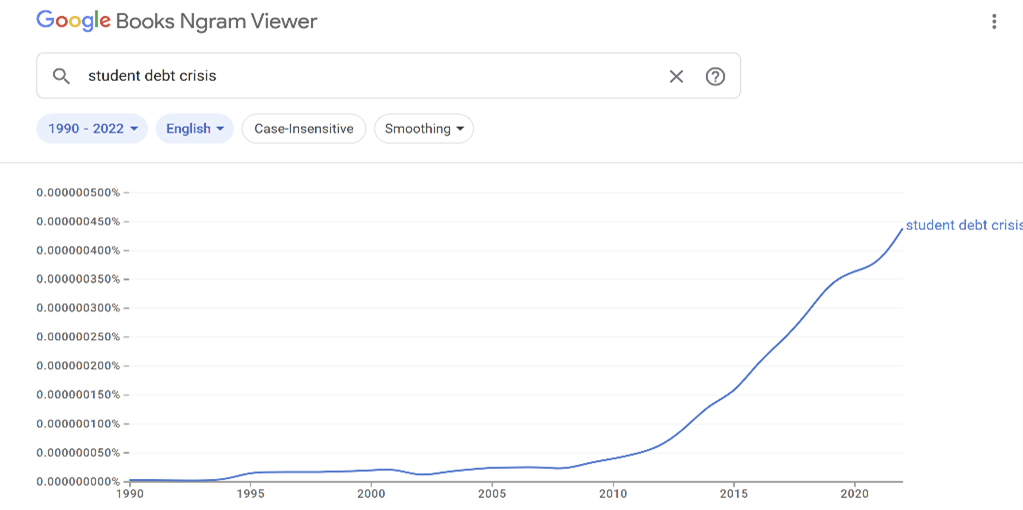
Google Ngram Showing Use of the Phrase “student debt crisis” Over Time
This shift in perspectives on debt enabled some immediate reforms. Previously overlooked corruption, fraud, and abuse perpetrated largely by for-profit colleges, servicers, education start-ups, accreditors, and even traditional colleges drew investigations and lawsuits.[114] Many of the most impactful lawsuits were brought by the offices of state attorneys general.[115] At the same time, in 2007, as the mortgage crisis was still unfolding, Congress passed the College Cost Reduction and Accessibility Act, which created the Public Service Loan Forgiveness (PSLF) program and the Income-Based Repayment (IBR) program. The former provided that borrowers who worked in public service jobs could have their debts canceled after ten years if they remained in good standing and dutifully submitted updates on their employment and payment status. The latter created a more borrower-friendly version of the underused and poorly implemented Income-Contingent Repayment (ICR) from the Clinton era,[116] which had also attempted to link borrowers’ monthly payments to their income. We refer to these types of programs generally as “income-linked repayment plans.”
When Barack Obama took office, the Department of Education created new income-linked repayment plans intended to improve both efficacy and appeal.[117] Congressional Democrats also attached the Student Aid and Fiscal Responsibility Act as a rider to health care legislation in 2010, formally making the Department of Education the only issuer of federal student loans.[118] That same year, Congress created the Consumer Financial Protection Bureau to combat the regulatory capture that had led to the financial crisis and included within it a Student Loan Ombudsman intended to aid borrowers and help address misconduct in student lending more systematically.[119]
Increasing disillusionment with debt generally and student debt in particular gave rise to social movements seeking deeper change. In 2011, new organizations formed, Student Debt Crisis and Occupy Wall Street, which in turn produced the Debt Collective. Both Student Debt Crisis and Occupy Wall Street called for free college for all through support of public institutions and cancellation of all existing student debt. Some states began to consider pay-as-you-earn programs and free community college.[120] In 2015, a sustained campaign from the Debt Collective (in which one of the authors participated) and ongoing pressure from Senator Elizabeth Warren led the Department of Education to begin to cancel the debts of thousands of students whom for-profit colleges had misled.[121] The Department undertook this elimination of debt obligations through application of a long-dormant “borrower defense” clause in the HEA; this was the first act of mass cancellation ever.[122] By his second term, President Obama was at least nominally in favor of making community college free.[123]
Throughout this period, research accumulated that challenged a simple narrative of student debt as a wise investment that was typically profitable.[124] Some scholars showed how common it was for students to incur student debt but then fail to earn sufficiently high incomes to repay the investment.[125] They found this outcome especially common for students who enrolled in the for-profit college sector, which combined low-value and even sham educations with high costs[126] and targeted relatively unsophisticated students from disadvantaged backgrounds.[127] Scholars found that similarly high-cost, low-value programs had also proliferated at more traditional schools, especially in highly career-focused master’s programs and online education programs.[128] An overlapping line of research highlighted how students that came from “non-traditional” backgrounds—students historically subordinated by class or race—were more likely to have difficulty finishing their education. Failure to finish led to debt burdens without degrees, no degrees meant no income boost, no income boost meant greater difficulty repaying loans, and repayment difficulty resulted in greater likelihood of default. This pattern meant that even relatively low debt burdens could prove catastrophic; low-balance borrowers were most likely to default.[129] When researchers paid closer attention to how the racial wealth gap impacted student loan borrowers, they found that even among students who obtained degrees, Black and Brown students had higher debt-income ratios, took longer to repay, and were more likely to default.[130]
This scholarship disaggregated the effects of student debt, interrogated its role in the reproduction of various forms of inequality, and complicated the standard narrative. Labor economists found that the premium earned by college graduates, though still sizeable, was smaller and declining for lower-income households.[131]
At the same time, shared ideas about the purpose of higher education had evolved: Students were paying for education in order to achieve financial benefits and greater socioeconomic security.[132] To the extent the federal government intervened to help with financing, this reflected the recognition that the wider spread of higher education could also benefit the national community as a whole.[133] In this paradigm, investment in human capital creates positive externalities: effects that extend beyond the individual student. However, the less obvious those communal benefits and the more entrenched the perception that education confers individual and personal gains, the more difficult the articulation of an alternative vision becomes and the more difficult it is to come up with a compelling justification of a policy reducing the burden of paying for higher education.
Then the pandemic struck and provided one.
B. The Pandemic and the Payment Pause
The pandemic affected everyone, and the federal government consequently came under extreme pressure to help everyone—even student loan borrowers. The unprecedented freeze on federal student loan payments came early in the public health crisis, announced by then-Secretary of Education Betsy DeVos on March 23, 2020. The suspension was not an inevitable policy response to the emergency; after all, the Trump administration had shown little sympathy for the burden of student loan debt since Trump’s election[134] and Trump himself had been critical of PSLF, which canceled repayment obligations for borrowers who worked in public service jobs for ten years.[135] In the early, chaotic days of the federal response to the pandemic, the needs of student loan borrowers could have gone unaddressed. The administration’s past disinterest perhaps explains why the initial response by the executive to the sudden shutdown of the national economy was suspension only of interest accumulation on federal student loans, announced by the president on March 13, 2020.[136]
Before the COVID-19 pandemic, the Department of Education had never implemented—and by all indications, never contemplated—a universal pause on interest accrual or payments. The Department had previously deferred payments for discrete groups of borrowers in light of smaller-scale disasters or in processing their claims for cancellation, but never had it suspended payment obligations altogether.[137] After the initial action suspending interest, some of the more left-leaning Democrats in Congress began agitating for a pause of student debt payments in the forthcoming COVID-19 relief bill.[138] The following week, apparently in an effort to forestall any more extreme action by the legislature, the Department asserted the unilateral authority—without initially specifying the source of that authority—to suspend all borrowers’ payment obligations for sixty days.[139] The week after that, in the Coronavirus Aid, Relief, and Economic Security (CARES) Act,[140] Congress enacted a total suspension of student loan payments for six months, lasting until the end of September.[141] In August, President Donald Trump directed Secretary DeVos to extend the suspension through the end of the year.[142] This action effectively extended the CARES Act payment pause for an additional three months. Then, in early December, the Department announced the extension of the pause through January 31, 2021, leaving the question of whether to restart it to the next president.[143] At the same time, the Trump administration eliminated the urgency of Congressional action to address student debt through legislation.[144] The next administration would ultimately extend the pause multiple times and it would last a total of three-and-a-half years.[145]
The pause had a major impact on borrowers’ household balance sheets. Beyond alleviation of the stressful obligation to repay, borrowers’ credit scores rose, and they took advantage of greater financial flexibility to make major investments, including investments that involved taking out new loans for cars and housing.[146] Borrowers affected by the pause were less likely to be delinquent on their student loans and enjoyed higher credit scores.[147] Qualitative studies corroborated these observations and provided additional context, finding that borrowers benefitting from the pause reported decreasing mental distress[148] and that they could increase savings[149] and reconsider major life decisions, such as family planning.[150]
Consistent with these findings, research focused on California borrowers found that while indicators of financial distress improved for all consumers in the state during the pause, student loan borrowers’ financial condition improved more, and the most distressed of those borrowers benefited most.[151] Last but by no means least is the finding, documented again by research focused on California, that during the payment pause, racialized gaps between White borrowers and Latine borrowers collapsed.[152] Prior to the pause, the average number of delinquent student loan borrowers in majority-Latine ZIP codes was significantly greater than the number of such borrowers in majority-White ZIP codes, but with the onset of the pause, the gaps almost entirely vanished.[153] The average dollar amounts in delinquent status followed the same pattern.[154]
Perhaps most importantly, the payment pause demonstrated that under the right circumstances, reforms more radical than anything previously regarded as politically feasible or fiscally responsible could be implemented. It also gave millions of people a taste of a world without monthly student loan payments—the rising credit scores; the newfound ability to afford houses, cars, and families; and the stress relief.[155] The pause reset the baseline from payment to nonpayment, making clear that collection was a political choice and therefore the decision to impose the burden of repayment of student debts needed justification. Research highlighting the harms of student debt, including its racially disparate effects,[156] and growing social movements mobilizing for its cancellation made it harder to justify. The insiders and lobbyists who previously dominated the politics of student debt found themselves on the defensive. The grant-and-tax paradigm offered a possible solution, justifying an increase in the public subsidy to students but effectively a higher tax rate—in the form of repayment obligations that varied with income—for recipients (borrowers) at the back end. The ex ante grant might be made in the form of a loan, but the variability of the repayment obligation made it the equivalent of a grant.
The altered politics of student debt were on display in the 2020 presidential campaign. During the Democratic primary, both Senator Sanders and Senator Warren promised to cancel student debt and make college more affordable.[157] Warren promised to use administrative authority to cancel $50,000 of student debt for each borrower “on day one of [her] presidency.”[158] Feeling the pressure, then-Vice President Biden made his own pledge to cancel student debt, though in a more limited and means-tested manner.[159] He did not explicitly commit to using administrative authority for this purpose, nor did he explicitly rule it out.[160] When Biden won the primary, both Sanders and Warren bargained for a role in shaping the Democratic platform, and when Biden won the presidency, they lobbied to shape Biden’s transition team. And they both used this leverage, in part, to push Biden to commit to canceling a larger amount of student debt, reforming the student loan system, and appointing reformers to the Department of Education. These moves set the stage for what could have been a transformative overhaul.
III. The Biden Reforms
When Biden took office, it was unclear how he would address student debt. He was focused on reopening after the COVID-19 emergency and, as part of that commitment, the administration appeared to take for granted the restarting of payments.[161] But political pressure to delay repayment and cancel debt grew as organized student debtors expanded their coalition to include organizations such as unions and the NAACP. Likely at the behest of lawmakers in the party’s left flank, Biden appointed reformers to many senior positions at the Department of Education.[162] These reformers lobbied internally for cancellation and sweeping reform.
Congress was unlikely to take on the issue, given thin Democratic majorities,[163] Republican obstructionism,[164] the limited ability to move centrist Democrats to embrace big changes,[165] and the administration’s other priorities,[166] all in the context of the pandemic. Legislative inaction put more pressure on Biden, who ultimately decided in favor of cancellation, while the Department of Education pursued other ideas for improving existing loan program operations, expanding repayment options, and promoting cancellation programs.
Officials at the Department reviewed existing statutory authorities to remedy past failures, reduce administrative burdens and the risk of graft, and alleviate payment burdens for those in the most financially precarious condition. In the absence of congressional action, the scope of their efforts had to be limited to what they understood (or could plausibly argue) existing law permitted. Through a series of rulemakings, enforcement actions, guidance documents, administrative reshufflings, and contract alterations, the reformers at the agency attempted to convert the student loan system into something as user-friendly and affordable as practicable under the HEA. Had the Department’s proposals been carried out to their fullest extent, they would have resulted in cancellation of additional hundreds of billions of dollars of debt,[167] consolidation and rationalization of the servicing regime,[168] automatic enrollment in income-based repayment plans that would have lowered overall payment burdens mostly by reducing monthly obligations for borrowers at the lower end of the income spectrum,[169] a functioning PSLF program,[170] and greater accountability for for-profit trade schools that bilk their students and manipulate the student loan system for profit.[171]
The Biden administration officials decided not to attempt to move reforms through a narrowly divided Congress through which it already was attempting to advance many other bills. That meant they had to work with and within the system that they inherited, benefiting from the opportunity to implement changes during the payment suspension but hampered by the inability to address internal flaws and regressive effects. They could not implement, for example, a program that directly provided grant aid instead of loans, nor could they make the suspension of payment obligations permanent. But they could take existing features of federal student aid and push them to their limits: canceling more debt over time for borrowers in repayment and using previously uncontroversial power to design more generous repayment plans, both consistent with making federal programs economically consistent with a grant-and-tax regime.
The Biden administration implemented three broad types of reforms. First, the administration attempted to correct past failures in program administration, implementing one-time “account adjustments” that made debt cancellation more widely available and creating new cancellation programs.
Second, the administration sought to create a more efficient and equitable collection system by moving as close as possible to universalizing income-linked repayment and making such a plan as easy to access as possible. In this way, monthly payments functionally constituted a surtax on borrowers, with higher payments for those whose earnings were greater. Enrollment in an income-linked repayment plan was to be closer to automatic, with payments calculated automatically.
Finally, the Department undertook reforms to the administration of the collection system itself, including duties entrusted to servicers, in order to make the other reforms possible to implement effectively.
Each of these forms was a step toward creating a regime that approximated a grant-and-tax system as much as possible under governing law. From this perspective, the adjustment to a more universal and progressively structured income-driven repayment structure was the core change. Correction for past-program implementation supplemented this shift by removing unduly burdensome debt loads that would not have been accumulated under a reformed system. Canceling debt was part in service of this goal and part in service of re-legitimating a system in order to encourage repayment moving forward. And reforms to program administration were simply necessary to make it work in practice rather than only in theory.
A. Remedying Past Wrongs
The Department under Biden attempted to make it easier for borrowers to have their debts reduced or canceled under specific circumstances contemplated by the HEA that historically had been difficult for borrowers to establish. The “borrower defense” provision of the law permits cancellation of the debts of students who attended and were deceived by a predatory provider of higher education.[172]
Predatory providers of higher education are institutions that engage in aggressive and misrepresentative recruitment conduct and provide students with a low-quality education. Borrowers who had taken on debt to attend such schools, usually operated for-profit, were among the loudest critics of federal student aid programs. Often, they had paid enormous amounts of money for low-quality educations that left them worse off than when they started.[173] A wave of state and federal enforcement actions against for-profit colleges followed the mortgage crisis.[174] During the Obama administration, debtors affected by these schools organized a debt strike and, pointing to the many lawsuits working their way through the courts, flooded the Department of Education with applications to have their debts canceled pursuant to the borrower defense term of the HEA.[175] That provision had rarely been used and the Obama administration was quickly overwhelmed.[176] The Department appointed Joseph Smith, who had managed the national mortgage settlement after the financial crisis,[177] to manage borrowers’ applications for relief it received. The Department also drafted regulations establishing a more formal process to manage future applications.[178] Meanwhile, it made several underpowered efforts to impose quality standards and accountability on for-profit colleges.[179] The Obama-era Department took these steps toward developing a full procedure, hoping it would be completed during a Hillary Clinton administration. After Trump, who had himself run an online for-profit school, won the 2016 election, his political appointees quickly undid as many of these reforms as they could.[180] Under Trump, the Department of Education succeeded in stymying borrower defense regulations and processes, making relief much more difficult to obtain and making it much harder to hold deceptive schools accountable.[181]
When Biden appointees, some of whom had worked as advocates for for-profit college students, took over four years later, they got to work restoring what the Trump administration had undone. The Department began writing new regulations that created an even more borrower-friendly process than the Obama-era Department.[182] Again, the rules constituted an “improvement[]” to prior versions that had hindered borrowers by imposing “unnecessary or unfair burdens.”[183] They created broad standards for wrongful conduct that could give rise to a discharge: adopting an expansive definition of “misrepresentation” while separately prohibiting “aggressive” recruitment tactics such as preventing a student from consulting with a family member or creating a false impression of a rush to enroll.[184] They created a process for applying for cancellation on these grounds, allowing group-based discharges based on evidence of deceptive conduct that had affected multiple borrowers. Borrowers did not have to establish that the deception was intentional. And the Department created a more detailed process for recoupment of the amount of canceled debt from schools that had engaged in deceptive misconduct, while also providing a procedure for schools to dispute the findings and present additional evidence. The Department followed up the rules with a new website for borrowers, intended to simplify and speed the process of obtaining relief through discharge of indebtedness.[185]
As the Department promulgated these rules, it also developed a system to process backlogged applications for relief and to investigate potential grounds for providing relief without requiring an application.[186] Over the course of the Biden administration, the Department canceled over $5 billion of debt owed by 208,000 former ITT Tech students,[187] nearly $6 billion of debt owed by 560,000 former Corinthian Colleges students,[188] $6 billion of debt owed by 317,000 former Art Institutes students,[189] and tens of millions of dollars of debt owed by students of other for-profit colleges, such as University of Phoenix and Ashford University.[190] According to the Biden administration’s count, the total amount canceled under borrower defense reached $22.5 billion by the end of its term.[191] In an attempt to protect future students from similar misconduct, the Department also tightened “gainful employment” standards that require such schools to prove that their graduates can pay their debts and have benefited from their educations through increased earnings.[192]
B. Payment Count Adjustment
To address the effects of other program features that had hindered access to existing debt relief programs, the Department temporarily adjusted how borrowers’ monthly payments were calculated. This one-time “adjustment” mattered for borrowers eligible for cancellation under the PSLF program because eligibility required ten years of payments.[193] An incomplete record of payments or the failure to include some payments in the count resulted in denial of relief.[194] If the Department did not properly record borrower payments or failed to note that a borrower on an income-linked repayment plan had a payment obligation of zero as a result of having a low income, then that borrower might not qualify for cancellation of outstanding loans despite being eligible. The account adjustment, announced by the Department in April 2022, included a review of the payment records of student loan borrowers who were on an income-linked repayment plan or could have been on such a plan, and counted any payments by those borrowers toward the 120 payments necessary to receive cancellation under PSLF.[195] The one-time review was intended to benefit both borrowers enrolled on income-linked repayment plans and those working in PSLF-eligible jobs.
The account review and adjustment addressed two logistical failings of federal student aid programs. First, as the Department explicitly recognized,[196] the servicers that contracted with the Department to manage its portfolio of federal student loans had not in fact accurately tracked borrowers’ payments. But second, more fundamentally, and only implicitly, by providing relief to borrowers who could have taken advantage of income-linked repayment plans but did not, the Department acknowledged the burden of program complexity and the inadequacy of efforts to inform borrowers of the flexible repayment options available to them.[197] Complexity, a clear obstacle to wider borrower use of income-linked repayment plans, resulted from the difficulty of navigating multiple options: Borrowers had to choose among several different repayment plans[198] with diverse terms tying monthly payments to income. Borrowers had to assess which plan was most favorable to them in light of their financial circumstances, a judgment which might change as new plans were added and amended. The account review aimed to reduce the complexity and uncertainty that undermined existing repayment plans. It would also shift the task of determining whether a borrower could be placed on a more favorable repayment plan and possibly receive a degree of debt relief to the Department.
When the Department offered a “fresh start” to borrowers who had been delinquent or had defaulted on loans prior to the pandemic payment pause, the agency implicitly recognized the harm borrowers suffered as a result of errors and potential misconduct by services. This fresh start initiative, announced without much fanfare in April 2022, allowed borrowers whose loans were delinquent or in default to reenter payment in good standing.[199] Of course, implementation of the fresh start still depended on the infrastructure of student lending, as discussed in more detail below.[200]
C. Reforming the Public Service Loan Forgiveness Program
Another corrective and transitional effort undertaken by the Department early in the Biden administration expanded eligibility for debt relief under the much criticized[201] PSLF program. The program was notoriously troubled, providing statutorily promised debt relief to a tiny share of potentially eligible borrowers, according to reviews by the Government Accountability Office[202] and Consumer Financial Protection Bureau,[203] and was consequently subject to withering criticism in the news media.[204] Because of the opposition to PSLF from the Trump administration, which proposed eliminating the program for new borrowers beginning after June 2018,[205] the Biden team had a chance to emphasize a difference in values and approach just months after taking office.[206] This was not the broad debt relief that had been bandied about on the campaign trail,[207] but the new administration, through PSLF overhaul, could signal to an important constituency, young people generally and college students in particular, its commitment simultaneously to meeting borrowers’ needs, honoring the government’s promises, and supporting public service. The PSLF program is a symbol of progressive idealism, representing collective commitment to recognizing and supporting those who help our communities—a sentiment that President Biden expressed repeatedly on the campaign trail.[208]
Substantively, the overhaul of PSLF—described as a “limited waiver” by the Department—had a few significant elements. Eligibility for debt relief under the program required that a borrower make payments over ten years toward their choice of qualifying payment plan; however, many borrowers misunderstood the implications of their chosen payment plan. To make PSLF relief more accessible, the waiver permitted borrowers to count payments on any payment plan toward meeting that ten-year requirement, so long as they applied by October 31, 2022.[209] Additionally, eligibility required that a borrower have taken out a particular kind of loan: a direct loan provided by the Department, or a consolidation loan that combined multiple loans, whether direct or FFEL.[210] Again, for a limited time, the Department’s waiver allowed all payments made on a federal student loan to count as a qualifying payment, even if the borrower had been paying down a federal loan made by a third party.[211] Even if an application had been previously denied, the Department committed to review it for eligibility.[212]
Although these fixes addressed flaws in the PSLF program that predated the pandemic, the Department emphasized in its publicity materials that the health emergency placed a tremendous strain on many people working in public service. “Many public servants have been on the front lines of the pandemic, making personal sacrifices to keep the rest of us safe,” read a press release; “Frontline sectors like teaching and healthcare are already seeing burnout and employee shortages.”[213] However, relief was provided to borrowers only for a limited time, presumably because relief that had been improperly denied in the past would be more readily available in the future. The time limit also created the risk that some borrowers who could benefit from different aspects of the relief provided might miss the chance.
D. Mass Cancellation: The Biden Jubilee
The Biden administration’s response to broad demands for a general cancellation of debt, rather than through specific programs, was a one-time, grand affair that immediately came under partisan attack. To facilitate transition to a more progressive student loan system, the Biden administration undertook several actions to make most borrowers’ obligations more manageable and correct past failures of lending program implementation and design. After the Supreme Court struck down their mass cancellation initiative, the two reforms put forth by the administration served those functions (in addition to being part of reforms that would make such cancellation more regular, if lower volume, moving forward). These were (1) the loan cancellation produced by the processing of borrower defense applications and (2) the planned cancellation produced by the first round of gap-filling waivers under the rubric of “Plan B.” And others would follow.
The relief initiative with the highest profile provided for the mass cancellation of between $10,000 and $20,000 of student debt per borrower. In public discourse, this plan was mostly discussed as if it were a cash transfer. Pundits hotly debated whether it was a “progressive” transfer in some sense,[214] with some focusing on whether it was fair to those who paid off their loans, those who scrimped and saved to avoid debt, or even to those who chose not to pursue higher education at all.[215] Political insiders also debated these questions, as well as others on the potential legal authority for such executive action. The Biden administration initially hesitated to cancel large amounts of student debt.[216] Eventually, “Biden gave in to pressure” and enacted the Jubilee.[217]
The proposed cancellation included different forms of targeted relief. For borrowers who earned less than $125,000 in annual income, the initiative eliminated $10,000 of indebtedness; borrowers who had received federal Pell grants, awarded to the neediest undergraduate students, were eligible for as much as $10,000 in additional cancellation.[218] The initiative also included adjustments to repayment obligations, limiting payments to 5 percent of a borrower’s discretionary income and effectively reducing discretionary income by increasing the category of nondiscretionary income.[219] And in a nod to the burden of student debt for relatively low-balance, low-income borrowers, the initiative would cancel the remaining obligation of borrowers who had borrowed less than $12,000 and made payments for ten years.[220] The Democratic Party did not unite behind the administration, which facilitated criticism of the administration’s tactics and motives. Later, in the opinion that shut down this mass cancellation effort, the Supreme Court’s conservative majority quoted an expression of doubt about mass cancellation made by the Democratic Speaker of the House, Nancy Pelosi.[221]
Formally, the Biden Jubilee was a means of transitioning borrowers who had spent years in a form of financial purgatory back into repayment. With the end of the payment pause looming, the Department reasoned that because “many borrowers [would] be at heightened risk of loan delinquency and default” after the end of the payment pause, and that the harm “could offset the benefits provided by the pause and leave borrowers worse off than they were before the pandemic,” it was appropriate to write down a significant amount of debt for borrowers at highest risk of default.[222] In coming to this conclusion, the Department adduced evidence that defaults spike when payments restart after a pause, and the most vulnerable to default are those with smaller loan balances and lower incomes.[223] It reasoned that lowering or eliminating monthly payment obligations at the same time as restarting payments would mitigate that risk.
It is hard to imagine political calculations did not also play an important role in the Biden Jubilee. These rationales align with a hallmark function of a one-time act of debt cancellation: It makes repayment easier moving forward for those with debt remaining. Moreover, it might also increase the legitimacy of the current system by making it seem, at least momentarily, more humane and responsive, which might encourage repayment and reduce the pressure for further reforms. More importantly, a one-time act of cancellation can serve as a rough-and-ready remedy for those struggling with repayment; for example, if they were manipulated by servicers, placed into the wrong payment plans, made mistakes that would not have been as consequential in a more progressive and flexible system, and so on.
The Department estimated at the time that if all eligible borrowers took advantage of the potentially available loan cancellation and other programs discussed below, forty-three million people would experience some benefit.[224] The debt owed by a significant share, consisting of approximately twenty million people, would be eliminated. Also, racial disparities in debt burdens would decline because Black borrowers were more likely to have received Pell grants, more likely to have borrowed to pay for higher education, and more likely to carry higher loan balances.[225]
The Department’s lawyers found authority for this broad cancellation in a provision of the Higher Education Relief Opportunities for Students Act of 2003, better known as the HEROES Act, which allows the Department to “waive or modify” provisions of the federal student aid program in a time of emergency.[226] Within weeks of the announcement of mass cancellation and this legal rationale, state attorneys general of six Republican-led states filed lawsuits challenging the authority of the executive branch to provide this debt relief. As discussed in more detail below, this litigation resulted in an injunction prohibiting cancellation, ultimately affirmed by the Supreme Court in Biden v. Nebraska.[227]
After the adverse decision by the Court, the Biden administration announced a “Plan B” to cancel large amounts of student debt based on other statutory authority. This announcement and the surrounding public relations campaign attempted, in part, to rebrand cancellation that was otherwise provided, such as that benefitting defrauded for-profit college students under borrower defense rules. But, as discussed above, Plan B also included the regulations that expanded availability of cancellation under circumstances not contemplated by other reforms.[228] Once it finalized the first part of these regulations, the Biden administration announced it would begin to automatically process as many eligible borrowers as possible, unless they affirmatively opted out.[229] Because many borrowers would qualify for relief, this process would result in a wave of cancellation, even if a significantly smaller benefit than the original mass cancellation would have provided. It would thus have a corrective and transitional effect similar to that of the stymied Jubilee.
E. Universalizing and Automating Income-Linked Repayment: SAVE
Perhaps the most important reforms undertaken by the Department of Education under the Biden administration were those aimed at correcting flaws in existing programs and providing new options to make management and repayment of student loans easier for borrowers. These improvements, which would have made it possible for existing aid initiatives to work as intended, were not as splashy or controversial as mass cancellation of indebtedness, but they affected more students, were more firmly in line with previous reform initiatives, and relied on statutory interpretations that had previously been uncontroversial.
The central plank of this restructuring was the “Saving on A Valuable Education,” or SAVE plan.[230] SAVE was an effort both to bring order to the confusing assortment of income-linked repayment plans and to make their terms more progressive by making repayment easier for those who have the most difficulty paying. This included reducing the number of steps needed to be placed in an income-linked plan and aiming to make enrollment in an income-linked plan close to automatic, while making payment close to automatic as well.[231]
As discussed briefly above, in 1993 Congress authorized the Department to create an income-contingent repayment plan for loans made under the then-new Direct Loan program, under which the Department was the lender. This ICR plan provided for “varying annual repayment amounts based on the income of the borrower, paid over an extended period of time prescribed by the Secretary, not to exceed twenty-five years.”[232] In 2008, Congress created an additional income-based repayment (IBR) plan for borrowers whose standard repayment plan had them paying more than 15 percent of their gross income above 150 percent of the poverty line.[233] Four years later, lawmakers made the terms more generous for loans issued after 2014, capping payments at 10 percent of adjusted gross income and limiting the repayment period to twenty years rather than twenty-five.[234] The Department then used its authority under ICR (i.e., the first income-linked repayment plan) to create yet another repayment plan, dubbed “Pay As You Earn” (PAYE), which made the terms of the more generous 2014 IBR plan available to all borrowers who took out loans after 2007.[235] The Department added a REPAYE plan in 2015, extending those terms to all borrowers who had taken out direct loans regardless of the year they were taken out.[236]
Both the PAYE and REPAYE income-linked plans relied on the direction by Congress that the Department design a plan with “annual repayment amounts based on the income of the borrower, paid over an extended period of time prescribed by the Secretary, not to exceed 25 years” in the original ICR statute.[237] The Biden administration drew on the same language to create SAVE. Formally, the Department amended the terms of REPAYE, the most generous of the prior plans, to apply to more borrowers and to be yet more progressive.[238] SAVE reduced the share of a borrower’s income used to calculate a monthly payment on undergraduate loans[239] to 5 percent (from 10 percent) and increased the amount of income exempted from this calculation to 225 percent of the federal poverty guideline (from 150 percent).[240] That meant that borrowers making less than 225 percent of the federal poverty line could have paid nothing and still received credit for repaying their debt so long as they were enrolled in the program. The regulation also eliminated interest accrual or capitalization on SAVE plans if the borrower’s calculated payment amount failed to cover interest.[241] And, for undergraduate loans, it provided for cancellation of outstanding principal after a certain period of repayment: 120 months for borrowers with loans with original principal less than $12,000 “plus an additional 12 monthly payments or the equivalent over a period of at least 1 year for every $1,000” by which the original principal exceeds $12,000, up to a maximum of 240 months.[242]
For most borrowers—and certainly for low-income and low-balance borrowers—SAVE was easily the most sensible repayment plan. Still, regulations left the other income-linked payment plans, including IBR (which was called for by statute) and PAYE, in place to allow borrowers to switch to those plans if they preferred.[243] The regulations also simplified the enrollment process by allowing a borrower to authorize the Internal Revenue Service to share information on the borrower’s earnings with the Department directly and by allowing the Department to enroll borrowers automatically in the plan that produced the most affordable monthly payments.[244] A borrower in delinquency or default who had made such an authorization would have automatically been pulled out of default and placed in the SAVE plan.[245] This feature meant that a borrower’s eligibility for any repayment plan’s monthly payment amount (and for PSLF) could be automatic, eliminating the need for a borrower to reenroll annually.[246] The lack of such an automatic system in combination with borrowers’ lack of understanding of or negligence in meeting program requirements was one reason that, for years, borrowers did not receive debt relief that they were otherwise eligible to receive.[247]
The SAVE repayment plan was an effort to make repayment of student debt easier in multiple senses. While plenty of borrowers would fail to qualify for an income driven repayment plan (IDR) due to high income, default status, failure to combine distinct types of loans, or lack of awareness of how repayment plans work, the SAVE plan aimed to make income-linked repayment close to universal. A standard repayment plan, requiring fixed, monthly payments for precise term of years, only applied to higher-income borrowers. According to the Department’s estimates, approximately twenty million borrowers (around half) would qualify for SAVE, resulting in a reduction of 40 percent in total payments. Most of that benefit would go to lower-income borrowers.[248]
F. Plugging Gaps: Unjustifiable Hardship Regulations
Taken together, the expansion of income-linked repayment plans and implementation of borrower defense regulations were designed to reduce or eliminate payment burdens for the most vulnerable borrowers. But each left gaps in coverage and, as discussed further below, hiccups in implementation could prevent some borrowers who qualified for relief from receiving it. With these limits in mind, the Department under the Biden administration also wrote regulations creating standards and procedures through which it could independently determine whether a borrower was facing an unjustifiable hardship and write down at least some of that borrower’s debts.
These regulations relied on an interpretation of the Secretary of Education’s discretionary “settlement authority” to waive obligations to the Department[249] to cancel at least some student debt after the Supreme Court struck down the Biden administration’s mass cancellation initiative.[250] Most of the public discussion of these rules focused on the degree to which they—on their own or in combination with other cancellation programs such as the borrower defense actions—enabled the Department to give a degree of relief to borrowers comparable to what mass cancellation would have provided. And, indeed, the Department was planning to use these regulations to implement cancellation in the short term.[251] But, the potential impact would have been greater than a one-time cancellation.
As proposed, the regulations would have clarified that a borrower was eligible for a waiver under a few nonexclusive circumstances.[252] If a borrower’s current balance exceeded the balance carried when beginning repayment, and the borrower met income requirements (earning less than $120,000 annually if filing as single), they would have been eligible to have the excess above the original balance canceled.[253] If a borrower had had a loan for more than twenty or twenty-five years (depending on the type of loan), they would have been eligible to have the balance canceled.[254] And if a borrower would have qualified for cancellation under another program—including an income-linked plan, borrower defense, and others—but failed to take advantage of that cancellation for whatever reason, the Secretary could have canceled their loans.[255] In addition, before Trump’s election made clear that they would not be implemented, the Department was preparing separate regulations for cancellation under conditions indicating financial hardship.[256]
Each of these sets of rules would have enabled the Department to cancel debts of borrowers struggling with repayment and who, for one reason or another, had failed to obtain relief under another program. The rules set the criteria and defined a procedure that was meant to last indefinitely, providing relief for future borrowers rather than a one-time adjustment benefitting only current borrowers.
G. Reforming Program Administration and Loan Servicing
Each of the reform initiatives described above were implemented through the existing institutions that manage student loan collection, which are notoriously bad at implementing reforms. The most important wrench was thrown into the works by servicers, the companies that contract with the Department to “send out billing invoices; maintain account balances; provide borrowers with information regarding forbearance, deferment, and repayment plans; and process borrower elections of those options.”[257] Brooks and Levitin have explained that “because servicers are the point of communication and contact for borrowers, they are the node through which borrowers’ rights . . . are effectuated (or not). This makes servicing of utmost importance in the operation of the Direct Loan system” and attempts to reform it.[258]
To review the basic dynamic: the Department pays fixed, per-borrower fees with bonuses for keeping borrowers out of delinquency but does not pay bonuses for increased payments.[259] Because it is more costly to work with individual borrowers to determine the best repayment plan than the per-borrower fee that could be earned from doing so, servicers tend to understaff and create longer wait times at their borrower-facing offices. They instead develop automated processes that direct borrowers into forbearance to keep them out of default rather than help them find the most manageable, long-term repayment option.[260] But forbearance, briefly described above, is not a great option for borrowers because interest continues to accrue on borrowers’ debts,[261] and payments may not count toward any eventual cancellation under an income-linked plan or under PSLF.[262] The Department had long failed to police servicers’ steering behavior and has even incentivized this behavior by developing formulas for future contracts that reward servicers for reducing defaults, even when achieved by pushing borrowers into forbearance.[263]
Officials in the Department (with help from officials at the Consumer Financial Protection Bureau) could see that if the student loan system was to function once repayment started, and if all of the aid program reforms were to succeed, reforms that had run aground previously had to move forward. Biden appointed Richard Cordray, the first director of the Consumer Financial Protection Bureau, as chief operating officer of the Office of Federal Student Aid (FSA) with a brief to bring order to the servicing system.[264]
Under Cordray, the Department planned to implement a unified system that would consolidate servicers and subject them to stricter supervision. All borrowers, regardless of servicer, would manage their loans through the same website. In May 2022, the Department announced this Unified Servicing and Data Solution (USDS) and solicited bids to develop it as the “Next Generation” of servicing.[265] A significant element of the plan was the establishment of benchmarks to ensure accountability for poor performance.[266] Under USDS, servicers would have to maintain core call center hours, submit to certain types of lawsuits rather than assert the shield of derivative sovereign immunity, and comply with more fine-grained reporting requirements.[267] To correct the poor incentives for servicers, the Office of Federal Student Aid would begin to apply new metrics to determine how to allocate loans among them.[268] The overhaul, which the Department estimated would take place over five years, promised to significantly improve borrower satisfaction by reducing the scope of servicer errors that could be costly to them.[269] Of course, that promise depended on successful implementation.
IV. The Inevitable Failure of the Biden Reforms
The Biden Reforms canceled the debt obligations of more than five million borrowers by correcting badly implemented relief programs,[270] yet they failed to achieve their broader intended goals. Courts enjoined the most consequential elements of the reform effort by applying an increasingly anti-administrative jurisprudence produced by the conservative justices on the Supreme Court. Narrow judicial interpretations of the most flexible provisions of the HEA made it impossible to ease payment burdens and difficult to improve the administration of lending and collection. The incoming second Trump administration, in any event, attempted to freeze or roll back remaining reforms, and Republicans in Congress successfully enacted legislation that moved federal student aid backward in time to a less generous and more punitive state.
Even without increasingly partisan courts and a hostile administration, these reforms could at best have been partially implemented due to the problems with the student loan servicing apparatus. Implementing affordability would have required a servicing system that in the past had been plagued with fraud and incompetence to suddenly become highly effective. All available evidence indicates that, despite the efforts of the Biden administration, a servicing renaissance was not on the horizon. Further, servicers and others whose profits depended on student debt would likely have mobilized to oppose meaningful reforms as they opposed them in the past.
Each of these obstacles to successful reform illustrates the impracticability of imposing a logic of affordability on a system that is poorly built to achieve that goal. The ambiguous language of the HEA made the legality of most of the reforms contestable—a problem when defending them before courts on a mission to resolve ambiguities against executive agencies. And the weaknesses of the servicing system combined with the difficulty of transition made reconstructing the system in the image of borrower-friendliness a nigh-impossible task.
In this Part, we examine the external challenges to the Biden Reforms, as well as the consequences of structural flaws in federal student aid, which are in tension with its mission.
A. External Challenges
Most of the Biden Reforms foundered in federal court as a result of lawsuits brought by Republican attorneys general before conservative judges (or centrist judges following the decisions of conservative judges) who remade standing doctrine and reconsidered interpretive principles to rule against the Department. Surviving reforms have faced the buzzsaw of a vengeful Trump administration, which has also floated the idea of closing down the Department altogether, and termination through federal legislation passed by an emboldened conservative majority.
1. Litigation
Nearly every effort at reforming the student loan system encountered challenges in court by a coalition of Republican state attorneys general, conservative impact litigation firms, or both. These suits confronted the preliminary barrier of establishing standing to sue. They had to show that they had suffered an injury from the Biden initiatives, and this was not obvious. In Biden v. Nebraska, the state of Missouri established a viable theory of standing based on its relationship to a state-created loan servicing entity, Missouri Higher Education Loan Authority (MOHELA). The surviving litigation has been largely successful at staying or enjoining new regulations. Before increasingly conservative courts confident in the position that any action of any significance by an administrative agency may be presumed unlawful,[271] these plaintiffs have largely prevailed on arguments that even broad grants of authority by Congress do not license the Department’s actions.
The most prominent and ultimately successful challenge concerned the mass cancellation program, which was the subject of Biden v. Nebraska. That program, discussed above, was enacted under the authority of the HEROES Act, which authorizes the Secretary to “waive or modify any statutory or regulatory provision applicable to the student financial assistance programs under title IV of the [HEA, which includes student loans] as the Secretary deems necessary in connection with a war or other military operation or national emergency” in order to “ensure that,” among other things, “recipients of [such] financial assistance . . . who are [affected by the emergency] are not placed in a worse position financially in relation to that financial assistance because of their status as affected individuals.”[272] This was the same legal authority that both the Trump and Biden administrations had invoked repeatedly to implement the payment pause.[273] To justify reliance on the HEROES Act, the Department of Education under Trump reasoned that the COVID-19 pandemic had caused the President to declare a “national emergency”[274] and that everybody in the United States was affected.[275] That emergency made it more difficult to repay loans, which justified freezing payment obligations by waiving Department regulations requiring payment and interest accrual and modifying the CARES Act to extend after its expiration date.[276] As described above, the Biden administration extended this logic, concluding that preventing borrowers from being made worse off by the pandemic required writing down debt to avoid the surge in defaults that often comes with a return to repayment.[277]
The six conservative Justices on the Supreme Court rejected that reasoning.[278] Chief Justice Roberts’s majority opinion, which did not mention any form of administrative deference, read the phrase “waive or modify” narrowly to prevent it from being used to change payment obligations under any circumstances:
The Secretary’s comprehensive debt cancellation plan cannot fairly be called a waiver—it not only nullifies existing provisions, but augments and expands them dramatically. It cannot be a mere modification because it constitutes “effectively the introduction of a whole new regime.” And it cannot be some combination of the two, because when the Secretary seeks to add to existing law, the fact that he has “waived” certain provisions does not give him a free pass to avoid the limits inherent in the power to “modify.”[279]
The opinion also made use of and expanded the Court’s “major questions doctrine,” concluding that if Congress had intended to grant such sweeping authority to the Department, lawmakers would have used more specific language.[280]
A series of lower-profile suits followed. Some failed, mostly on jurisdictional grounds. For example, a coalition of conservative nonprofits did not have standing to challenge the PSLF account adjustment on constitutional, statutory, or Administrative Procedure Act (APA) grounds.[281] Other challenges were more successful. A trade association of for-profit colleges obtained an injunction against the updated Borrower Defense regulations[282] from a Fifth Circuit appellate panel.[283] In justifying the injunction, Judge Jones’s opinion for the court expressed contemptuous skepticism about nearly every aspect of the regulations, even suggesting that the rules were “of a piece with the Executive Branch’s larger goal to sidestep, to the greatest extent possible, the Supreme Court decision holding Presidential student loan discharges illegal in Biden v. Nebraska,”[284] despite the fact that the rules were the latest iteration of nearly a decade of reform efforts in the sector. Among other things, the opinion questioned the very possibility of using the statutory Borrower Defense authority to develop a process by which borrowers could affirmatively challenge their payment obligations on the basis of school misconduct.[285] The implication of such reasoning is that, even if there were clear evidence that a higher education provider was entirely fraudulent, the Department would be compelled to collect on any defrauded students’ debt unless and until those students defaulted, initiating some sort of coercive collection proceedings in which a defense could be asserted. This decision was appealed to the Supreme Court but voluntarily dismissed with the change of administration.[286] Further regulatory change in the second Trump administration has rendered it outdated, but it remains to be seen how much of its reasoning might survive in future contestations over efforts at getting relief to students defrauded by for-profit colleges.[287]
The centerpiece of the effort to transition to a grant-and-tax-like model, the income-linked repayment plan known as SAVE,[288] has similarly foundered in courts. On June 24, 2024, two separate district courts—ruling on suits brought by two separate groups of Republican attorneys general—preliminarily enjoined components of the plan. One of those rulings was affirmed by the Eighth Circuit, and the Trump administration agreed to end the SAVE program before appellate decision on the other.[289]
Judge John Ross, an Obama appointee sitting in the Eastern District of Missouri, found that, although the adjusted payment amounts were clearly lawful, cancellation under the newer repayment plans was “questionable” under the major questions doctrine.[290] The portion of the HEA creating one income-linked repayment plan, ICR, did not explicitly provide for cancellation, so, the judge reasoned, Congress did not express clear intent to delegate cancellation authority.[291] Relying on Biden v. Nebraska, he went on to note that other provisions of the HEA do explicitly provide for cancellation, and thus, “Congress has made it clear under what circumstances loan forgiveness is permitted, and the ICR plan is not one of those circumstances.”[292] According to Judge Ross, because the text is “clear,” it does not matter that the Department has used the ICR authority to authorize cancellation for years with no reaction from Congress.
Judge Daniel Crabtree, an Obama appointee in the District of Kansas, went further, finding the entire SAVE plan likely unlawful.[293] He reasoned that, even though the Department “mustered a plausible construction suggesting that Congress conferred” the authority to create the SAVE plan, the major questions doctrine and Biden v. Nebraska require more: a “clear showing of such authority.”[294] And though nothing in the SAVE plan contradicts the language of the statute, Judge Crabtree reasoned, the fact that it provides for payments smaller than those Congress had previously set and allows for cancellation of some debts in less time than Congress ever had means that any grant of authority is at best unclear.[295] The two decisions made clear just how difficult it would be for the administration to act independently to address student debt burdens.
Both decisions were appealed. A three-judge panel of the Eighth Circuit that featured two Trump appointees and one George W. Bush appointee summarily affirmed Judge Ross’s ruling, granting an administrative stay and injunction pending appeal that was even broader than Ross’s in scope, apparently stopping implementation of all loan cancellation under any ICR plan and halting all other implementation of SAVE’s modifications to prior income-linked plans.[296] The Supreme Court denied the government’s petition to vacate, and the Tenth Circuit affirmed the preliminary injunction and remanded it for expansion.[297] In the Tenth Circuit, matters moved more slowly.[298] Ultimately, the Trump administration settled with the Republican attorneys general, agreeing to phase out the SAVE plan and follow new legislation discussed below.[299]
In addition to striking down the most prominent effort at loan cancellation, Biden v. Nebraska has also changed doctrine and the spirit surrounding doctrine[300] sufficiently to call into question most of the important reforms implemented by the Biden administration. Because each of these reforms relies on borrower-friendly interpretations of statutes that have previously been interpreted more narrowly, they are vulnerable to the anti-novelty and cost-sensitive logics of the major questions doctrine and related interpretive moves.[301]
Still, some lower-profile reforms—the one-time payment adjustment, for instance—survived, and at least elements of others may as well. While the litigation was pending, the Department announced that all borrowers who enrolled or will enroll in SAVE will be granted interest-free administrative forbearance until the legal issues could be sorted out.[302] However, the reversal of course in the litigation by the Trump administration and other changes discussed below mean that most of the potential benefits of the reforms will not be realized.
2. The Change in Administration
Because the Biden Reforms relied on executive authority to promulgate rules that implemented existing and unchanging federal law, they were vulnerable to modification or outright reversal by a new executive.[303] Unsurprisingly, the second Trump administration seized the opportunity to undo what the Biden administration had done.
Even before Trump could take office and appoint new leadership at the Department, the effect of the election made itself felt. Biden’s outgoing appointees withdrew the proposed regulations that would have formed the basis for a ‘Plan B’ jubilee as well as the basis for a more regularized gap-filling cancellation authority.[304] They did so because they anticipated that either their replacements would not allow these regulations to go into effect before they were finalized or Congress would invoke the CRA to repeal them.[305]
Once Trump appointed the professional wrestling executive Linda McMahon as Secretary of Education, these expectations were borne out. The Department ceased to defend the SAVE plan, reaching a settlement with attorneys general in December 2025.[306] The Department has also attempted to slow or cease granting borrower defense claims, although a district court supervising a settlement between it and a class of borrowers has partially thwarted these attempts.[307] And it has proposed amendments to the regulations implementing PSLF to restrict eligibility for purportedly “illegal” work that, in many cases, may prove to be just the work of progressive organizations that have agendas disliked by the administration.[308] Biden appointees withdrew other efforts to relieve borrowers, such as proposed hardship discharge regulations, in anticipation of similar opposition.[309]
The Trump administration’s ambitions for higher education administration extended well beyond repealing Biden’s initiatives. In March, Trump signed an executive order purporting to initiate the closing of the Department of Education.[310] Because Congress mandated the creation of the Department of Education in 1979 and has not repealed that statute, it is difficult to see how its closure could be carried out lawfully.[311] So far, it seems that the Trump administration’s strategy is to fire as many staff and relocate to other agencies as many responsibilities as possible, while nominally keeping the agency open.[312] If this strategy survives (or evades) court review, student loans may find themselves administered by the Small Business Administration or Treasury, or perhaps sold to private financial companies.[313]
Meanwhile, the Department of Education and Trump appointees have assaulted colleges and universities directly, rather than through student aid policy, and have targeted the most elite and selective institutions especially.[314] These attacks have targeted institutions of higher education directly by cutting off federal funds for research[315] rather than indirectly by modifying student aid programming that enabled students to pay tuition revenue. The full scope of the Trump administration’s punishment of higher education is beyond this Article, but it provides important context. The changes to federal aid policy that are adverse to students accompany unprecedented executive actions aimed at changing who is admitted, who is hired, what is taught, and what is studied. Financial pressure on colleges and universities in turn affects their offerings and may well prompt changes in institutional policies and practices that undermine access for students who are less privileged and less able to pay. The legislative changes implemented in the first year of the new administration, discussed below, should be recognized as part of a broader effort to reshape higher education in the United States, and not in the direction of greater accessibility.
3. New Legislation
The Republican majority in Congress enacted the most significant reforms to federal student aid programs at least since the closure of the guaranteed loan program in the wake of the financial crisis that began in 2007. The reconciliation legislation, enacted on July 4, 2025, reshapes federal student loan offerings and repayment plans in ways that (if it survives the ongoing political tumult) will affect students for years to come. Implementing a more progressive agenda in the future will require legislation of the sort that Democrats were unable to deliver to President Biden during his term in office.[316]
Perhaps most significantly, the new legislation imposes limits on the annual and aggregate amounts that undergraduate students, their parents, and graduate and professional students could borrow. Beginning on July 1, 2026, the law limits total undergraduate borrowing to $257,500 and borrowing by parents of undergraduate students who are dependents to $20,000 per year and $65,000 in the aggregate.[317] Students enrolled in graduate school may borrow no more than $20,500 per year and $100,000 in total, while professional students may borrow no more than $50,000 per year and $200,000 in total.[318] Further, the legislation imposes limits on borrowing for students enrolled part time, providing for borrowing “in direct proportion to the degree to which [a] student is not . . . enrolled on a full-time basis.”[319]
The limits on annual and aggregate federal student loan and parental education loan borrowing effectively reduce the overall subsidy to students seeking higher education. Students and their parents will not borrow less; instead, they will have to take out private loans with worse terms, including higher interest rates, higher origination fees, required payments while enrolled, less flexibility in cases of financial hardship, and longer overall repayment periods. These private loans, made by banks and other lending institutions, will not provide for income-dependent repayment or other borrower protections available under federal aid programs (even as these programs have been pared back, as described below). The net effect is an increase to the cost of financing higher education for those students who cannot pay without borrowing, undermining the overall goal of the federal student aid policy in the first place: to enable students to pursue higher education regardless of family income or wealth.[320]
In addition to the limits on borrowing at the front end, the Republican legislation modified the repayment plans available to students upon graduation or withdrawal from a program of study. The law requires that as of July 1, 2026, the Department provide two repayment plans: a “standard” repayment plan requiring fixed, monthly payments over a specified period of ten, fifteen, twenty, or twenty-five years, depending on the amount borrowed,[321] or an income-linked plan requiring payments of an increasing share of borrower income based on that borrower’s annual earnings.[322] Borrowers must make payments for thirty years, then the Secretary of Education must cancel the obligation.[323]
The law phases out existing income-linked repayment plans[324] and, what’s more, affirmatively prohibits the Department from offering to borrowers any other repayment plan, preventing a future administration from pursuing the forms of borrower support that the Biden administration implemented.[325] The statutory repayment scheme is complicated: Borrowers pay a larger percentage of their income, the higher their income, up to 10 percent of discretionary income.[326] The new income-linked repayment plan thus requires paying a larger share of income than the SAVE plan required.[327] The net effect is clear: Borrowers face higher monthly payments than they would under preexisting repayment plans, which could set monthly payments for low-income borrowers to zero dollars.
These legislative changes will certainly change conditions for students—especially those pursuing graduate education—but they are notably narrow, even relative to the Trump administration’s efforts via the executive branch. As of this writing, Trump appointees continue to find ways to eliminate the Department of Education altogether, despite a clear legislative mandate.[328] Going through Congress would avoid these difficulties and make it possible to restructure the substance and administration of the programs to boot. But the Republican majority in Congress has not pursued such a legislative agenda, at least so far, perhaps because of concern over voter backlash.
B. Internal Challenges
Even if the Biden Reforms had survived the litigation, the Trump administration, and the Republican majority in Congress, there remained an internal threat to the student loan administration system that, at the very least, would have constrained their impact: servicing.
Servicing presented two types of threats. First, it was simply not set up to enact the type of student loan system that the Biden Reforms envisioned. The Biden Reforms aimed at servicing would not have been sufficient to remedy these problems; their implementation would have required substantial new investments and time. Second, servicers themselves mounted considerable and coordinated political resistance to the reforms, working together with other student debt insiders and partisan allies of convenience to restore the old politics of erosion of reforms once public attention shifted.
1. A Flawed Servicing System
As discussed above, the student loan servicing system has been a subject of criticism for years.[329] Servicers have been accused of providing inadequate advice to borrowers, as well as of making mistakes in tracking borrowers’ obligations and payments.[330]
The flaws in servicing are a major problem on their own, but they are also a problem for reforms that require effective systems for transitioning payment plans, keeping sufficient track of borrower records to make sure the proper payment amounts are credit, and guiding borrowers to the forms of relief that best fit their situation. Bad servicing has undermined previous affordability-oriented reforms: If, for example borrowers do not receive good information about potentially favorable repayment plans, it does not matter that the plans exist.[331] The Biden administration was aware of all this, which was one reason it included servicing reform in its reform agenda. But there is good reason to believe that servicing reform would have left much to be desired, rendering the new system full of holes.
Recall that the Department attempted to reconstruct the servicing system through the creation of the Unified Servicing and Data Solution, discussed above.[332] That transition was rocky, to say the least. In 2022, a Consumer Financial Protection Bureau supervision report found that the process of transferring borrower accounts, as with previous such transfers, resulted in “thousands of account errors, including but not limited to inaccurate monthly payment information, inaccurate [income-driven repayment plan] payment counting, and inaccurate interest capitalization or paid ahead status.”[333] It also found that the servicers chosen to take part in USDS continued to make serious errors in calculating payments, in misrepresenting borrowers’ options, and in making it difficult for borrowers to find the relevant information or to find the best repayment and cancellation options for their situation. Similar errors and manipulations have continued to plague the transition to repayment, as documented by both the Consumer Financial Protection Bureau and the Department of Education itself. A close examination of the practices of one particularly prominent servicer, MOHELA, by the Student Borrower Protection Center found that “four in ten [student loan] borrowers” serviced by MOHELA “experienced a documented servicing failure since loan payments resumed in September 2023.”[334]
It is doubtful that these problems would have gone away even with full implementation of USDS. For one thing, the Department never allocated enough money to put in place the high-quality servicing regime it promised. Cost concerns had already led the Department to change standards during the rollout of USDS in ways that “negatively impacted the quality of loan servicing” that borrowers received.[335] Cost pressures would have likely increased to accommodate all the new programs, which would have required even more funding from Congress (or squeezing funds from other parts of the Title VI budget). And cost was not the only obstacle: Recordkeeping, accountability, and training issues would have continued to present obstacles to smooth administration of the sort that servicers have never proven inclined to remedy and the Department has never demonstrated a capacity to resolve.[336]
In addition, the Department repeatedly committed its own dramatic administrative errors related to servicing. In a 2022 settlement, the Department agreed to cancel the debts of approximately 195,000 borrowers who had been manipulated into taking out loans by for-profit colleges.[337] Two years later, well past the deadline set by the court, at least one-quarter of those borrowers had not received the promised relief, and the Department was unable to determine when they would.[338] During this two-year period, servicers billed people whose debt was supposedly canceled or placed in forbearance pending resolution of claims, despite multiple contacts from the Department. When pressed by plaintiffs’ counsel, the Department admitted that it did not know what servicers were doing and was not able to supervise them in sufficient detail to ensure the settlement was being carried out.[339]
There is every indication that the sort of servicing reform that would be necessary to make it possible to reform the existing student loan system into one that operates in a manner consistent with a logic of affordability would require significant reorganization, retraining, realignment of incentives, and supervision––all of which would require significant new investments. At the very least, such new investments would have to be authorized by Congress, and the Department would need more time and personnel to plan and enact the relevant changes. Neither the executive nor the legislative branches have acted to promote accountability and protect students by asserting more control over servicing.
2. Political Opposition from Servicers and Other Insiders
Servicers, along with others whose business significantly depends on the student loan system, present a different sort of obstacle: political opposition. As discussed above, previous smaller-scale efforts to reform the student loan system have long been most effective during moments of scandal and/or crisis but then erode once public attention moves on and the student loan industry again becomes the dominant political force in the field.[340] The industry remains a powerful presence in Washington, D.C., albeit significantly less powerful than in the early 2000s. Once repayment had again become a fact of life and active contestation around the details of student loan plans had died down, the political terrain would likely have shifted to become more favorable to lobbyist-dominated insider politics. And because effective servicing is more expensive than the slipshod version, it is very likely that servicers, among others, will continue to try to make the student loan payment process more regressive and difficult for borrowers.[341]
Indeed, the past few years have demonstrated that, even setting aside servicers’ own political efforts, their role in the student debt system can facilitate ideological challenges to student loan reform. The most effective legal challenges to the Biden Reforms relied on a theory of standing based on the relationship between a servicer and a state government. In Biden v. Nebraska, the Supreme Court found that the fact that the servicer MOHELA is a semi-public Missouri corporation (originally formed to purchase student loans, deliver aid to students, and fund state scholarship programs, among other tasks[342]) made it possible for the state’s attorney general to allege potential losses to the state of Missouri because reducing borrowers’ payment obligations could reduce revenue received by MOHELA.[343] It is not clear how far such reasoning might go in subsequent challenges, but the notion that politicians who see political opportunity in opposing the student loan reforms of a political rival can gain formal standing––or, perhaps, other forms of political purchase––by claiming to be defending the interests of a state charity seems likely to reappear.
One might object that we now live in a world with a more substantial borrower-side lobby and with more elected representatives who are skeptical of the student loan industry, so the past might not necessarily serve as a guide to the future. While we do think that the student loan industry faces more effective and broad-based opposition than in the past, we also think that the politics of student debt have not shifted decisively away from insider domination. And borrower power is much more effective in moments of scandal or crisis that delegitimize insider politics. Further, the increased politicization of student debt that an upsurge in borrower resistance has facilitated has also created a different sort of outsider student loan politics, one exemplified by the Missouri attorney general: opposition to student loan reform on grounds of ideology or partisan advantage. In other words, the post-Biden Reforms politics of student debt likely would have involved more populism, but that populism would not necessarily have cut in favor of enduring reforms. Ongoing political engagement would still have been required.
V. The New Normal
After much Sturm und Drang, the payment pause and the Biden Reforms did not move the student loan program all that far from where it stood before the pandemic. Yes, billions of dollars of debt were canceled, a backlog of fraudulent or mischaracterized debts was cleared, public servants received promised debt relief, and some progress toward a unified servicing system was made. Yet payment plans are now less progressive, future debt cancellation is less likely, and the overall student loan system remains incoherent and confusing.
Still, we have not simply reverted to pre-pandemic conditions. The payment pause and the Biden Reforms changed the political possibilities and the coalitions struggling to realize them. On the one hand, they have made it harder to achieve further change via administrative action. On the other hand, they demonstrated the limits of making higher education more affordable through administrative action, cemented the place of student borrowers as a relevant political constituency, and inspired the movement for student loan reform to aim for deeper changes. Meanwhile, political dynamics have changed for reasons unrelated to student debt drama––administrative agencies, including the Department of Education, are now in the bullseye of a radical right committed to pushing the boundaries of constitutionality to realize their agenda.
We can extract important lessons that inform our understanding of what these factors mean for student aid and higher education moving forward. While we hesitate to predict how this will play out with any detail, we feel confident saying that, in this new status quo, the familiar insider politics of student debt will be buffeted. Populists from the right will attempt to revive the logic of individual responsibility and low-accountability profiteering, and progressives from the left will seek transformation of the federal role in higher education finance.
A. Limits on Reform Within the Department of Education
The first clear, forward-looking lesson of the Biden Reforms is that, given judicial opposition, future efforts at making federal student aid more progressive will not gain purchase in the absence of legislation. By testing how to improve the student debt system without changing the statutes that govern it, the Biden Reforms created precedents that revealed its limits. In doing so, they revealed the willingness of the federal judiciary to block administrative efforts at reform.
As has been well documented elsewhere, decades of Federalist Society organizing and constitutional hardball has created a Supreme Court majority ideologically committed to overturning major aspects of the Progressive, New Deal, and Great Society orders.[344] In the field of administrative law, a core focus has been refusing to defer to administrative agencies’ interpretations of ambiguously worded statutes (in part by refusing to recognize their ambiguities).[345] Given these jurisprudential tendencies, it was entirely foreseeable that the Biden Reforms would run into trouble in federal courts––and, indeed, the Biden administration seems to have been mostly aware of the risks. But it took the gamble because it had other priorities to push through Congress, and it knew that thin Democratic majorities and a Republican Party committed to other forms of hardball to prevent or roll back any Democratic initiatives (whether or not those aligned with their policy preferences) meant that only so many of those priorities would make it through. Anticipated or not, this vulnerability to hostile courts has proven fatal to the Biden Reforms.[346]
In addition to illustrating the political limits of relying on existing statutory authorities when confronting a reactionary Supreme Court, the Biden Reforms illustrated some of the practical difficulties of pushing change through a student loan system not built to accommodate borrowers. As Brooks and Levitin have argued convincingly, there is no reforming the student loan system without reforming the servicing system.[347] The Biden administration’s failure to do so effectively, even while committed to the effort and while payment requirements were paused, demonstrates the difficulty––perhaps impossibility––of making that change.
As with the limits imposed by constraining judicial interpretation, the limits imposed by the flawed servicing system apply just as much to small-bore reforms as major efforts to rethink who should pay how much. Separately and together, these limitations narrow the possibilities for making student aid programs friendly to borrowers without new legislation, which would require legislative coalitions committed to a more progressive system of federal student aid. The future of student loan reform, then, depends on building such coalitions.
B. The New Politics of Student Debt
The Biden Reforms, combined with the payment pause, also altered the political terrain on which new coalitions might form. First, the reforms raised expectations of change on the left and sparked greater opposition to change on the right. On the left, the payment pause demonstrated the possibility of a total cessation of payment obligations, and the Biden Reforms demonstrated the outlines of forward-looking reforms, raising the sights of advocates.
On the right, Democratic initiatives prompted a reactionary backlash and, in a generally more partisan environment, political opposition to any form of relief is more intense now than in the pre-pandemic era. Second, the pause and the reforms disrupted the insider-driven politics of federal student aid, giving outsiders more room to maneuver. In the process of fighting for cancellation, student borrowers and their allies have accumulated more political power than ever before and will remain a significant constituency to be courted by candidates on the left and an important target of attacks from politicians on the right. Meanwhile, insider defenders of long-established components of the current student aid system are weaker than they have been in the past, which may enable advocates of more transformative change (in either direction) to push for reforms previously perceived as impossible. The result is the most volatile politics of higher education finance in decades, in which even piecemeal amendments to the HEA will likely entail pitched political battles and at the same time, far more sweeping changes than previously recognized as possible will be considered.
C. The Future of Higher Education
The conversion of student debt into a partisan political issue also means that for the more outspoken and ambitious members of the Republican Party, it will be important to oppose any steps to support student loan borrowers. Attacks on the Biden Reforms as unjustified transfers have contributed to a high level of antagonism between those who have pursued higher education and those who have not, ensuring greater popular opposition to any degree of cancellation in the future. The effectiveness of partisan attacks on relief to borrowers also forces progressive advocates to respond to arguments that student debt relief is regressive: favoring the pampered scions of the elite who financed their overpriced educations using federal loans and are in line for lofty salaries, while disfavoring lower income, hard-working, non-college-educated taxpayers.
Opponents of future reforms are certain to use this characterization—indeed, it was invoked by Justice Gorsuch, who joined the majority in shutting down the Biden Jubilee during the oral argument in Biden v. Nebraska.[348] And because student debt will serve a politically useful purpose as a wedge issue that divides socioeconomic classes and identifies cultural “elites,” it will be used in other contexts too. All of this will make it more difficult to advance substantive policy changes to address the burdens of student debt and the broader issue of federal financial support of higher education.
A similar change in size and scope of proposals is underway on the left. The payment pause raised expectations by illustrating how smooth a transition to a system without student loan payments could be. Student debt cancellation quickly became a mainstream idea that was immediately popular. Even had they been enacted, the Biden Reforms would not have met those expectations for many borrowers due to likely administrative hitches and a continued payment burden after years of no payments at all. Now that the reforms have failed, anybody whose hopes were raised will be disappointed. Some of these people will move on as if nothing happened, but many will have more durably changed their understanding of the legitimacy of debt, the desirability of reform, and the value of fighting for it. And some of these borrowers have joined organizations to advocate for debt cancellation and deeper reforms—usually leaning toward free college. Such organizations are part of an expanding ecosystem of nonprofit organizations[349] that are in turn supported by private philanthropic organizations[350] pursuing broader higher education access. Meanwhile, the payment pause produced powerful empirical evidence that a cessation of the machinery of student debt is possible and of great benefit to borrowers. A steadily growing community of scholars has produced research illustrating the pernicious effects of student debt generally,[351] its disparities along lines of race and gender,[352] and the potential impact of policy changes aimed at alleviating them.[353]
Meanwhile, rising costs of higher education and changing demographics of those who attend and those who aspire to attend college mean that debt amounts will only grow and become more burdensome, creating a growing population potentially sympathetic to reform. Data analysis by the Chronicle of Higher Education in fall 2024 found that the number of white students enrolling in undergraduate programs has declined disproportionately: While college student enrollment declined by 7 percent overall between 2018 and 2024, enrollment of white undergraduate students fell more.[354] Additional data suggests that the decline is greater among higher-income white students, who are very desirable to colleges because of their greater ability to pay. At the same time, enrollment by lower-income white students and an increasing number of Black and Latinx students has increased.[355] The changing demographics of the college-going population may affect the politics of federal student aid in complex ways, perhaps in the short term leading to lower levels of support for any relief to borrowers among communities sending fewer students to college. In the longer term, if the economy sours and those without higher education credentials are, as in the past, more vulnerable to loss of employment, members of that group may mobilize in unpredictable directions. And looming in the background is an expected, overall decline in the population of high school graduates, a “demographic cliff” feared by admissions officers at many colleges and universities.[356] The effects of that reality may scramble the politics of student debt further, as some colleges and universities recognize that expanded federal aid could make the difference between institutional survival and closure.[357]
Especially given the failure of the Biden Reforms, borrowers may be less inclined to think about reform in terms of making a system of finance that focuses on mass indebtedness work better and more in terms of increasing grants to colleges and students in the name of lowering upfront cost of higher education. In other words, while a coalition for progressive reforms of the higher education finance system is growing, that coalition is not necessarily committed to making the student debt system work better. One indication of this change is the increasing seriousness with which the left wing of the Democratic Party has developed the idea of free college and the growing (but still relatively small) support that idea has within the Party. A bill on that issue introduced by Representative Pramila Jayapal and Senator Sanders is a serious and relatively detailed proposal, a far cry from the messaging bill of four years earlier.[358] And it was a bill that was introduced with eight co-sponsors in the Senate, including that leading advocate of student loan reform, Senator Warren.[359]
Student debt is no longer doing a very good job papering over fundamental disagreements about the purpose of higher education and who may access it. The new political reality is more labile, with the logic of federal student aid more deeply contested than it has been in decades. For the first time since the 1960s, it seems perfectly plausible that the existing system of federal higher education finance could be replaced with something dramatically different. Whether that replacement will be dramatically more progressive, dramatically more austere, dramatically more authoritarian, or something else depends on how political struggles well beyond the domain of higher education finance play out. These are exciting times, for better or worse.
Conclusion
In the preceding pages, we have argued that the series of reforms that the Biden administration attempted to implement to the student loan system amounted to a broad effort to resolve the enduring ambiguities of the system in favor of access and affordability. That effort used the unique opportunity created by the emergency pause on student loan payments during the COVID-19 pandemic to fix nagging problems with program administration and to try to modify federal student aid policy to the steps actually required to lower default rates and reduce borrower stress. But the decision to run the reform effort through the Department of Education using existing statutory authorities made these efforts vulnerable both to partisan opposition in courts and to a subsequent administration, on the one hand, and to inherent, internal problems in the structure of the student loan system, on the other. The vulnerability of statutory authority proved fatal to nearly all of the reforms and to the larger project of student debt reform before efforts to address the internal challenges could be tested.
We are not back where we started, however. The failed attempt to reform the student loan system has closed off channels for even small-scale reform through administrative action, while also destabilizing the old, insider-driven politics of student debt. Especially in this highly partisan and volatile political environment, future battles over student debt will be hotly contested and may yield more extreme policy outcomes than desired by either the left or the right, with a wide gap in-between. In other words, the longstanding, prior incoherence of student debt policy has returned, but the meaning and implications of that confusion are now a matter of active controversy and political mobilization.
For those who desire a more progressive system for financing higher education, things will get worse before they get better. Yet in the medium term, the possibility of an even more transformative reform than that attempted by the Biden administration is more real than it has been in a long time. We expect to explore what those reforms might look like in future work, and we hope others will join that conversation.
Copyright © 2026 Luke Herrine* and Jonathan D. Glater**
* Assistant Professor of Law, University of Alabama.
** Professor of Law, University of California, Berkeley. The authors are grateful for comments shared by participants in faculty workshops at the University of California, Berkeley, School of Law, Denver Sturm School of Law, and the University of Georgia School of Law. We are also grateful for the comments provided by Ryann Liebenthal on an early draft of this Article. This Article benefitted greatly from the research assistance of Abby Etta Smith and Emily Kelley. Any remaining errors are our own.
[1].See infra Part III for a detailed description of these orders and regulations.
[2]. See John R. Brooks & Adam J. Levitin, Redesigning Education Finance: How Student Loans Outgrew the “Debt” Paradigm, 109 Geo. L.J. 5, 5 (2020); Susan Dynarski, America Can Fix Its Student Loan Crisis. Just Ask Australia, N.Y. Times (July 9, 2016), https://www.nytimes.com/2016/07/10/upshot/america-can-fix-its-student-loan-crisis-just-ask-australia.html [https://perma.cc/UYN3-4D7U]. See infra Part II.B for further discussion.
[3]. Coronavirus Aid, Relief, and Economic Security Act (CARES Act), Pub. L. No. 116–136, § 3513, 134 Stat. 281, 404 (2020). A week before CARES passed, likely to get credit ahead of Congress, President Trump had announced an interest-rate freeze but not a payment freeze. Michael Stratford, Trump to Waive Interest on Federal Student Loans “Until Further Notice,” Politico (Mar. 13, 2020), https://www.politico.com/news/2020/03/13/trump-administration-student-loan-payments-suspension-128181 [https://perma.cc/TD7V-DR8F].
[4]. See Alexandra Hegji, Cong. Rsch. Serv., R46314, Federal Student Loan Debt Relief in the Context of COVID-19 8 (2024), https://www.congress.gov/crs_external_products/R/PDF/R46314/R46314.17.pdf [https://perma.cc/3E4F-8QBU].
[5]. American Rescue Plan Act, Pub. L. No. 117-2, § 9675, 135 Stat. 4, 185 (2021).
[6]. Seeinfra Part III.
[7]. See infra Part IV.A. On the conservative and anti-administrative turn of the courts, see generally Mark A. Lemley, The Imperial Supreme Court, 136 Harv. L. Rev. F. 97 (2022); Daniel Deacon & Leah Litman, The New Major Questions Doctrine, 109 Va. L. Rev. 1009 (2023); Beau J. Baumann, Americana Administrative Law, 111 Geo. L.J. 465 (2023); Ryan Doerfler, Late-Stage Textualism, 2021 Sup. Ct. Rev. 267 (2022).
[8]. Katherine Knott, Trump’s Plan to Move Student Loans to SBA Raises Concerns, Inside Higher Ed (Mar. 21, 2025), https://www.insidehighered.com/news/government/student-aid-policy/2025/03/21/small-business-administration-take-over-student-loans [https://perma.cc/L4VN-A42Q]; Michael C. Bender & Dana Goldstein, Education Department Fires 1,300 Workers, Gutting Its Staff, N.Y. Times (Mar. 11, 2025), https://www.nytimes.com/2025/03/11/us/politics/trump-education-department-firings.html [https://perma.cc/A8SE-XNXV]; Linda McMahon, U.S. Dep’t of Educ., Our Department’s Final Mission (Mar. 3, 2025), https://www.ed.gov/about/news/speech/secretary-mcmahon-our-departments-final-mission [https://perma.cc/Y9NF-G5QS].
[9]. See Emma Green, Inside the Trump Administration’s Assault on Higher Education, New Yorker, Oct. 20, 2025, at 12.
[10]. See infra Part IV.A.2.
[11]. The Gramscian idea of “interregnum” we mean to invoke is a situation in which the previous strategies of legitimation (“hegemony”) by a ruling class no longer work as well, but there is not yet a new strategy of legitimation (or a new ruling class). Antonio Gramsci, Selections from the Prison Notebooks 276 (Quintin Hoare & Geoffrey Nowell Smith eds. & trans., 1971) (“The crisis consists precisely in the fact that the old is dying and the new cannot be born; in this interregnum a great variety of morbid symptoms appear.”). See also Gilbert Achcar, Morbid Symptoms: What Did Gramsci Really Mean?, Notebooks: J. for Stud. on Power 384–87 (2022) (discussing the historical context of Gramsci’s analysis and explaining how our different historical circumstances change its relevance). As it pertains to our current moment, the insight is that the legitimation strategies of the neoliberal era are no longer working and political elites (in both dominant political parties and outside party politics) are flailing about for ways of shoring up support.
[12]. Hoare & Nowell Smith, supra note 11, at 276.
[13]. Or the private businesses hired by the Department to perform this task.
[14]. See infra Part I.D, where this argument is elaborated and sourced.
[15]. One of the authors took part in organizing some of these actions. See Ryann Liebenthal, The Long Fight to Cancel Student Loans, New Republic (Apr. 19, 2021), https://newrepublic.com/article/161883/biden-student-loans-debt-cancel [https://perma.cc/WE6M-FGQB].
[16]. This is the argument of Part II.A, infra.
[17]. Seeinfra Part II.B.
[18]. In previous work, one of the authors has argued that the notion that politicians have a limited amount of “political capital” they can spend within a given period of time is misleading, since achieving a given political outcome can make other political outcomes easier. See Luke Herrine, The Law and Political Economy of a Student Debt Jubilee, 68 Buff. L. Rev. 281, 336 (2020) [hereinafter Herrine, Jubilee].
[19]. See infra Part III.
[20]. See infra Part IV.A.1.
[21]. See infra Part IV.B.
[22]. See infra Part V.
[23]. See generally Ryann Liebenthal, Burdened (2024); Suzanne Mettler, Degrees of Inequality (2014); Josh Mitchell, The Debt Trap (2021); Elizabeth Tandy Shermer, Indentured Students (2021). See also Lawrence E. Gladieux, Federal Student Aid Policy: A History and Assessment, in U.S. DEP’T EDUC., Financing Postsecondary Education: The Federal Role 43, 44 (1995), https://www2.ed.gov/offices/OPE/PPI/FinPostSecEd/gladieux.html [https://perma.cc/T2U6-Z4AY]; Herrine, supra note 18.
[24]. See Liebenthal, supra note 23, at 111–16; Beth Akers & Matthew M. Chingos, Game of Loans 49 (2016).
[25]. See Liebenthal, supra note 23, at 153–54.
[26]. See, e.g., Akers & Chingos, supra note 24; Liebenthal, supra note 23; Mettler, supra note 23; Mitchell, supra note 23; Shermer, supra note 23; Gladieux, supra note 23; Herrine, Jubilee, supra note 18.
[27]. See infra Part II.
[28]. Robert B. Archibald & David H. Feldman, Why Does College Cost So Much? 83 (2010); Luke Herrine, Roosevelt Inst., The Neoliberalization of Higher Education: Changes in State Funding and Governance Throughout the 20th Century 21–26 (2025).
[29]. Jennifer A. Delaney, The Role of State Policy in Promoting College Affordability, 655 Annals Am. Acad. Pol. & Soc. Sci. 56, 60, 62 fig. 2 (2014) (observing that “[n]et tuition [which is cost after accounting for financial aid] appears to replace declines in state appropriations”).
[30]. See Akers & Chingos, supra note 24, at 40–42.
[31]. Id. at 49; Liebenthal, supra note 23, at 111–16.
[32]. Dongbin Kim & Therese S. Eyermann, Undergraduate Borrowing and Its Effects on Plans to Attend Graduate School Prior to and After the 1992 Education Act Amendments, 36 J. Student Fin. Aid 5, 5 (2006) (describing an “explosion in student borrowing” as “attribut[able] primarily to the passage of the Higher Education Amendments of 1992”).
[33]. Jennifer Ma, Matea Pender & Meghan Oster, Coll. Bd., Trends in College Pricing and Student Aid 2024 35 fig. SA-3 (2024), https://research.collegeboard.org/media/pdf/Trends-in-College-Pricing-and-Student-Aid-2024-ADA.pdf [https://perma.cc/8ACW-WJT5].
[34]. Id.
[35]. Adam Looney & Constantine Yannelis, What Went Wrong with Federal Student Loans?, 38 J. Econ. Persp. 209, 2010 fig. 1 (2024), https://pubs.aeaweb.org/doi/pdfplus/10.1257/jep.38.3.209 [https://perma.cc/E42C-WXEX].
[36]. Akers & Chingos, supra note 24, at 43; Ma, Pender & Oster, supra note 33, at 40 fig. SA-9A.
[37]. W. Norton Grubb & Marvin Lazerson, The Education Gospel: The Economic Power of Schooling 2 (2004); Tressie McMillan Cottom, Lower Ed 10 (2017).
[38]. See Akers & Chingos, supra note 24, at 42–44; Mitchell, supra note 23, at 125–30.
[39]. See Herrine, Neoliberalization, supra note 28, at 16.
[40]. See Barrett J. Taylor & Brendan Cantwell, Unequal Higher Education: Wealth, Status, and Student Opportunity 47–50 (2019).
[41]. Id.; Herrine, Neoliberalization, supra note 28, at 29–30;Ozan Jacquette, Jack Kent Cooke Found., State University No More: Out-of-State Enrollment and the Growing Exclusion of High-Achieving, Low-Income Students at Public Flagship Universities 14–15 (2017). See generally Elizabeth A. Armstrong & Laura T. Hamilton, Paying for the Party: How College Maintains Inequality (2013) (discussing how recruitment strategies for well-off out-of-state students shape campus culture in ways that are detrimental to lower-income students).
[42]. See Charlie Eaton, Jacob Habinek, Adam Goldstein, Cyrus Dioun, Daniela García Santibáñez Godoy & Robert Osley-Thomas, The Financialization of US Higher Education, 14 Socio-Econ. Rev. 507, 521–23 (2016); The Coalition Against Campus Debt, Lend & Rule: Fighting the Shadow Financialization of Public Universities (2024).
[43]. The aughts were the period in which colleges began to rely heavily on tuition discounting strategies, by which they set very high tuition prices but provide discounts for many students via institutional “scholarships.” Matthew Quirk, The Best Class Money Can Buy, Atlantic (Nov. 1, 2005), http://www.theatlantic.com/magazine/archive/2005/11/the-best-class-money-can-buy/304307 [https://perma.cc/Q9EY-ZJ74] (“Financial-aid leveraging is the enrollment manager’s secret weapon.”). These practices were mostly restricted to colleges with large endowments and lower class sizes, and, in any case, did not become as central to student aid until after the crisis.
[44]. Jennifer A. Delaney & William R. Doyle, State Spending on Higher Education: Testing the Balance Wheel over Time, 36 J. Educ. Fin. 343, 349–52 (2011).
[45]. Herrine, Jubilee, supra note 18.
[46]. See, e.g., Ann Carrns, More Companies Consider Helping Workers Pay Student Loans,N.Y. Times (Jan. 28, 2022), https://www.nytimes.com/2022/01/28/your-money/student-loans-debt-employee-benefit.html [https://perma.cc/DKT9-VADM].
[47]. From 2003 to 2004, “50% (207,300) of undergraduate certificate recipients had Title IV loans and owed an average of $6,300.” See Rita R. Zota, Cong. Rsch. Serv., IF10158, A Snapshot of Federal Student Loan Debt 1 (2025), https://www.congress.gov/crs_external_products/IF/PDF/IF10158/IF10158.5.pdf [https://perma.cc/247V-Q5MD].
[48]. Reagan’s second Secretary of Education, William Bennett, advised those who could not afford education without government assistance to “[d]o your family planning a little better or find other means” to afford education. Liebenthal, supra note 23, at 123.
[49]. On the political uses of intuitive logics of debt, see David Graeber, Debt: The First 5,000 Years 1–19 (2011).
[50]. See generally Gary S. Becker, Human Capital (3d ed. 1993) (a foundational theoretical text, supplemented by initial empirical findings); Claudia Goldin & Lawrence F. Katz, The Race Between Education and Technology (2008) (a highly influential historical account of the importance of education to productivity and how this importance has shaped supply and demand for education in the 20th century, applying some human capital theory); Walter W. McMahon, Higher Learning, Greater Good (2009) (a summary of the empirical literature on the economic importance of education, applying a broader notion of human capital that highlights impacts on health, happiness, and so on); Laura Holden & Jeff Biddle, The Introduction of Human Capital Theory into Education Policy in the United States, 49 HIST. POL. ECON. 537 (2017) (tracing the emergence of human capital theory in education policy in the 1950s and 1960s and its introduction into policy through economist appointees in the Kennedy and Johnson administrations).
[51]. Human capital theory is richer and more complex than the above discussion, and it does not inexorably tilt toward individualistic policies. Economists like Walter McMahon and David Deming have employed human capital theory to argue for much more extensive public support for higher education, for example. See, e.g., David J. Deming, Econfip,The Economics of Free College 2–3 (2019); McMahon, supra note 50. Here is not the place to delve into these complexities. Our objections to the theory remain even when one accounts for them and their relevance to various policy questions. The discussion above the line is meant to provide a boiled down version of how the theory was most commonly applied during this era of policy debate. It will also set up our below discussion of the “grant-and-tax” paradigm.
[52]. See Christopher Avery & Sarah Turner, Student Loans: Do College Students Borrow Too Much—Or Not Enough?, 26 J. Econ. Persps. 165, 188–89 (2012). For overviews of the labor economics literature, see Goldin & Katz, supra note 50, at 8–44. See generally David Card & John E. DiNardo, Skill-Biased Technological Change and Rising Wage Inequality: Some Problems and Puzzles, 20 J. Lab. Econ. 733 (2002) (discussing the debate over the role of education gaps in explaining increasing inequality of incomes).
[53]. See Michael Simkovic, Risk-Based Student Loans, 70 Wash. & Lee L. Rev. 527, 600–01 (2013).
[54]. E.g., Akers & Chingos, supra note 24, at 8–12. One of the authors previously argued that the early history of student loans can be seen as the inverse of the standard human capital story:
From the perspective of human capital theory, the government’s main task is to encourage that socially beneficial investment. It can do so by facilitating lending as much as possible and directly subsidizing only as necessary to supplement for the poorest borrowers. Midcentury politicians, on the other hand, operated within a reality in which financing education was primarily a collective responsibility except perhaps for the very wealthy. Loans were introduced to supplement for those who slipped through the cracks when consensus could not be reached on the value of universal higher education. And loans were understood to exist in a broader education policy apparatus focused on shaping not just workers, but citizens.
Herrine, Jubilee, supra note 18, at 297–98.
[55]. Suzanne Mettler refers to this dynamic as “policy drift.” Mettler, supra note 23, at 67–68.
[56]. National Defense Education Act, Pub. L. No. 85-864, 72 Stat. 1580 (1958); Shermer, supra note 23, at 117–63; see Christopher P. Loss, Between Citizens and the State 156–60 (2012).
[57]. Herrine, Jubilee, supra note 18, at 293–94.
[58]. Actually, the government set up a set of “guarantee agencies” that guaranteed the loans in the first instance, with the federal government serving as backstop to the guarantors.
[59]. Higher Education Act of 1965, Pub. L. No. 89-329, 79 Stat. 1219 (1965).
[60]. We are ignoring the changes in the name of the program over time. See Elizabeth Popp Berman & Abby Stivers, Student Loans as a Pressure on U.S. Higher Education, 46 Rsch. Socio. Orgs. 129, 134 (2016).
[61]. See Kelly Field, Perkins Loan Program, a Federal Stalwart Since 1958, Meets Its Demise, Chron. Higher Educ. (Oct. 1, 2015), https://www.chronicle.com/article/Perkins-Loan-Program-a/233527 [https://perma.cc/CRL2-8B6G].
[62]. Shermer, supra note 23, at 254–69; Berman & Stivers, supra note 60, at 158–59.
[63]. Changes in the limits over time are mapped out in Akers & Chingos, supra note 24, at 46–49.
[64].Higher Education Act Amendments of 1992, Pub. L. No. 102-325, 106 Stat. 448, 535 (1992); Top 4 Questions: Direct Subsidized Loans vs. Direct Unsubsidized Loans, Fed. Student Aid, https://studentaid.gov/articles/subsidized-vs-unsubsidized-loans/ [https://perma.cc/3NNW-Q5V7].
[65]. Ben Cecil, How We Got Here: The Rise and Fall of the Grad PLUS Loan Program, Third Way (Dec. 4, 2025), https://www.thirdway.org/memo/how-we-got-here-the-rise-and-fall-of-the-grad-plus-loan-program [https://perma.cc/L5KF-S93E].
[66]. Education Amendments of 1980, Pub. L. No. 96-374, §§ 419, 428(b), 94 Stat. 1367, 1424–25 (1980); Brooks & Levitin, supra note 2, at 25–26.
[67]. For one summary of various programs (that includes programs added after 2006 but is far from comprehensive), see Daniel A. Austin, The Indentured Generation: Bankruptcy and Student Loan Debt, 53 Santa Clara L. Rev. 329, 338–51 (2013).
[68]. David Burk & Jeffrey Perry, Cong. Budget Off., The Volume and Repayment of Federal Student Loans 14 (2020) [hereinafter CBO Rpt.], http://www.cbo.gov/publication/56706 [https://perma.cc/8XE2-899M].
[69]. For an extended discussion of the role of servicers in the student loan system, see Brooks & Levitin, supra note 2, at 50–52.
[70]. The various roles of Sallie Mae and its lobbying strength are well elaborated in Mitchell, supra note 23.
[71]. Brooks & Levitin, supra note 2, at 52–57.
[72]. We will discuss income-driven repayment plans in more detail in the following Section.
[73]. Brooks & Levitin, supra note 2, at 52–57.
[74]. Id.
[75]. See Federal Student Loans: Key Weaknesses Limit Education’s Management of Contractors: Hearing Before the Subcomm. on Gov’t Operations of the H. Comm. on Oversight & Gov’t Reform & the Subcomm. on Higher Educ. & Workforce Training of the H. Comm. on Educ. & the Workforce, 114th Cong. (Nov. 18, 2015) (statement of Melissa Emrey-Arras, Dir. Educ., Workforce & Income Sec., U.S. Gov’t Accountability Off.), https://www.gao.gov/assets/gao-16-196t.pdf [https://perma.cc/M5HS-S6G3].
[76]. Brooks & Levitin, supra note 2, at 57–58.
[77]. See Offices of Sens. Elizabeth Warren, Richard Blumenthal, Ed Markey & Chris Van Hollen, Servicing Scandals: Student Loan Servicers’ Failures During Return to Repayment 2–3 (2024), https://www.warren.senate.gov/imo/media/doc/Loan%20Servicer%20Report%20PDF.pdf [https://perma.cc/3D6C-4FAX]; Tamara Cesaretti, Student Borrower Prot. Ctr., Selected Federal and State Claims Against Student Loan Servicers slide 3 (2019), https://protectborrowers.org/wp-content/uploads/2019/12/Claims-Against-Student-Loan-Servicers_12.19.pdf [https://perma.cc/E6DA-6XXV].
[78]. E.g., Jonathan D. Glater, Offering Perks, Lenders Court Colleges’ Favor, N.Y. Times (Oct. 24, 2006), http://www.nytimes.com/2006/10/24/education/24loans.html [https://perma.cc/9LDF-R4E3]; Jonathan D. Glater, Sallie Mae Agrees to Student Loan Settlement, N.Y. Times (Apr. 11, 2007), https://www.nytimes.com/2007/04/11/education/11loanscnd.html [https://perma.cc/3G64-DHSP]; Jonathan D. Glater, Student Lender Pays $2.5 Million Settlement, N.Y. Times (Apr. 16, 2007), https://www.nytimes.com/2007/04/16/education/16direct.html [https://perma.cc/U62R-LMP8]; Jonathan D. Glater, College Board Quits the Loan Business, N.Y. Times (Aug. 23, 2007), https://www.nytimes.com/2007/08/23/us/23loan.html [https://perma.cc/CGG4-XRLH].
[79]. Some of these issues are discussed in summary in Liebenthal, supra note 23, at 155–72; Mettler, supra note 23, at 99–110; Herrine, Jubilee, supra note 18, at 304–05.
[80]. CBO Rpt., supra note 68, at 4–5; Julie Margetta Morgan & Marshall Steinbaum, Roosevelt Inst., The Student Debt Crisis, Labor Market Credentialization, and Racial Inequality 5 (2018), https://marshallsteinbaum.org/assets/morgan-and-steinbaum-2018-student-debt-labor-market-credentialization-and-racial-inequality.pdf [https://perma.cc/CP3G-GMS8]. We do not mean to suggest that default rates corresponded to amount owed. In fact, on average, default has been more common among borrowers with lower debt loads, because those with higher debt loads are much more likely to have gone to graduate school and/or to a more selective college—which corresponds with higher incomes—and because those with lower debt loads are more likely to have failed to complete an undergraduate education, leaving the debt with little benefit.
[81]. CBO Rpt., supra note 68, at 5; Akers & Chingos, supra note 24, at 83; Bd. of Governors of the Fed. Reserve Sys., Delinquency Rate on Single-Family Mortgages, Booked in Domestic Offices, All Commercial Banks, FRED (Aug. 18, 2025), https://fred.stlouisfed.org/series/DRSFRMACBS [https://perma.cc/XD5L-PWHM].
[82]. CBO Rpt., supra note 68, at 5; Akers & Chingos, supra note 24, at 83.
[83]. CBO Rpt., supra note 68, at 5; Akers & Chingos, supra note 24, at 83.
[84]. Lindsay Ahlman & Veronica Gonzalez, Inst. For Coll. Access & Success,Casualties of College Debt: What Data Show and What Experts Say About Who Defaults and Why 4, 7–9 (2019), https://ticas.org/wp-content/uploads/legacy-files/pub_files/casualties_of_college_ debt_.pdf [https://perma.cc/LGS3-7F6Z]; Mark Huelsman, Demos, The Debt Divide: The Racial and Class Bias Behind the “New Normal” of Student Borrowing 7–14 (2015), http://www.demos.org/publication/debt-divide-racial-and-class-bias-behind-new-normal-student-borrowing [https://perma.cc/2DV6-97W4]; Adam Looney & Constantine Yannelis, A Crisis in Student Loans? How Changes in the Characteristics of Borrowers and in the Institutions They Attended Contributed to Rising Loan Defaults, Brookings Papers on Econ. Activity, Fall 2015, at 1 (2015), https://www.brookings.edu/wp-content/uploads/2016/07/ConferenceDraft_LooneyYannelis_StudentLoanDefaults.pdf [https://perma.cc/P278-2EEC]; Morgan & Steinbaum, supra note 80; Kavya Vaghul & Marshall Steinbaum, How the Student Debt Crisis Affects African Americans and Latinos, Wash. Ctr. For Equitable Growth (Feb. 17, 2016), http://equitablegrowth.org/ research-analysis/how-the-student-debt-crisis-affects-african-americans-and-latinos/ [https://perma.cc/KY7R-YUNR].
[85]. Abbye Atkinson, Race, Educational Loans, & Bankruptcy, 16 Mich. J. Race & L. 1, 11–26 (2010); A. Mechele Dickerson, Race Matters in Bankruptcy, 61 Wash. & Lee L. Rev. 1725, 1774 (2004).
[86]. See Ahlman & Gonzalez, supra note 84, at 7; David J. Deming, Claudia Goldin & Lawrence F. Katz, The For-Profit Postsecondary School Sector: Nimble Critters or Agile Predators?, 26 J. Econ. Persps. 139, 152–60 (2012); Stephanie Riegg Cellini & Nicholas Turner, Gainfully Employed? Assessing the Employment and Earnings of For-Profit College Students Using Administrative Data 2–3 (Nat’l Bureau of Econ. Rsch., Working Paper No. 22287, 2018), https://www.nber.org/system/files/working_papers/w22287/w22287.pdf?utm_campaign=PANTHEON_STRIPPED&%3Butm_medium=PANTHEON_STRIPPED&%3Butm_source=PANTHEON_STRIPPED [https://perma.cc/T4GV-E7C2].
[87]. See Jinhee Kim & Swarn Chatterjee, Student Loans, Health, and Life Satisfaction of US Households: Evidence from a Panel Study, 40 J. Fam. & Econ. Issues 36, 37 (2019); Gaurav R. Sinha, Madhubalan Viswanathan & Christopher R. Larrison, Student Loan Debt and Mental Health: A Comprehensive Review of Scholarly Literature from 1900 to 2019, 21 J. Evidence-Based Soc. Work 363, 364, 366 (2024).
[88]. See 11 U.S.C. § 523(a)(8) (limiting cancellation of student loan obligations to cases involving “undue hardship,” a term undefined in the Bankruptcy Code); Austin, supra note 67, at 363–70; Nicole Langston, Discharging Government Debt, 78 Vand. L. Rev. 73, 100–01 (2025).
[89]. See Atkinson, supra note 85; Austin, supra note 67; Langston, supra note 88, at 102; see also Jacob P.K. Gross, Osman Cekic, Don Hossler & Nick Hillman, What Matters in Student Loan Default: A Review of the Research Literature, 39 J. Student Fin. Aid 19, 27 (2009) (distinguishing between “students who are at greater risk of defaulting,” on the one hand, and “students who triumph over their circumstances, repay their loans, and go on to lead responsible, productive lives” on the other).
[90]. See Luke Herrine, The Destabilizing Politics of Student Debt, Ill. L. Rev. (forthcoming 2027) (manuscript at 21) (on file with author).
[91]. As Elizabeth Popp Berman and Abby Stivers put it, the various constituencies “align[ed] around growth.” Berman & Stivers, supra note 60, at 137–41.
[92]. See Berman & Stivers, supra note 60, at 158–59; Shermer, supra note 23, at 254–69; see also Susan B. Hannah, The Higher Education Act of 1992: Skills, Constraints, and the Politics of Higher Education, 67 J. Higher Educ. 498, 511 (1996) (“Clinton’s support for the concept of direct loans . . . sparked wide national interest, beginning to build the broad national constituency critical for significant policy change to come.”).
[93]. Supra note 62 and accompanying text.
[94].Brooks & Levitin, supra note 2, at 38–40.
[95]. See Sandy Baum & Jason Delisle, Urban Inst., The History of Income-Driven Repayment 6–7 (2022), https://www.jstor.org/stable/pdf/resrep66705.6.pdf [https://perma.cc/5D8V-TVM7].
[96]. Id. at 7.
[97]. 2004 Republican Party Platform, Am. Presidency Project (Aug. 30, 2004), https://www.presidency.ucsb.edu/documents/2004-republican-party-platform [https://perma.cc/PJB2-BRU2]; 2004 Democratic Party Platform, Am. Presidency Project (July 27, 2004), https://www.presidency.ucsb.edu/documents/2004-democratic-party-platform [https://perma.cc/5NVN-WWXB]; 2008 Democratic Party Platform, Am. Presidency Project (Aug. 25, 2008), https://www.presidency.ucsb.edu/documents/2008-democratic-party-platform [https://perma.cc/JB7R-H62W].
[98]. Tamar Lewin, Student Loan Default Rates Rise Sharply in Past Year,N.Y. Times (Sep. 12, 2011), https://www.nytimes.com/2011/09/13/education/13loans.html [https://perma.cc/3LQB-WXLT].
[99]. See, e.g., Jonathan D. Glater, Marketing Code for Student Lenders, N.Y. Times (Sep. 9, 2008), https://www.nytimes.com/2008/09/10/business/10loan.html. [https://perma.cc/Q7XE-WK2H].
[100]. Liebenthal, supra note 23, at 205–30.
[101]. Id.
[102]. See generally Kathleen C. Engel & Patricia A. McCoy, The Subprime Virus: Reckless Credit, Regulatory Failure, and Next Steps (2011) (describing the causes and consequences of the subprime crisis); Adam Tooze, Crashed: How a Decade of Financial Crises Changed the World (2018) (situating the subprime crisis in a larger financial and political context and tracing its consequences globally).
[103]. Examples of the disaggregation include Deming et al., supra note 86; Adam Looney & Constantine Yannelis, Brookings Inst., Borrowers with Large Balances: Rising Student Debt and Falling Repayment Rates (2018), https://www.brookings.edu/wp-content/uploads/2018/02/es_20180216_looneylargebalances.pdf [https://perma.cc/Z8KC-UGE2];Susan Dynarski, Why Students with Smallest Debts Have the Larger Problem, N.Y. Times (Aug. 31, 2015),https://www.nytimes.com/2015/09/01/upshot/why-students-with-smallest-debts-need-the-greatest-help.html [https://perma.cc/8FF3-JNKV]. Examples of deeper skepticism include Morgan & Steinbaum, supra note 80; Sara Goldrick-Rab & Marshall Steinbaum, What Is the Problem with Student Debt?, 39 J. Pol’y Analysis & Mgmt. 533 (2020).
[104]. Adam Harris, What Sets Bernie Sanders’s Student-Debt Plan Apart, Atlantic (June 24, 2019), https://www.theatlantic.com/education/archive/2019/06/sanders-omar-jayapal-cancel-student-debt-make-college-free/592462/ [https://perma.cc/48R4-9ZVJ].
[105]. The sources of financing, for their part, would argue that they are investors and not subject to laws and regulations governing the extension of credit. See Kevin Carey, New Kind of Student Loan gains Major Support. Is There a Downside?, N.Y. Times (Dec. 24, 2019), https://www.nytimes.com/2019/12/16/upshot/student-loan-debt-devos.html [https://perma.cc/V2ED-LTD2] (observing that providers of income-share agreements described them as “not a loan”).
[106]. E.g., Jason Delisle, Am. Enter. Inst., How to Make Student Debt Affordable and Equitable 4 (2019), https://media4.manhattan-institute.org/sites/default/files/R-0719-JD2.pdf [https://perma.cc/45SG-N8PK]; see also Mary Clare Amselem, Heritage Found., Income Share Agreements Have the Potential to Revolutionize College Financing 1 (2018), https://www.heritage.org/education/report/income-share-agreements-have-the-potential-revolutionize-college-financing [https://perma.cc/9JDY-HMW4].
[107]. We borrow this terminology from Brooks & Levitin, supra note 2, at 11. See also Susan Dynarski & Daniel Kreisman, Loans for Educational Opportunity: Making Borrowing Work for Today’s Students (Hamilton Project, Discussion Paper No. 2013-5, 2013), https://www.hamiltonproject.org/wp-content/uploads/2023/01/THP_DynarskiDiscPaper_Final.pdf[https://perma.cc/M57K-HXVM]; Monica Potts, Paying it Forward on Student Debt, Am. Prospect (Aug. 13, 2013), https://prospect.org/power/paying-forward-student-debt/ [https://perma.cc/7BW7-5MQU].
[108]. The sharing of the expense of higher education beyond the beneficiary would reflect a further socialization of the cost. This would be politically easier if benefits beyond the borrower’s education were widely acknowledged, but the narrative of higher education as an engine of individual socioeconomic mobility gets in the way of such recognition. After all, it is difficult to argue that everyone who pays taxes should subsidize what is effectively a financial benefit for just a subset of the population. Jonathan D. Glater, The Narrative and Rhetoric of Student Debt, 2018 Utah L. Rev. 1, 11 (2018).
[109]. See Bankruptcy Abuse Prevention & Consumer Protection Act of 2005 (BAPCPA), Pub. L. No. 109-8, 119 Stat. 23 (2005) (codified at 11 U.S.C. § 523(a)(8)); Austin, supra note 67; Langston, supra note 88, at 75–76. In fact, public student debt became nondischargeable (without a showing of “undue hardship”) in 1978, and BAPCPA merely extended that rule to private student debt. The fact of the extension even in the face of growing defaults illustrates where the locus of political power was.
[110]. Morgan & Steinbaum, supra note 80.
[111].CBO Rpt., supra note 68, at 5, fig. 2; supra notes 80–83 and accompanying text.
[112]. See, e.g., Christopher Palmer, Why Did So Many Subprime Borrowers Default During the Crisis: Loose Credit or Plummeting Prices? 2–3 (Apr. 14, 2015) (unpublished manuscript), https://files.consumerfinance.gov/f/documents/P5_-_CPalmer-Subprime.pdf [https://perma.cc/5N2A-4QTV] (arguing that falling prices bore a greater share of responsibility for defaults than consumer choices of loan amounts or types).
[113]. See generally Julie Margetta Morgan & Marshall Steinbaum, Roosevelt Inst., The Student Debt Crisis, Labor Market Credentialization, and Racial Inequality: How the Current Student Debt Debate Gets the Economics Wrong (Oct. 2018), https://marshallsteinbaum.org/wp-content/uploads/2018/10/morgan-and-steinbaum-2018-student-debt-labor-market-credentialization-and-racial-inequality.pdf [https://perma.cc/U73L-QLAW].
[114]. See For-Profit Colleges: Undercover Testing Finds Colleges Encouraged Fraud and Engaged in Deceptive and Questionable Marketing Practices: Hearing Before the S. Comm. on Health, Educ., Lab., & Pensions, 111th Cong. 2 (2010) (statement of Gregory D. Katz, Managing Dir. Forensics Audits & Special Investigations, U.S. Gov’t Accountability Off.), http://www.gao.gov/new.items/d10948t.pdf [https://perma.cc/S2UD-CX6Y]; David Halperin, Law Enforcement Investigations and Actions Regarding For-Profit Colleges, Republic Rep. (Apr. 9, 2014), https://www.republicreport.org/2014/law-enforcement-for-profit-colleges/ [https://perma.cc/7HA4-FJDF]; Annie Waldman, Who’s Regulating For-Profit Schools? Execs from For-Profit Colleges, Pro Publica (Feb. 26, 2016), https://www.propublica.org/article/whos-regulating-for-profit-schools-execs-from-for-profit-colleges [https://perma.cc/2ELG-C8YJ]; see also Molly Hensley-Clancy, Lower Education: How a Disgraced College Chain Trapped Its Students in Poverty, Buzzfeed News (Nov. 13, 2014), https://www.buzzfeednews.com/article/mollyhensleyclancy/lower-education#.hsQRJepR4 [https://perma.cc/6NT3-XHSS] (reporting on predatory practices advanced by Everest University and its parent company, Corinthian Colleges). Lawsuits and investigations had been directed at student loan profiteers before. Sometimes these succeeded, at least in the short term. However, as Bob Shireman has argued, usually they resulted in a cycle of “scandal, regulate, forget, repeat.” Robert Shireman, The For-Profit College Story: Scandal, Regulate, Forget, Repeat, Century Found. (Jan. 24, 2017), https://tcf.org/content/report/profit-college-story-scandal-regulate-forget-repeat/ [https://perma.cc/9Y3J-5EBZ].
[115]. See, e.g., Press Release, Off. of Cal. Att’y Gen., Attorney General Kamala D. Harris Obtains $1.1 Billion Judgment Against Predatory For-Profit School Operator (Mar. 23, 2016), https://oag.ca.gov/news/press-releases/attorney-general-kamala-d-harris-obtains-11-billion-judgment-against-predatory; [https://perma.cc/QP93-URYB]; Scott Jaschik, Illinois Attorney General Will Sue For-Profit College, Inside Higher Ed (Jan. 17, 2012), https://www.insidehighered.com/quicktakes/2012/01/18/illinois-attorney-general-will-sue-profit-college [https://perma.cc/3XM5-TT9N].
[116]. Brooks & Levitin, supra note 2, at 28.
[117]. Sylvia L. Bryan, Alexandra Hegji, & Elain J. Heisler, Cong. Rsch. Serv., R43571, Federal Student Loan Forgiveness and Repayment Programs (2024), https://www.congress.gov/crs-product/R43571 [https://perma.cc/2Q77-LD47].
[118]. Health Care & Education Reconciliation Act of 2010, Pub. L. No. 111-152, §§ 2201 et seq., 124 Stat. 1029, 1071 (2010).
[119]. Dodd-Frank Wall Street Reform and Consumer Protection Act, Pub. L. No. 111-203, §1035, 124 Stat. 1376, 2009 (2010) (codified at 12 U.S.C. §5535).
[120]. See John R. Brooks, Income-Driven Repayment and the Public Financing of Higher Education, 104 Geo. L.J. 229, 277–79 (2016) (discussing Oregon’s proposal and its context).
[121]. See, e.g., Press Release, Off. of Mass. Att’y Gen., AG Healey Leads Multistate Effort to Cancel Loans of Students Who Attend Predatory For-Profit Schools (Apr. 9, 2015), https://wayback.archive-it.org/1101/20180102204338/http://www.mass.gov/ago/news-and-updates/press-releases/2015/2015-04-09-for-profit-school-loans.html [https://perma.cc/DK8R-57NW] (describing effort by state attorneys general to persuade the Department of Education to cancel debts of borrowers who attended certain for-profit schools); Tamar Lewin, Government to Forgive Student Loans at Corinthian Colleges, N.Y. Times (June 8, 2015), https://www.nytimes.com/2015/06/09/education/us-to-forgive-federal-loans-of-corinthian-college-students.html [https://perma.cc/MP4B-Y4CL] (describing student loan cancellation by Department of Education for borrowers who attended for-profit school).
[122]. Joseph A. Smith Jr., U.S. Dep’t of Educ., First Report of the Special Master for Borrower Defense to the Under Secretary 2 (2015), https://www.ed.gov/media/document/first-report-of-special-master-borrower-defense-under-secretary-september-3-2015-44256.pdf [https://perma.cc/3AV5-9V2V] (describing mass cancellation as “new territory” for the Department of Education in response to an “unprecedented number of claims from aggrieved borrowers”).
[123]. Fact Sheet, White House Off. of Press Sec’y, White House Unveils America’s College Promise Proposal: Tuition-Free Community College for Responsible Students (Jan. 9, 2015), https://obamawhitehouse.archives.gov/the-press-office/2015/01/09/fact-sheet-white-house-unveils-america-s-college-promise-proposal-tuition [https://perma.cc/8MRT-CQHE]; Exec. Off. of the President, America’s College Promise: A Progress Report on Free Community College 3 (2015), https://obamawhitehouse.archives.gov/sites/default/files/docs/progressreportoncommunitycollege.pdf [https://perma.cc/5SP3-QHM7].
[124]. We have already cited some of this research above, since it provided a more skeptical perspective on the state of student loans in the early 2000s.
[125]. Seesupra note 84.
[126]. The Federal Investment In For-Profit Education: Are Students Succeeding?: Hearing of the S. Comm. on Health, Educ., Lab. & Pensions, 111th Cong. 1 (Sep. 30, 2010) (statement of Sen. Tom Harkin, Chairman, S. Comm. on Health, Educ., Lab. & Pensions).
[127]. Toby Merrill, Joshua Rovenger, Genevieve Bonadies, Brenda Shum & Eileen Connor, For-Profit Schools’ Predatory Practices and Students of Color: A Mission to Enroll Rather than Educate, Harv. L. Rev. Blog (July 30, 2018), https://harvardlawreview.org/blog/2018/07/for-profit-schools-predatory-practices-and-students-of-color-a-mission-to-enroll-rather-than-educate/ [https://perma.cc/8LEM-Z4WD].
[128]. Marc Novicoff, How Predatory Master’s Programs Get Away With It, Wash. Monthly (Aug. 25, 2024), https://washingtonmonthly.com/2024/08/25/how-predatory-masters-programs-get-away-with-it/ [https://perma.cc/VQ4A-CUX4https://perma.cc/VQ4A-CUX4]; see also Cottom, Lower Ed, supra note 37, at 173–77.
[129]. Kiese Hansen & Tim Shaw,Aspen Inst., Solving the Student Debt Crisis 3 (2020), https://files.eric.ed.gov/fulltext/ED606386.pdf [https://perma.cc/U6RH-PYLB]; accord Susan M. Dynarski, The Trouble With Student Loans? Low Earnings, Not High Debt, Brookings (Jan. 7, 2016), https://www.brookings.edu/articles/the-trouble-with-student-loans-low-earnings-not-high-debt/[https://perma.cc/AZ5G-F327]; Susan Dynarski, Why Students With Smallest Debts Have the Larger Problem, N.Y. Times (Aug. 31, 2015), https://www.nytimes.com/2015/09/01/upshot/why-students-with-smallest-debts-need-the-greatest-help.html [https://perma.cc/UYN3-4D7U]; see also Meta Brown, Andrew F. Haughwout, Donghoon Lee, Joelle Scally & Wilbert van der Klaauw, Looking at Student Loan Defaults through a Larger Window, Liberty St. Econ. (2015), https://libertystreeteconomics.newyorkfed.org/2015/02/looking_at_student_loan_defaults_through_a_larger_window/#.VOeEk2RDvK6 [https://perma.cc/B7JU-YUE4].
[130]. Atkinson, supra note 85; Suzanne Kahn, Mark Huelsman & Jen Mishory, Roosevelt Inst., Bridging Progressive Policy Debates: How Student Debt and the Racial Wealth Gap Reinforce Each Other 12–29 (2019), https://rooseveltinstitute.org/publications/bridging-progressive-policy-debates-student-debt-racial-wealth-gap-reinforce-each-other/ [https://perma.cc/VFN6-Q7S8]; Ilan Levine, Ama Takyi-Laryea & Regan Fitzgerald, Pew Rsch. Ctr.,The Student Loan Default Divide: Racial Inequities Play a Role 1–29 (2024), https://www.pew.org/en/research-and-analysis/reports/2024/12/the-student-loan-default-divide-racial-inequities-play-a-role [https://perma.cc/WT6T-V3XC]; Ben Miller, Ctr. for Am. Progress, The Continued Student Loan Crisis for Black Borrowers 1–2 (2019), https://www.americanprogress.org/article/continued-student-loan-crisis-black-borrowers/ [https://perma.cc/K8UL-7PSV].
[131]. Morgan & Steinbaum, supra note 80; Zachary Bleemer & Sarah Quincy, Changes in College Mobility Pipeline Since 1900 24–26 (Nat’l Bureau of Econ. Rsch., Working Paper No. 33797, 2025), https://www.nber.org/papers/w33797 [https://perma.cc/3BH9-R459]; Damir Cosic, College Premium and Its Impact on Racial and Gender Differentials in Earnings and Future Old-Age Income, (Urb. Inst., Working Paper, 2019), https://pgpf.org/wp-content/uploads/2024/02/US-2050-The-College-Premium-and-Its-Impact-on-Racial-and-Gender-Differentials-in-Earnings-and-Future-Retirement-Income.pdf [https://perma.cc/W65U-VP69].
[132]. Ella Bara Stolzenberg, Melissa C. Aragon, Edgar Romo, Victoria Couch, Destiny McLennan, M. Kevin Eagan & Nathaniel Kang, Higher Educ. Rsch. Inst.,The American Freshman: National Norms Fall 2019 46 (2019), https://www.heri.ucla.edu/monographs/TheAmericanFreshman2019.pdf [https://perma.cc/3RQJ-ZGG3].
[133]. This is an idea that has become embroiled increasingly in partisan politics. The conservative blueprint for reform of higher education financing in Project 2025, for example, frames public benefit of helping financing of higher education a little differently, demanding that “[t]axpayers should expect their investments in higher education to generate economic productivity” and “[w]hen the federal government lends money to individuals for a postsecondary education, taxpayers should expect those borrowers to repay.” Heritage Found., Mandate for Leadership: The Conservative Promise 322 (2023) [hereinafter Project 2025].
[134]. For example, the Trump administration declined to implement regulations put in place by the previous administration to provide debt relief to student borrowers who were victims of fraud. Erica L. Green, Education Department Has Stalled on Debt Relief for Defrauded Students, N.Y. Times (Apr. 5, 2019), https://www.nytimes.com/2019/04/05/us/politics/betsy-devos-student-loan-debt-relief.html [https://perma.cc/PV8V-PAPT]. The Department’s inaction followed a court order that the regulations be followed. Bauer v. DeVos, 325 F. Supp. 3d 74 (D.D.C. 2018) (memorandum opinion and order). Separately, the Trump administration oversaw the near-total failure to provide debt relief through the Public Service Loan Forgiveness program, which provided for cancellation of loan obligations for borrowers who worked in public service jobs for at least ten years. Stacy Cowley, 28,000 Public Servants Sought Student Loan Forgiveness. 96 Got It, N.Y. Times (Sep. 27, 2018), https://www.nytimes.com/2018/09/27/business/student-loan-forgiveness.html [https://perma.cc/895C-UM4W]. In contrast, on the campaign trail in 2016, Trump periodically described revised repayment terms for student loan borrowers, including limiting the repayment term on federal loans to fifteen years and capping payment obligations at 12.5 percent of a borrower’s income. Jeremy Diamond, Trump Details Student Loan Policies, but Doesn’t Mention Cost, CNN (Oct. 13, 2016), https://www.cnn.com/2016/10/13/politics/donald-trump-student-debt-proposals/index.html [https://perma.cc/5MER-42QQ]; see also Danielle Douglas-Gabriel, Trump Just Laid Out a Pretty Radical Student Debt Plan, Wash. Post (Oct. 13, 2016), https://www.washingtonpost.com/news/grade-point/wp/2016/10/13/trump-just-laid-out-a-pretty-radical-student-debt-plan/ [https://perma.cc/3M4A-8B89] (noting that Trump’s proposal was “remarkable” because it “flies in the face of the fiscal conservatism that’s supposed to define the Republican Party”). The Education Department under the Trump administration did not implement any aspect of this proposal.
[135]. The Trump administration proposed ending Public Service Loan Forgiveness in its proposed budget in 2017. Caitlin Dickerson, How Student Loan Forgiveness Changed Graduates’ Paths, N.Y. Times (June 7, 2017), https://www.nytimes.com/2017/06/07/us/student-loan-forgiveness.html [https://perma.cc/JM3R-29RB].
[136]. Stratford, supra note 3.
[137]. Borrowers had the option of continuing to pay, and many thousands took advantage of that option. Julia Carpenter, When Student Loan Debt Paused, These Borrowers Kept Paying, Wall St. J. (May 3, 2022), https://www.wsj.com/personal-finance/when-student-loan-debt-paused-these-borrowers-kept-paying-11651582849 [https://perma.cc/RSZ9-GY7R].
[138]. See, e.g., Eliza Relman, Alexandria Ocasio-Cortez Demands the Government Distribute a Universal Basic Income and Implement ‘Medicare for All’ to Fight the Coronavirus, Bus. Insider (Mar. 12, 2020), https://www.businessinsider.com/coronavirus-aoc-demands-universal-basic-income-other-radical-measures-2020-3 [https://perma.cc/9BH4-NS82] (mentioning this policy among others being suggested by progressive Democrats). When running for president, Senator Hillary Clinton called for a three-month suspension of student loan payment obligations to provide borrowers with an opportunity to restructure their debts. Anne Gearan & Abby Phillip, Clinton to Propose 3-Month Hiatus For Repayment of Student Loans, Wash. Post (July 5, 2016), https://www.washingtonpost.com/news/post-politics/wp/2016/07/05/clinton-to-propose-3-month-hiatus-for-repayment-of-student-loans/ [https://perma.cc/S5YX-BUAC].
[139]. Press Release, U.S. Dep’t of Educ., Delivering on President Trump’s Promise, Secretary DeVos Suspends Federal Student Loan Payments, Waives Interest During National Emergency (Mar. 20, 2020), https://www.ed.gov/news/press-releases/delivering-president-trumps-promise-secretary-devos-suspends-federal-student-loan-payments-waives-interest-during-national-emergency [https://perma.cc/TE59-PJPT]. Technically, the Department put every federal student loan borrower into an administrative forbearance, a form of relief the Department may provide “due to a . . . national emergency.” 34 C.F.R. § 674.33(d)(5) (2026).
[140]. CARES Act, Pub. L. No. 116-136, 134 Stat. 281 (2020).
[141]. Id. § 3513, 134 Stat. at 404. The emergency relief was to expire as of September 30, 2020.
[142]. Memorandum on Continued Student Loan Payment Relief During the COVID-19 Pandemic, 85 Fed. Reg. 49585 (Aug. 8, 2020), https://trumpwhitehouse.archives.gov/presidential-actions/memorandum-continued-student-loan-payment-relief-covid-19-pandemic/ [https://perma.cc/9FTA-6CD5]; Kevin M. Lewis, Sean M. Stiff & Jay B. Sykes, Cong. Rsch. Serv., LSB10532, President Trump’s Executive Actions on Student Loans, Wage Assistance, Payroll Taxes, and Evictions: Initial Takeaways 1–2 (2020), https://crsreports.congress.gov/product/pdf/LSB/LSB10532 [https://perma.cc/R26B-HDNY].
[143]. Michael Stratford, DeVos Extends Student Loan Pause Through January, Politico (Dec. 4, 2020), https://www.politico.com/news/2020/12/04/student-loan-pause-extended-442988 [https://perma.cc/9XST-6P3L].
[144]. Rita R. Zota, Cong. Rsch. Serv., IF10158, Student Loans: A Timeline of Actions Taken in Light of the COVID-19 Pandemic 1–2 (2025), https://www.congress.gov/crs_external_products/IF/PDF/IF10158/IF10158.5.pdf [https://perma.cc/GKG4-D5W5]; see Michael Stratford, Trump Extends Student Loan Relief Through Year’s End, Politico (Aug. 8, 2020), https://www.politico.com/news/2020/08/08/trump-extends-student-loan-relief-through-years-end-392724 [https://perma.cc/H9XH-XYPN].
[145]. Katie Lobosco, Student Loan Payments Will Be Due Starting in October, Department of Education Clarifies, CNN (June 12, 2023), https://www.cnn.com/2023/06/12/politics/student-loan-payments-pause-ends-october/index.html [https://perma.cc/WA7S-XAP7].
[146]. Michael Dinerstein, Constantine Yannelis & Ching-Tse Chen, Debt Moratoria: Evidence from Student Loan Forbearance 3 (Nat’l Bureau of Econ. Rsch., Working Paper No. 31247, 2023), https://papers.ssrn.com/sol3/Delivery.cfm/SSRN_ID4443376_code1213723.pdf?abstractid=4443376&mirid=1 [https://perma.cc/6XTC-BEGZ].
[147]. Id.
[148]. Daniel A. Collier, Dan Fitzpatrick, Chloe Fann, Frederick Engram, Carol Bruzzano & Mecca Keyes, Student Borrower Prot. Ctr., Pause and Effect: Examining the Dynamics of the Student Loan Pause and the Challenge of Resuming Payments for Public Service Loan Forgiveness Borrowers 9 (2024), https://588c1dac-b185-4260-97fd5214bbdbf257.usrfiles.com/ugd/588c1d_1bc515046c2449aab349a7afe21738d6.pdf [https://perma.cc/BE75-3CWP].
[149]. Id. at 10.
[150]. Id. at 13.
[151]. Dalié Jiménez, Jonathan Glater & Sultana Fouzia, Student Borrower Prot. Ctr., The Student Loan Payment Pause: Assessing Financial Distress in California7 (2023), https://www.slli.org/databrief1 [https://perma.cc/9A4U-DW3D].
[152]. Sultana Fouzia, Dalié Jiménez & Jonathan Glater, Student Borrower Prot. Ctr., Student Loans in California: A Narrative of Racial Inequality 7 (2023), https://www.slli.org/databrief2 [https://perma.cc/6GY9-PC5E].
[153]. Id. at 6–7.
[154]. Id. at 7.
[155]. Dinerstein et al., Debt Moratoria, supra note 146.
[156]. Fenaba R. Addo, Jason N. Houle & Daniel Simon, Young, Black, and (Still) in the Red: Parental Wealth, Race, and Student Loan Debt, 8 Race Soc. & Probs. 64, 74–75 (2016).
[157]. College for All and Cancel All Student Debt, Bernie (Jan. 21, 2020), https://berniesanders.com/issues/free-college-cancel-debt/ [https://perma.cc/83DS-MCVE]; My Plan to Cancel Student Loan Debt on Day One of My Presidency, Warren for Senate [hereinafter My Plan], https://elizabethwarren.com/plans/student-loan-debt-day-one [https://perma.cc/3CHV-3TQ4]; Affordable Higher Education for All, Warren for Senate, https://elizabethwarren.com/plans/affordable-higher-education [https://perma.cc/T7PQ-J48E];
[158]. My Plan, supra note 157.
[159]. Joe Biden, Joe Biden Outlines New Steps to Ease Economic Burden on Working People, Medium (Apr. 9, 2020), https://medium.com/@JoeBiden/joe-biden-outlines-new-steps-to-ease-economic-burden-on-working-people-e3e121037322 [https://perma.cc/SM9T-KSB6].
[160]. See Stacy Cowley & Tara Siegel Bernard, What Biden’s Election Could Mean for Student Loans, N.Y. Times (Nov. 13, 2020), https://www.nytimes.com/2020/11/13/business/biden-student-loans.html [https://perma.cc/P2DE-8F9R] (noting that the “higher-education platform Mr. Biden campaigned on was noticeably silent about a proposal that progressives say is ripe for executive action: outright cancellation of some student debt”).
[161]. Within months of taking office, the Department of Education under Biden announced the end of the student loan payment pause. Erica L. Green, Student Loan Payments Paused Until Jan. 31, N.Y. Times (Aug. 6, 2021), https://www.nytimes.com/2021/08/06/us/politics/biden-student-loan-repayment-extension.html [https://perma.cc/BR3F-YWRZ]. As noted above, the pause continued for two more years, ending in fall 2023. Tara Siegel Bernard, The Student Loan Payment Pause Is Ending. Here’s How to Prepare, N.Y. Times (June 1, 2023), https://www.nytimes.com/2023/06/01/your-money/student-loan-payment-restart.html [https://perma.cc/37X7-AFZQ].
[162]. Ayelet Sheffey, Tackling Student Debt May Have Just Gotten Easier as 4 More Advocates Join Biden’s Ranks, Bus. Insider (July 12, 2021), https://www.businessinsider.com/student-loan-debt-advocates-biden-federal-student-aid-cfpb-warren-2021-7?op=1 [https://perma.cc/Z7AJ-M8QZ].
[163]. The Democratic Party lost its majority in the House of Representatives in the midterm elections and held onto only a bare majority in the Senate. Scott Bland, Republicans Have Won the House, Regaining Control of the Chamber for the First Time since 2018, Politico (Mar. 14, 2025), https://www.politico.com/2022-election/results/house/ [https://perma.cc/4BXB-F4M9].
[164]. See Zach Montague, Biden’s Push to Cancel Student Debt Surpasses 5 Million Borrowers, N.Y. Times (Jan. 13, 2025), https://www.nytimes.com/2025/01/13/us/politics/biden-student-loan-forgiveness.html [https://perma.cc/L877-WSGQ] (noting the role of Republican state attorneys general in blocking Biden administration efforts to address federal student loan debt).
[165]. See, e.g., Jonathan Weisman & Maggie Astor, Biden’s Student Loan Forgiveness Plan Divides Elected Officials, Including Democrats, N.Y. Times (Aug. 25, 2022), https://www.nytimes.com/live/2022/08/25/us/primary-elections-midterms [https://perma.cc/UD3C-4V3M] (describing “some Democrats using the plan to distance themselves from a president who could prove to be a heavy burden in their states and districts” and noting that views within the party “were starkly divided along racial and generational lines, with Black candidates and younger voters more likely to approve and Democrats running as centrists more likely to be critical”).
[166]. See Jim Tankersley, Biden’s Big Dreams Meet the Limits of ‘Imperfect’ Tools, N.Y. Times (Aug. 27, 2022), https://www.nytimes.com/2022/08/27/us/politics/biden-student-loans.html [https://perma.cc/ETH3-SS74].
[167]. See, e.g., Zach Montague, Biden Administration Floats Student Loan Relief for Borrowers Facing Hardship, N.Y. Times (Oct. 25, 2024), https://www.nytimes.com/2024/10/25/us/politics/student-loan-debt-hardship-biden.html [https://perma.cc/6STQ-YDVH] (describing the Biden administration proposal authorizing the “secretary of education . . . to cancel federal student loans in cases where the Education Department determined ‘a hardship is likely to impair the borrower’s ability to fully repay the loan or render the costs of continued collection of the loan unjustified’”).
[168]. Alexandra Hegji & Sean Stiff, Cong. Rsch. Serv., R48152, Biden Administration Executive Actions Resulting in Modifications for the Federal Student Loan Programs 10–12 (2024), https://www.congress.gov/crs-product/R48152 [https://perma.cc/3UKY-78S6].
[169]. Improving Income-Driven Repayment for the William D. Ford Federal Direct Loan Program, 88 Fed. Reg. 1894, 1916–18 (Jan. 11, 2023), https://www.govinfo.gov/content/pkg/FR-2023-01-11/pdf/2022-28605.pdf [https://perma.cc/HYM3-96X6].
[170]. Zach Montague, Student Debt Hits a Mark in Relief Plan, N.Y. Times (Oct. 17, 2024), https://www.nytimes.com/2024/10/17/us/politics/student-loans-public-service.html [https://perma.cc/RY6E-6DCT]; see alsoMaking Public Service Loan Forgiveness Work for Borrowers and the American People, White House (Oct. 17, 2024), https://bidenwhitehouse.archives.gov/cea/written-materials/2024/10/17/making-public-service-loan-forgiveness-work-for-borrowers-and-the-american-people/ [https://perma.cc/B685-EHGR] (describing reforms to the program and increase in cancellation of debts of benefitting student loan borrowers).
[171]. The Department of Education’s rules imposing requirements on for-profit schools that participate in federal student aid programs were enjoined almost immediately after taking effect. Career Colls. & Schs. of Tex. v. Dep’t of Educ., 98 F.4th 220, 256 (5th Cir. 2024). Although the Department initially appealed and certiorari was granted, Dep’t of Educ. v. Career Colls. & Schs. of Tex., 145 S. Ct. 1039 (2025), the Department voluntarily dismissed the appeal with the change of administration. Joint Stipulation to Dismiss, Dep’t of Educ. v. Career Colls. & Schs. of Tex., 145 S. Ct. 1039 (2025) [hereinafter Joint Stipulation]. Meanwhile, the One Big Beautiful Bill Act “restored and revived” the Borrower Defense regulations put into place during the first Trump administration to supersede the regulations that had been put into place during the Obama administration. Pub. L. No. 119-21, § 85001(b), 139 Stat. 355–56 (2025). As of publication, one challenge to these regulations was dismissed, see Adam S. Minsky, Strict Limits on Discharging Student Loans to Remain After Court Dismisses Challenge, Forbes (May 22, 2026), https://www.forbes.com/sites/adamminsky/2026/05/22/strict-limits-on-discharging-student-loans-to-remain-after-court-dismisses-challenge/ [https://perma.cc/74MP-96WF], and another remains pending. See Defendants’ Motion to Dismiss the Amended Complaint, Career Colls. & Schs. of Tex. v. Dep’t of Educ., No. 1:23-cv-00433-RP (W.D. Tex. May 5, 2026). Remarkably, cancellation has continued, largely due to continued pressure from a class of students that has been suing the Department in a lawsuit that has lasted across three administrations. See Annie Nova, 450,000 Defrauded Student Loan Borrowers Are Eligible for Debt Forgiveness — Here’s Who Qualifies, CNBC (July 31, 2026), https://www.cnbc.com/2026/07/31/sweet-v-mcmahon-student-loans-borrower-defense.html [https://perma.cc/3G2B-VD24]. It seems likely that, even after the dust settles after this round of regulatory change, the matter will continue to be contested across administrations until a more fundamental settlement is arrived at.
[172]. The borrower defense updates also involved updates that make it easier for eligible borrowers to obtain other discharges, such as those resulting from closed schools or total and permanent disability.
[173]. See Deming et al., supra note 86, at 153–62.
[174]. See generally Ayelet Sheffey, 5 of the Biggest For-Profit Colleges that Were Accused of Defrauding Their Students, Bus. Insider (Mar. 23, 2021), https://www.businessinsider.com/for-profit-colleges-alleged-fraud-student-loans-debt-cancelation-education-2021-3?op=1 [https://perma.cc/VJ2F-A9UC] (providing a brief overview of the claims against major for-profit colleges).
[175]. See Alan Pyke, Inside the Historic Meeting Between Student Debt Strikers and Their Government Antagonists, ThinkProgress (Apr. 1, 2015), https://archive.thinkprogress.org/inside-the-historic-meeting-between-student-debt-strikers-and-their-government-antagonists-1be0c85449e2/ [https://perma.cc/642X-EJ4K] (discussing how over one thousand borrowers sought to submit borrower defense forms). One of the authors (Herrine) was involved in organizing and carrying out this campaign.
[176]. Student Assistance General Provisions, 81 Fed. Reg. 75926, 75933 (Nov. 1, 2016) (describing the “flood of borrower defense claims” and the failure of the existing system to manage them in justifying new regulations).
[177]. See David Dayen, Mortgage Settlement Monitor Lets Servicers Steal from Customers for Two Years Before Stepping in with Toothless Metrics, Naked Capitalism (Oct. 4, 2013), https://www.nakedcapitalism.com/2013/10/david-dayen-mortgage-settlement-monitor-lets-servicers-steal-from-customers-for-two-years-before-stepping-in-with-toothless-metrics.html [https://perma.cc/E2CC-9PPF] (discussing actions taken by Smith in his role managing the National Mortgage Settlement).
[178]. See id. (discussing the draft regulations); Clare McCann, The Ins and Outs of the Borrower Defense Rule, New Am. (July 10, 2017), https://www.newamerica.org/education-policy/edcentral/ins-and-outs-borrower-defense-rule/ [https://perma.cc/BQ9Z-SGTP]; Smith, supra note 122.
[179]. See Ariel Gelrud Shiro & Richard V. Reeves, The For-Profit College System is Broken and the Biden Administration Needs to Fix It, Brookings (Jan. 12, 2021), https://www.brookings.edu/articles/the-for-profit-college-system-is-broken-and-the-biden-administration-needs-to-fix-it/ [https://perma.cc/DVA5-SM99] (enumerating several ways Obama-era regulatory efforts came up short); Chris Kirkham, Obama Administration Caved on For-Profit College Regulations, Insiders Say, HuffPost (June 16, 2011), https://www.huffpost.com/entry/obama-for-profit-college_n_877860 [https://perma.cc/X6M9-VWC3] (explaining how lobbyists pressured the Obama administration to loosen “gainful employment” regulations that would have withdrawn federal aid to schools that could not show that graduate were earning wages sufficient to cover their debt); Doug Lederman & Paul Fain, The Higher Education President, Inside Higher Ed (Jan. 18, 2017), https://www.insidehighered.com/news/2017/01/19/assessing-president-obamas-far-reaching-impact-higher-education [https://perma.cc/ZZ73-Y55F] (arguing that Obama made important strides but came up short in other areas). But see Allie Grasgreen, Obama Pushes For-Profit Colleges to the Brink, Politico (July 1, 2015), https://www.politico.com/story/2015/07/barack-obama-pushes-for-profit-colleges-to-the-brink-119613 [https://perma.cc/25N4-ESE2] (portraying Obama-era regulations going as far as possible without totally toppling the for-profit college industry).
[180]. See Kathryn Krawczyk, Democrats Asked Betsy DeVos to Cancel Defrauded ITT Tech Students’ Loans. She Did – ‘with Extreme Displeasure.,’ Week (Sep. 30, 2019), https://theweek.com/speedreads/868858/democrats-asked-betsy-devos-cancel-defrauded-itt-tech-students-loans-did--extreme-displeasure [https://perma.cc/223P-NBJS](expressing displeasure with the cancellation of loans for defrauded ITT students); Cory Turner, Betsy DeVos Overruled Education Dept. Findings on Defrauded Student Borrowers, NPR (Dec. 11, 2019), https://www.npr.org/2019/12/11/786367598/betsy-devos-overruled-education-dept-findings-on-defrauded-student-borrowers [https://perma.cc/NF67-LD45] (describing DeVos’s actions to undo reforms).
[181]. See Katie Lobosco, Betsy DeVos Stalled Obama’s Student Loan Relief Program. Borrowers Hope Biden Will Fix It, CNN (Dec. 19, 2020), https://www.cnn.com/2020/12/19/politics/student-loan-relief-devos-trump-biden/index.html [https://perma.cc/EKG9-VVPL].
[182]. See Institutional Eligibility Under the Higher Education Act of 1965,87 Fed. Reg. 65905 (Nov. 1, 2022).
[183]. Id.
[184]. 34 C.F.R. §§ 668.71, 668.501 (2026).
[185]. Katie Lobosco, First on CNN:Biden Administration Makes It Easier for Borrowers Misled by For-Profit Colleges to Apply for Student Loan Forgiveness, CNN (Feb. 3, 2023), https://www.cnn.com/2023/02/03/politics/student-loan-forgiveness-borrower-defense/index.html [https://perma.cc/8VC2-STUE].
[186]. Press Release, U.S. Dep’t of Educ., Department of Education Announces Action to Streamline Borrower Defense Relief Process (Mar. 18, 2021), https://www.ed.gov/news/press-releases/department-education-announces-action-streamline-borrower-defense-relief-process [https://perma.cc/G2J4-QQUJ].
[187]. Press Release, U.S. Dep’t of Educ., Education Department approves $3.9 Billion Group discharge for 208,000 borrowers who attended ITT Technical Institute (Aug. 16, 2022), https://www.ed.gov/news/press-releases/education-department-approves-39-billion-group-discharge-208000-borrowers-who-attended-itt-technical-institute [https://perma.cc/4HGW-XKA5]; Press Release, U.S. Dep’t of Educ., Extended Closed School Discharge Will Provide 115K Borrowers from ITT Technical Institute More Than $1.1B in Loan Forgiveness (Aug. 26, 2021), https://www.ed.gov/news/press-releases/extended-closed-school-discharge-will-provide-115k-borrowers-itt-technical-institute-more-11b-loan-forgiveness [https://perma.cc/HF35-KVHS].
[188]. Press Release, U.S. Dep’t of Educ., Education Department Approves $5.8 Billion Group Discharge to Cancel all Remaining Loans for 560,000 Borrowers who Attended Corinthian (June 1, 2022), https://www.ed.gov/news/press-releases/education-department-approves-58-billion-group-discharge-cancel-all-remaining-loans-560000-borrowers-who-attended-corinthian-colleges [https://perma.cc/6CDG-9UVL].
[189]. Katie Lobosco, Biden to Cancel $6 Billion in Student Debt for Borrowers Misled by The Art Institutes, a Former For-Profit College Group, CNN (May 1, 2024), https://www.cnn.com/2024/05/01/politics/student-loan-forgiveness-art-institutes/index.html [https://perma.cc/2LCA-HC5U].
[190]. Id.
[191].Press Release, White House,President Joe Biden Outlines New Plans to Deliver Student Debt Relief to Over 30 Million Americans Under the Biden-Harris Administration (Apr. 8, 2024) [hereinafter Biden Debt Relief Press Release], https://www.whitehouse.gov/briefing-room/statements-releases/2024/04/08/president-joe-biden-outlines-new-plans-to-deliver-student-debt-relief-to-over-30-million-americans-under-the-biden-harris-administration/ [https://perma.cc/47VW-TYNM].
[192]. Press Release, U.S. Dep’t of Educ., Department of Education Releases Proposed Rules on Accountability for Certificate and For-Profit Programs and Transparency into Unaffordable Student Debt (May 17, 2023), https://www.ed.gov/news/press-releases/department-education-releases-proposed-rules-accountability-certificate-and-profit-programs-and-transparency-unaffordable-student-debt [https://perma.cc/UN4T-ALT6]. The long history of attempts to impose accountability on for-profit colleges and the relationship of “gainful employment” standards goes beyond our account here. But see Katherine Knott, How Gainful Employment Changed Higher Ed, Inside Higher Ed (Apr. 14, 2023), https://www.insidehighered.com/news/government/student-aid-policy/2023/04/14/how-gainful-employment-changed-higher-ed [https://perma.cc/HG29-9S79]; Doug Lederman, For-Profits’ Fundamental Difference, Inside Higher Ed (May 21, 2014), https://www.insidehighered.com/news/2014/05/22/paper-argues-profit-colleges-operate-and-should-be-treated-differently [https://perma.cc/4RJE-YBBH]. The key element of the regulatory scheme is potential exclusion from access to federal student aid under Title IV of the HEA. 34 C.F.R. § 668.601(a) (2026).
[193]. 34 C.F.R. § 685.219(c)(1)(iii) (2026).
[194]. The Pay As You Earn and the version of Income-Based Repayment plans available to new borrowers permit cancellation after twenty years of qualifying payments, while earlier income-driven plans require twenty-five years. 34 C.F.R. § 685.209(k)(1)–(2) (2026). This cancellation was available to borrowers who meet the “new borrower” requirements, including having no outstanding federal student loan balance as of October 1, 2007. Id. § 685.209(b). The Income-Based Repayment plan permits cancellation of indebtedness after twenty-five years for older loans and twenty years for newer loans. Id. § 685.209(b), (k)(1)–(2).
[195]. See Press Release, U.S. Dep’t of Educ., Department of Education Announces Actions to Fix Longstanding Failures in the Student Loan Programs (Apr. 19, 2022), https://www.ed.gov/news/press-releases/department-education-announces-actions-fix-longstanding-failures-student-loan-programs[https://perma.cc/F7MC-W4U7]. While the review of borrowers’ records was a one-time initiative, the Department also announced that it would revise guidance to student loan servicers in an effort to ensure better tracking of payments. Id.
[196]. Seeid.
[197]. Studies of uptake of flexible repayment plans have identified various reasons why they are not more popular. See, e.g., Sarah Gunn, Nicholas Haltom & Urvi Neelakantan, Economic Brief: Should More Student Loan Borrowers Use Income-Driven Repayment Plans?, Fed. Rsrv. Bank of Richmond (June 2021), https://www.richmondfed.org/publications/research/economic_brief/2021/-eb_21-20 [https://perma.cc/8KW7-DMS2] (finding that although the share of borrowers on income-linked repayment plans increased between 2010 and 2017, that share had then reached only 27 percent of borrowers, and observing that while the “current [student loan] repayment system in the U.S. rests on the idea that borrowers will optimally choose a repayment plan based on their unique circumstances[,] . . . calculating costs and benefits of different plans — and doing so under uncertainty — is undoubtedly difficult”); accord Nadia Karamcheva, Jeffrey Perry & Constantine Yannelis, Cong. Budget Off., Income-Driven Repayment Plans for Student Loans: Budgetary Costs and Policy Options 13 (2020), https://www.cbo.gov/system/files/2020-02/55968-CBO-IDRP.pdf [https://perma.cc/L3EG-PZWZ] (also noting that the uptake of the repayment plans by graduate borrowers increased more quickly).
[198]. See Karamcheva et al., Income-Driven Repayment Plans, supra note 197, at 8, tbl. 1-1 (listing different repayment plans).
[199]. Press Release, U.S. Dep’t of Educ., Biden-Harris Administration Extends Student Loan Pause through August 31 (Apr. 6, 2022), https://www.ed.gov/news/press-releases/biden-harris-administration-extends-student-loan-pause-through-august-31 [https://perma.cc/77E5-24H8].
[200]. See infra Part III.G.
[201]. See, e.g., Erica L. Green & Stacy Cowley, Broken Promises and Debt Pile Up as Loan Forgiveness Goes Astray, N.Y. Times (Nov. 28, 2019), https://www.nytimes.com/2019/11/28/us/politics/student-loan-forgiveness.html[https://perma.cc/R3Z4-KMC5] (describing “tens of thousands of graduates [who] were led to believe by their student loan servicers that they would qualify for relief at the end of a decade, only to be shocked when their applications were rejected.”).
[202]. Melissa Emrey-Arras, Debra Prescott, William Colvin & Linda Collins, Gov’t Accountability Off., Public Service Loan Forgiveness: Education Needs to Provide Better Information for the Loan Servicer and Borrowers 9 (Sep. 5, 2018), https://www.gao.gov/assets/gao-18-547.pdf [https://perma.cc/8W5R-7Z7P] (noting that of more than 890,000 borrowers who initially sought PSLF relief, only fifty-five applicants received relief; of nearly 1.2 million borrowers who applied certification of their loans to qualify for relief, more than 280,000 were denied). The findings were sufficiently damning that Congress acted, but a later Government Accountability Office study found that the resulting Temporary Expanded PSLF program provided relief to 1 percent of requests for debt cancellation. Melissa Emrey-Arras, Michelle L. St. Pierre, Nora Boretti & Aaron Karty, Gov’t Accountability Off., Public Service Loan Forgiveness: Improving the Temporary Expanded Process Could Help Reduce Borrower Confusion11 (Sep. 5, 2019), https://www.gao.gov/assets/gao-19-595.pdf [https://perma.cc/A76G-ZDZY].
[203]. Seth Frotman, Consumer Fin. Prot. Bureau,Staying on track while giving back: The cost of student loan servicing breakdowns for people serving their communities 19–43 (2017), https://files.consumerfinance.gov/f/documents/201706_cfpb_PSLF-midyear-report.pdf [https://perma.cc/56HY-D4EJ] (describing consumer complaints about the conduct of student loan servicers that resulted in lack of availability of debt relief that PSLF was intended to provide).
[204]. See, e.g., Cowley, supra note 134 (describing how few applicants for relief under PSLF actually received it).
[205]. Dickerson, supra note 135.
[206]. This coverage was generally positive. See, e.g., Stacy Cowley & Erica L. Green, Troubled Student Loan Forgiveness Program Gets an Overhaul, N.Y. Times (Oct. 6, 2021), https://www.nytimes.com/2021/10/06/us/politics/student-loan-forgiveness.html [https://perma.cc/VVT8-ZFKD] (describing the change as the “latest effort by the Biden administration to chip away at the extensive problems plaguing the federal student loan system, which controls $1.6 trillion in debt owed by 43 million borrowers”).
[207]. Erica L. Green, Luke Broadwater & Stacy Cowley, Student Loan Cancellation Sets Up Clash Between Biden and the Left, N.Y. Times (Dec. 10, 2020), https://www.nytimes.com/2020/12/10/us/politics/biden-student-loans.html [https://perma.cc/AFA5-LHWS].
[208]. In announcing a set of proposals including student debt relief, then-candidate Biden included the hope that over the course of and after the pandemic, “Americans will come together and take care of each other,” adding that, “We can do anything we put our minds to, even in the most difficult times—and [that] includes rebuilding for a better future.” See Biden, supra note 159.
[209]. Fact Sheet, U.S. Dep’t of Educ., Public Service Loan Forgiveness (PSLF) Program Overhaul (Oct. 6, 2021), https://www.ed.gov/news/press-releases/fact-sheet-public-service-loan-forgiveness-pslf-program-overhaul [https://perma.cc/6M2R-XFU3].
[210]. Prior to legislation responding to the financial crisis of 2008, federal student loans were available both from the Department directly and through the Federal Family Education Loan (FFEL) program, which provided private banks and other lenders with a federal guarantee of payment of federal student loans they made. Jonathan D. Glater, Student Debt and the Siren Song of Systemic Risk, 53 Harv. J. on Legis. 99, 128 n.166 (2016). The terms of these loans for borrowers and for lenders were set by Congress rather than by the market. Id. at 143.
[211]. Fact Sheet, supra note 209, at 2–3.
[212]. Id. at 4.
[213]. Id. at 2–3.
[214]. See, e.g., Adam Looney, Student Loan Forgiveness Is Regressive Whether Measured by Income, Education, or Wealth: Why Only Targeted Debt Relief Policies Can Reduce Injustices in Student Loans 14 (Hutchins Ctr., Working Paper No. 75, 2022), https://www.brookings.edu/wp-content/uploads/2022/01/WP75-Looney_updated_1.pdf [https://perma.cc/RMQ5-QAZA] (arguing student loan forgiveness is regressive); Sandy Baum, Urb. Inst., Why Forgive Student Debt? (Aug. 24, 2020), https://www.urban.org/urban-wire/why-forgive-student-debt [https://perma.cc/7C8R-B3AM] (arguing that “[i]t is difficult to justify picking student loans as the most problematic form of debt,” and targeting medical debt would benefit the most vulnerable borrowers); Charlie Eaton, Adam Goldstein, Laura Hamilton & Frederick Wherry, Roosevelt Inst., Student Debt Cancellation is Progressive: Correcting Empirical and Conceptual Errors, 1, 1 (2021), https://rooseveltinstitute.org/wp-content/uploads/2021/06/RI_StudentDebtCancellation_IssueBrief_202106.pdf [https://perma.cc/8GPM-NQJE] (arguing that “careful analysis of household wealth data shows that student debt cancellation—at all proposed levels—is progressive; it would provide more benefits to those with fewer economic resources and could play a critical role in addressing the racial wealth gap and building the Black middle class.”); Tressie McMillan Cottom, America Turned the Greatest Vehicle of Social Mobility into a Debt Machine, N.Y. Times (May 21, 2022), https://www.nytimes.com/2022/05/21/opinion/cancel-student-loan-debt.html [https://perma.cc/69Q7-GJJX] (explaining how college debt forgiveness benefits socioeconomically disadvantaged groups).
[215]. See, e.g., Neal Snyder, Letter to the Editor: Where Is My Student Loan Refund?, Columbus Dispatch (May 5, 2022), https://www.dispatch.com/story/opinion/letters/2022/05/05/letters-not-fair-forgive-student-loans/9624652002/ [https://perma.cc/6BXY-PBNT] (posing the question, “[h]aving paid off my loans years ago, I no longer have any student debt to cancel . . . [b]ut, in the spirit of the president’s largesse, I was wondering whether I could apply for a refund.”).
[216]. Cowley & Bernard, supra note 160.
[217]. Michael D. Shear, Jim Tankersley & Zolan Kanno-Youngs, Biden Gave in to Pressure on Student Debt Relief After Months of Doubt, N.Y. Times (Aug. 26, 2022), https://www.nytimes.com/2022/08/26/us/politics/biden-student-loans.html [https://perma.cc/86YZ-CKD4] (describing efforts by Senator Schumer and others to persuade President Biden to set aside his doubts that student debt cancellation would benefit “people who have gone to Harvard and Yale and Penn”).
[218]. Declaration of James A. Campbell: Exhibit C at 109, Biden v. Nebraska, 600 U.S. 477 (2023) (Nos. 22-506, 22-535).
[219]. Id.
[220]. Id. at 110.
[221]. Biden v. Nebraska, 600 U.S. 477, 504 (2023).
[222]. Declaration of James Richard Kvaal: Exhibit A at 228, Biden v. Nebraska, 600 U.S. 477 (2023) (Nos. 22-506, 22-535) (memorandum from James Kvaal, Undersecretary of Postsecondary Educ. to Miguel Cardona, Sec’y of Educ.).
[223]. Id.
[224]. Id.
[225]. Seeid.
[226]. 20 U.S.C. § 1098bb(a)(1). The Trump administration had relied on this same provision in implementing the initial payment pause.
[227]. Nebraska v. Biden, 52 F.4th 1044, 1047 (8th Cir. 2022); Biden v. Nebraska, 600 U.S. 477, 488 (2023).
[228]. See infra Part III.F.
[229]. Press Release, U.S. Dep’t of Educ., Biden-Harris Administration Takes Next Step Toward Additional Debt Relief for Tens of Millions of Student Loan Borrowers This Fall (July 31, 2024) [hereinafter Biden Next Step Press Release], https://www.ed.gov/news/press-releases/biden-harris-administration-takes-next-step-toward-additional-debt-relief-tens-millions-student-loan-borrowers-fall [https://perma.cc/6NNU-E2QP].
[230]. Fact Sheet, U.S. Dep’t of Educ., Biden-Harris Administration Launches Most Affordable Repayment Plan Ever, Transforming Income-Driven Repayment by Cutting Undergraduate Payments in Half and Preventing Unpaid Interest Accumulation (Aug. 22, 2023) [hereinafter White House SAVE Fact Sheet], https://www.ed.gov/news/press-releases/biden-harris-administration-launches-most-affordable-repayment-plan-ever-transforming-income-driven-repayment-cutting-undergraduate-payments-half-and-preventing-unpaid-interest-accumulation [https://perma.cc/RC9P-6ZE2].
[231]. The effort to reduce confusion was itself confusing, though. In its announcement of the terms of the newest income-linked repayment plan in the Federal Register, the Department referred to the SAVE plan by the name of a prior payment plan in its final rule. Improving Income Driven Repayment for the William D. Ford Federal Direct Loan Program and the Federal Family Education Loan (FFEL) Program, 88 Fed. Reg. 43822 (July 10, 2023) [hereinafter Improving Income Driven Repayment].
[232]. Omnibus Budget Reconciliation Act of 1993, Pub. L. No. 103-66, 107 Stat. 312, 348 (1993) (codified at 20 U.S.C. § 1087e(d)(1)(D)).
[233]. 20 U.S.C. §§ 1087e(d)(1)(E), 1098e(a)(3).
[234]. Health Care & Education Reconciliation Act of 2010, Pub. L. No. 111-152, 124 Stat. 1029, 1081 (2010).
[235]. Federal Perkins Loan Program, Federal Family Education Loan Program, & William D. Ford Federal Direct Loan Program, 77 Fed. Reg. 66088, 66088–89 (Nov. 1, 2012).
[236]. Student Assistance General Provisions, Federal Family Education Loan Program, & William D. Ford Federal Direct Loan Program, 80 Fed. Reg. 67204 (Oct. 30, 2015).
[237]. 20 U.S.C. § 1087e(d)(1)(D).
[238]. The White House issued a comprehensive guide to major provisions of SAVE: White House SAVE Fact Sheet, supra note 230.
[239]. A 10 percent cap is applied to loans taken out for graduate education. 34 C.F.R. § 685.209(f)(1)(iii) (2026).
[240]. Id. § 685.209(f)(1)(i), (ii).
[241]. Id. § 685.209(h)(1).
[242]. Id. § 685.209(k)(2), (3). For graduate loans and consolidation loans, the maximum repayment period is 300 months. Id. § 685.209(k)(1).
[243]. 34 C.F.R. §§ 685.209(c), (i), 685.210(b) (2026).
[244]. Id. § 685.209(m).
[245]. Id.
[246]. See Improving Income Driven Repayment, 88 Fed. Reg. at 43828 (explaining that the new regulation includes “automatic enrollment,” eliminating the need for action by the borrower).
[247]. Cowley, supra note 134.
[248]. White House SAVE Fact Sheet, supra note 230.
[249]. 20 U.S.C. § 1082(a)(6). See also Herrine, Jubilee, supra note 18 (discussing this authority); John Patrick Hunt, The Failed Legal Case Against Student Debt Jubilee, 2022 Ill. L. Rev. Online 84, 86 (2022), https://illinoislawreview.org/online/the-failed-legal-case-against-student-debt-jubilee/ [https://perma.cc/G747-NTE3] (outlining some of the key legal arguments around the interpretation of this term, applying a textualist approach); Howell Jackson & Colin Mark, Executive Authority to Forgive Student Loans Is Not So Simple, Regul. Rev. (Apr. 19, 2021), https://www.theregreview.org/2021/04/19/jackson-mark-executive-authority-forgive-student-loans-not-simple/ [https://perma.cc/S7VM-JC7H] (making the case that settlement authority should be read in context of a general strict presumption against executive branch officials being able to compromise claims); Letter from Eileen Connor, Deanne Loonin & Toby Merrill, Project on Predatory Student Lending, to Sen. Elizabeth Warren (Sep. 14, 2020), https://www.warren.senate.gov/imo/media/doc/Ltr%20to%20Warren%20re%20admin%20debt%20cancellation.pdf [https://perma.cc/8V6K-23ER] (outlining the basic case in favor of application of settlement authority to cancel a large amount of student debt).
[250]. Biden Debt Relief Press Release, supra note 191.
[251]. Off. Postsecondary Educ., U.S. Dep’t of Educ., Proposed Regulatory Text Student Debt Relief Negotiated Rulemaking, Session 4 (Feb. 23, 2024), https://www2.ed.gov/policy/highered/reg/hearulemaking/2023/sdr-negotiated-rulemaking-section-30-91-final-text-consensus-reached.pdf [https://perma.cc/AHN7-Z55A].
[252]. Student Debt Relief for Direct Loans, FFEL, Perkins & HEAL Programs, 89 Fed. Reg. 27564, 27565–66 (Apr. 17, 2024).
[253]. Id. at 27571. This applies to borrowers on an IDR plan. Borrowers on other plans are eligible for a lower amount of cancellation. Id. at 27573–74.
[254]. Id. at 27575–76. This provision is indexed to particular dates, likely on the assumption that borrowers are not likely to hold loans for such a long time given other reforms. Since those other reforms are likely to fail in several ways, it remains to be seen whether this provision might be updated for similar circumstances.
[255]. Id. at 27577–84. Some of these provisions relate to borrowers who would not have qualified for cancellation under specific programs but experienced similar circumstances—such as attending a school that was closed due to a failure to meet program requirements or that failed to meet the new gainful employment standards. The Department refers to these as “low-financial value programs.” Biden Next Step Press Release, supra note 229. But the basic idea is the same.
[256]. See Proposed Regulatory Text, supra note251, at 1–3; Press Release, U.S. Dep’t of Educ., Biden-Harris Administration Releases First Set of Draft Rules to Provide Debt Relief to Millions of Borrowers (Apr. 16, 2024), https://www.ed.gov/news/press-releases/biden-harris-administration-releases-first-set-draft-rules-provide-debt-relief-millions-borrowers?daily [https://perma.cc/3EVW-SEC3] (discussing additional ways to qualify for loan relief).
[257]. Brooks & Levitin, supra note 2, at 50.
[258]. Id. at 50–51.
[259]. Seeid. at 52–53.
[260]. Id. at 53–55.
[261]. 34 C.F.R. § 685.205 (2026).
[262]. 34 C.F.R. §§ 685.209, 685.219 (2026).
[263]. See Brooks & Levitin, supra note 2, at 55–58; see also Emrey-Arras et al., supra note 202 (discussing FSA oversight failures).
[264]. See Press Release, U.S. Dep’t of Educ., U.S. Department of Education Announces Richard Cordray as Chief Operating Officer of Federal Student Aid(May 3, 2021), https://www.ed.gov/news/press-releases/us-department-education-announces-richard-cordray-chief-operating-officer-federal-student-aid [https://perma.cc/VFT8-Q3BU].
[265]. Id.
[266]. See Sarah Sattelmeyer, A [Recent] History of Student Loan Servicing Reform, New Am. (May 20, 2022), https://www.newamerica.org/education-policy/edcentral/a-recent-history-of-student-loan-servicing-reform [https://perma.cc/H69S-GXAA].
[267]. See generally Fact Sheet, Fed. Student Aid, The Next Generation of Loan Servicing, at 2–4 (Apr. 24, 2023), https://studentaid.gov/sites/default/files/usds-fact-sheet.pdf [https://perma.cc/JFE8-Q2ZU].
[268]. Id.
[269]. Id. at 1–3.
[270]. See Press Release, U.S. Dep’t of Educ., Biden-Harris Administration Surpasses 5 Million Borrowers Approved for Student Loan Forgiveness (Jan. 13, 2025), https://web.archive.org/web/20250114003536/https://www.ed.gov/about/news/press-release/biden-harris-administration-surpasses-5-million-borrowers-approved-student-loan-forgiveness [https://perma.cc/DB2T-MKQX].
[271]. See Deacon & Litman, supra note 7, at 1066–74, 1083–88 (explaining that the Court’s conservative majority relies on the major questions doctrine, which requires explicit Congressional authorization for significant agency action, to presume against agency power and describing the effect of the new doctrine as “deregulatory”); Chris Walker, Cato Inst., Responding to the New Major Questions Doctrine26 (2023) (describing the effect of the new doctrine as “deregulatory”); see also Lemley, supra note 7 (arguing that the Supreme Court has been disempowering every other branch).
[272]. 20 U.S.C. §§ 1098bb(a)(1), (a)(2)(A) (emphasis added).
[273]. Biden v. Nebraska, 600 U.S. 477, 486–487 (2023) (describing pandemic relief relying on 20 U.S.C. §1099bb(a)(2)(A)); see also Kevin M. Lewis & Edward C. Liu, Cong. Rsch. Serv., The Biden Administration Extends the Pause on Federal Student Loan Payments: Legal Considerations for Congress 2 (2021), https://crsreports.congress.gov/product/pdf/lsb/lsb10568 [https://perma.cc/D8D8-AZNG].
[274]. Declaring a National Emergency Concerning the Novel Coronavirus Disease (COVID-19) Outbreak, 85 Fed. Reg. 15337, 15337 (Mar. 18, 2020).
[275]. Updated Waivers and Modifications of Statutory and Regulatory Provisions, 85 Fed. Reg. 79856 (Dec. 11, 2020). Technically, everybody in the United States was in a “disaster area” within the meaning of that act.
[276]. See id. at 79862, 79863. The pause was not challenged until March 2023, when SoFi Bank, the largest private student loan company, decided that its financial losses made filing suit worth the harm to its reputation. See Complaint for Declaratory & Injunctive Relief at 1–5, Sofi Bank, N.A. v. U.S. Dep’t of Educ., No. 23-cv-00599-TSC (D.D.C. Mar. 3, 2023). SoFi agreed to a voluntary dismissal two months later when Congress mandated the end of the pause. Joint Stipulation of Dismissal at 1–2, Sofi Bank, No. 23-cv-00599-TSC.
[277]. Biden v. Nebraska, 600 U.S. at 487–488.
[278]. Id. at 506.
[279]. Id. at 499–500 (quoting MCI Telecomm. Corp. v. Am. Tel. & Tel. Co., 512 U.S. 218, 234 (1994)).
[280]. Id. at 501–04.
[281]. Cato Inst. v. Cardona, 689 F. Supp. 3d 456, 466 (E.D. Mich. 2023); Mackinac Ctr. for Pub. Pol’y v. Cardona, 102 F.4th 343, 354, 356 (6th Cir. 2024).
[282]. See 34 C.F.R. §§ 685.206(c)–(e) (2026).
[283]. Career Coll. & Sch. of Tex. v. U.S. Dep’t of Educ., 98 F.4th 220, 256 (5th Cir. 2024). Judge Edith Jones drafted the opinion. She is a Reagan appointee with a reputation for conservatism to the point of hostility toward liberal legal academics. See Suzanne Monyak, Federalist Society Leader Thanks Liberal Panelists after Ambush, Bloomberg L. (Nov. 15, 2024), https://news.bloomberglaw.com/us-law-week/federalist-society-leader-thanks-liberal-panelists-after-ambush [https://perma.cc/JL29-AJB6]. Also on the panel were Judges Kyle Duncan and Cory Wilson, both Trump appointees.
[284]. Career Coll., 98 F.4th at 226 n.1. Remarkably, Judge Jones made this speculation after providing a fairly detailed recounting of the circumstances that led to the borrower defense rules, including multiple demonstrations of the intractability and irrationality of adjudicating claims in collection proceedings on a case-by-case basis.
[285]. Id. at 240–42.
[286]. Joint Stipulation to Dismiss, supra note 171.
[287]. Seesupra note 171 and accompanying text.
[288]. See supra Part III.E.
[289]. Settlement Agreement, Missouri v. Trump, No. 4:24-cv-520-JAR (E.D. Mo. Dec. 9, 2025), www.ed.gov/media/document/missouri-settlement-112689.pdf [https://perma.cc/Z85J-BDDC].
[290]. Memorandum and Order at 1148, Missouri v. Biden, 738 F. Supp. 3d 1113 (E.D. Mo. 2024) (No. 4:24-cv-00520-JAR).
[291]. Id. at 1144–45.
[292]. Id. at 1147.
[293]. Memorandum and Order at 900–01, Alaska v. U.S. Dep’t of Educ., 739 F. Supp. 3d 673 (D. Kan. 2024) (No. 24-1057-DDC-ADM).
[294]. Id. at 892.
[295]. Id. at 895–96.
[296]. Missouri v. Biden, 112 F.4th 531, 539 (8th Cir. 2024).
[297]. Biden v. Missouri, 145 S. Ct. 109 (2024) (mem.); Missouri v. Trump, 128 F.4th 979, 986 (8th Cir. 2025).
[298]. Justice Gorsuch denied an application to vacate the district court’s stay on the grounds that the Eighth Circuit’s stay would remain in place in any case. Alaska v. Dep’t of Educ., 145 S. Ct. 109 (2024).
[299]. Adam S. Minsky, Education Department Officially Kills SAVE Plan for Student Loans, Forbes (Dec. 9, 2025), https://www.forbes.com/sites/adamminsky/2025/12/09/education-department-officially-kills-save-plan-for-student-loans/ [https://perma.cc/YK2L-BV34].
[300]. We think it is best to read both Judge Crabtree and Judge Ross as worried about where Biden v. Nebraska might lead doctrinally: They are reading the writing on the wall regarding what the Supreme Court’s attitude toward regulation is likely to be, rather than directly applying established doctrine or interpreting the clear meaning of a statute.
[301]. Leah M. Litman, Debunking Antinovelty, 66 Duke L.J. 1407, 1424–27 (2017).
[302]. Adam S. Minsky, Big Updates on Student Loan Forgiveness and Payment Pause as SAVE Plan Forbearance Proceeds, Forbes (July 29, 2024), https://www.forbes.com/sites/adamminsky/2024/07/29/big-updates-on-student-loan-forgiveness-and-payment-pause-as-save-plan-forbearance-proceeds/ [https://perma.cc/BA3T-ZL7N].
[303]. Generally, agencies can reverse course if they can provide reasons for doing so that are neither arbitrary or capricious nor contrary to law. See generally F.C.C. v. Fox Television Stations, Inc., 556 U.S. 502 (2009). Short of changing official policy, agencies can engage in foot-dragging, which occurred under the first Trump administration. See Stacy Cowley, Judge Rejects DeVos’s Halt of Rule to Help Defrauded Students, N.Y. Times (Sep. 13, 2018), https://www.nytimes.com/2018/09/13/business/devos-student-relief-defrauded.html[https://perma.cc/9HLV-8GUY] (reporting on litigation filed after Trump’s Secretary of Education unilaterally decided not to enforce rules properly adopted by the prior administration).
[304]. Student Debt Relief for the William D. Ford Federal Direct Loan Program (Direct Loans), the Federal Family Education Loan (FFEL) Program, the Federal Perkins Loan (Perkins) Program, and the Health Education Assistance Loan (HEAL) Program; Withdrawal, 89 Fed. Reg. 104939, 104939 (Dec. 26, 2024) (to be codified at 34 C.F.R. pts. 30 and 682).
[305]. Collin Binkley & Chris Megerian, White House Starts Scrapping Pending Regulations on Transgender Athletes and Student Debt, AP (Dec. 20, 2024), https://apnews.com/article/student-loan-forgiveness-debt-cancellation-619a94aa46c4e356f6d6cf7c6fa13e32 [https://perma.cc/2DUH-FX9M].
[306]. Settlement Agreement, Missouri v. Trump, No. 4:24-cv-520-JAR (E.D. Mo. Dec. 9, 2025); Shahar Ziv, Trump Signs PSLF Executive Order Limiting Eligibility: Who’s Affected?, Forbes (Mar. 8, 2025), https://www.forbes.com/sites/shaharziv/2025/03/08/trump-signs-pslf-executive-order-limiting-eligibility-whos-affected/ [https://perma.cc/WLZ8-A4J9].
301. Order Denying Defendants’ Motion For Relief Under Fed. R. Civ. P. 60(B) at 2–6, Sweet v. Cardona, No. 3:19-cv-03674-HSG (N.D. Cal. Feb. 24, 2026).
302. Restoring Public Service Loan Forgiveness, White House (Mar. 7, 2025), https://www.whitehouse.gov/presidential-actions/2025/03/restoring-public-service-loan-forgiveness/ [https://perma.cc/6UFA-4BVH].
[309]. Student Debt Relief Based on Hardship: Withdrawal, 89 Fed. Reg. 104934 (Dec. 26, 2024). The announcement of the withdrawal of the notice of proposed rulemaking referred tactfully to “uncertainty around the implementation of the NPRM proposals,” but the outgoing Department officials had little uncertainty: They knew that the incoming administration would abandon these efforts to assist borrowers. Id. at 104940.
[310]. Exec. Order No. 14242, 90 Fed. Reg. 13679 (Mar. 25, 2025). The Department of Education has long been a bête noire for part of the conservative movement, and Project 2025 called for its elimination. Project 2025, supra note133, at 319.
[311]. Dept. of Educ. Organization Act, Pub. L. No. 96-88, 93 Stat. 669 (1979).
[312]. See Cory Turner, Trump Administration Shares New Moves to Dismantle More of the Education Department, NPR (Nov. 18, 2025), https://www.npr.org/2025/11/18/nx-s1-5607221/education-department-trump [https://perma.cc/HLL4-6GAB].
[313]. Annie Nova, Court Order Challenges Trump’s Plan to Move Federal Student Loans to Small Business Administration, CNBC (May 27, 2025), https://www.cnbc.com/2025/05/27/court-order-challenges-trumps-plans-to-move-student-loans-to-sba.html [https://perma.cc/FY9B-75FU]; Michael Stratford, Trump Administration Considers Sale of Federal Student Loan Debt, Politico (Oct. 7, 2025), https://www.politico.com/news/2025/10/07/trump-administration-selling-federal-student-loan-portfolio-00595456?ICID=ref_fark&utm_content=link&utm_medium=website&utm_source=fark [https://perma.cc/98DW-H2VB].
[314]. Green, Degrees of Hostility, supra note 9.
[315]. Stephanie Saul, As Trump Goes After Universities, Students Are Now on the Chopping Block, N.Y. Times (Mar. 6, 2025), https://www.nytimes.com/2025/03/06/us/politics/trump-university-funding-grad-student-cuts.html [https://perma.cc/QC5P-HTWG].
[316]. The legislation specifically suspends rules enacted by the Biden administration that provided to borrowers a “defense to repayment” if they attended a school that engaged in fraud, for example. One Big Beautiful Bill Act, Pub. L. No. 119-21, § 85001, 139 Stat. 72, 355 (2025).
[317]. Id. § 81001(2), 139 Stat. at 335–336 (amending 20 U.S.C. § 1087e(a)).
[318]. Id. at 335.
[319]. Id. at 336. However, the legislation curbs the impact of these new limits in two ways. First, the limits do not take effect until July 1, 2026. Second, for graduate and professional students who are currently enrolled, the prior, more generous loan limits continue to apply through the “expected time to credential,” which may be up to three years. Id. This structure ensures that the law’s changes take effect somewhat gradually, protecting graduate and professional students who began their program of study no later than fall 2025. It also means that lawmakers could conceivably revise the law before it even has a chance to take complete effect, possibly representing a nod to the risk of backlash once the harmful financial effects of the new regime become apparent. Even supporters of limits to federal support of higher education access recognized that such changes would likely not be popular. See, e.g.,Rachel Greszler & Lindsey M. Burke, A Better, Fairer Way to Handle Student Loans, Heritage Found. (June 10, 2022), https://www.heritage.org/education/commentary/better-fairer-way-handle-student-loans [https://perma.cc/Z3MX-ARN6] (noting in criticism of Biden-era policies favoring student debtors that paring back federal subsidies promoting higher education accessibility “may not be as politically appealing as ‘gifting’ the most affluent Americans $10,000 of other people’s money”).
[320]. Pres. Lyndon B. Johnson, Remarks at Southwest Texas State College Upon Signing the Higher Education Act of 1965 (Nov. 8, 1965), https://www.presidency.ucsb.edu/documents/remarks-southwest-texas-state-college-upon-signing-the-higher-education-act-1965 [https://perma.cc/4NV8-48AT] (The HEA “means that a high school senior anywhere in this great land of ours can apply to any college or any university in any of the 50 States and not be turned away because his family is poor”).
[321]. One Big Beautiful Bill Act, Pub. L. No. 119-21, § 82001(b), 139 Stat. 72, 339 (2025).
[322]. Id. at 344–45. The lowest monthly payment required is ten dollars, and the highest is one-twelfth of the amount that is 10 percent of the borrower’s annual, adjusted gross income. Id.
[323]. Id. at 342.
[324]. Id. at 340.
[325]. Id. at339.
[326]. Id.
[327]. It also required making a minimum payment of ten dollars, id., while the SAVE plan contemplated the possibility of a zero-dollar monthly payment for borrowers with very low incomes.
[328]. Supra notes 310–311 (discussing Trump’s Executive Order and the 1979 law creating the Department of Education).
[329]. See, e.g., Consumer Fin. Prot. Bureau, Student Loan Servicing: Analysis of Public Input and Recommendations for Reform 2–5 (2015) [hereinafter CFPB Rpt.], https://files.consumerfinance.gov/f/201509_cfpb_student-loan-servicing-report.pdf [https://perma.cc/NU2W-D25D] (laying out some of the problems with student loan servicing as of 2015).
[330]. See Tara Siegel Bernard, More Than 400,000 Student Loan Borrowers Had Wrong Monthly Payments, N.Y. Times (Oct. 16, 2023), https://www.nytimes.com/2023/10/16/your-money/student-loans-save-mistakes.html [https://perma.cc/NL4T-6BLL].
[331]. A Government Accountability Office study found thousands of borrowers who could have been eligible for loan cancellation but may have received inadequate information on how to take advantage of the relief. Melissa Emrey-Arass, Debra Prescott, Barbara Steel, Marissa Jones Friedman & Michael Naretta, Gov’t Accountability Off., Education Needs to Take Steps to Ensure Eligible Loans Receive Income-Driven Repayment Forgiveness 17, 19 (2022), https://www.gao.gov/assets/gao-22-103720.pdf [https://perma.cc/LBN3-ST97].
[332]. See supra note 275 and accompanying text.
[333]. Alpha S. Taylor, Nat’l Consumer L. Ctr., New Federal Student Loan Servicing Contracts, New Promises 14 (2024) (quoting Consumer Fin. Prot. Bureau, Supervisory Highlights: Student Loan Servicing Special Edition 11–13 (Sep. 2022), https://files.consumerfinance.gov/f/documents/cfpb_student-loan-servicing-supervisory-highlights-special-edition_report_2022-09.pdf [https://perma.cc/MGG4-DEJN]), https://www.nclc.org/wp-content/uploads/2024/02/202402_Report_New-Federal-Student-Loan-Servicing-Contracts-New.pdf [http://perma.cc/B77C-QSP4].
[334]. Student Borrower Prot. Ctr., The MOHELA Papers: The Rise of a Student Loan Servicing Giant and the Fall of the Student Loan System 4–5 (2024).
[335]. Taylor, supra note 333, at 15–16.
[336]. Id. at 16–17; Offs. Of Sens. Elizabeth Warren, Richard Blumenthal, Ed Markey & Chris Van Hollen, Servicing Scandals: Student Loan Servicers’ Failures During Return to Repayment 6–7, 9–13 (2024), https://www.warren.senate.gov/imo/media/doc/Loan%20Servicer%20Report%20PDF.pdf [https://perma.cc/PDK8-PG4J]; Stud. Borrower Prot. Ctr. & Am. Fed’n of Tchrs., Broken Promises: The Untold Failures of ACS Servicing 3–4 (2020), https://protectborrowers.org/wp-content/uploads/2020/12/Broken-Promises_ACS-12_9.pdf [https://perma.cc/YPF5-DA9M].
[337]. Plaintiff’s Motion to Enforce Settlement Agreement at 1, Sweet v. Cardona, No. 3:19-cv-03674-WHA (N.D. Cal. Mar. 19, 2025); Transcript of Proceedings at 20–30, Sweet v. Cardona, No. 3:19-cv-03674-WHA (N.D. Cal. Apr. 24, 2024); see Supplemental Declaration of Richard Cordray at 1, Sweet v. Cardona, No. 3:19-cv-03674-WHA (N.D. Cal. Apr. 23, 2024).
[338]. Transcript of Proceedings at 7–14, Sweet v. Cardona, No. 3:19-cv-03674-WHA (N.D. Cal. Apr. 24, 2024); Declaration of Richard Cordray at 33–34, Sweet v. Cardona, No. 3:19-cv-03674-WHA (N.D. Cal. Apr. 2, 2024).
[339]. Transcript of Proceedings at 13–16, Sweet v. Cardona, No. 3:19-cv-03674-WHA (N.D. Cal. May 7, 2025).
[340]. Shireman, supra note 114. Shireman developed his framework to theorize about the for-profit college regulatory cycle, but other student loan profiteers have proven adept at watering down regulatory reform after public attention moves on. See Liebenthal, supra note 23, at 198 (discussing how PHEAA, then a major student loan servicer, used the revolving door to reduce regulatory pressure).
[341]. Liebenthal, supra note 23, at 198–201.
[342]. Mo. Rev. Stat. §173.385 (2007).
[343]. Biden v. Nebraska, 600 U.S. 477, 489–94 (2023).
[344]. See, e.g.,Amanda Hollis-Brusky, Ideas With Consequences (2015); Steven Teles, The Rise of the Conservative Legal Movement (2012) (describing efforts of conservatives to mobilize in spaces that historically leaned heavily Democratic: law schools, public interest organizations, and professional organizations); Elliott Ash, Daniel L. Chen & Suresh Naidu, Ideas Have Consequences: The Impact of Law and Economics on American Justice, 141 Q. J. Econ. 845, 880–81 (2026) (describing how the discipline of economics proved influential with judges in issuing rulings that were more conservative); Neal Devins & Lawrence Baum, Split Definitive: How Party Polarization Turned the Supreme Court into a Partisan Court, 2016 Sup. Ct. Rev. 301, 305 (2016) (observing that “conservative elites have consciously sought to overcome what they see as a liberal bias in the legal system, including the courts”); Nancy Scherer & Banks Miller, The Federalist Society’s Influence on the Federal Judiciary, 62 Pol. Rsch. Q. 366, 375 (2009) (studying the role of the Federalist Society in guiding young lawyers to adopt “originalist” constitutional interpretation and argue for conservative outcomes); see also Paul Baumgardner, Moving to the Right? How the Conservative Movement Has Shaped American Legal Education, 18 Ann. Rev. L. & Soc. Sci. 249, 252 (2022) (describing “hid[den]” campaign by conservative lawyers and scholars to reshape legal education and thus law).
[345]. Gillian E. Metzger, The Roberts Court and Administrative Law, 2019 Sup. Ct. Rev. 1, 3 (2020).
[346]. See supra note 276 and accompanying text (describing litigation challenging statutory authority for Biden student debt relief initiatives).
[347]. See supra note 2 and accompanying text.
[348]. See Transcript of Oral Argument at 50, Biden v. Nebraska, 600 U.S. 477 (2023) (No. 22-506), https://www.supremecourt.gov/oral_arguments/argument_transcripts/2022/22-506_k53l.pdf[https://perma.cc/3LU8-TG7P] (raising concerns that the Biden mass cancellation initiative raised questions of “fairness, for example, [to] people who have paid their loans, people who . . . have planned their lives around not seeking loans and people who are not eligible for loans in the first place and that a half a trillion dollars is being diverted to one group of favored persons over others”).
[349]. See supra Part II.A (discussing these organizations).
[350]. Foundations including the Arnold Foundation and the Pew Charitable Trusts have invested in recent years in scholarship and advocacy focused on student debt, for example. See, e.g., Student Loan Initiative, Pew Charitable Trs., https://www.pewtrusts.org/en/projects/student-loans [https://perma.cc/Y78K-5YPS] (describing Pew Charitable Trust’s research initiative on student debt that aims “through research, analysis, and engagement . . . to promote successful repayment of student debt among those most at risk of default and delinquency, and to help improve the federal student loan repayment system”); Higher Education, Arnold Ventures, https://www.arnoldventures.org/work/higher-education [https://perma.cc/96QA-4B8X] (describing investment by Arnold Ventures in “research, policy, advocacy and litigation, [to help] build[] a higher education system that ensures students are better off for having attended higher education and that taxpayers are not left holding the bag for ineffective institutions”).
[351]. See, e.g., Alvaro Mezza, Daniel Ringo, Shane Sherlund & Kamila Sommer, Student Loans and Homeownership, 38 J. Lab. Econ. 215, 255 (2020) (finding that student debt is associated with a lower homeownership rate for borrowers in their mid-20s); Rajashri Chakrabarti, Vyacheslav Fos, Andres Liberman & Constantine Yannelis, Fed. Rsrv. Bank N.Y., Tuition, Debt, and Human Capital 1 (2023) (finding that high undergraduate tuition, which increases student debt, significantly reduces graduate school enrollment).
[352]. See, e.g., Addo et al., supra note 156, at 74–75 (analyzing disparities in levels of indebtedness along lines of race and relating those gaps to underlying disparities in wealth); Fenaba R. Addo & Xing S. Zhang, Gender Stratification, Racial Disparities, and Student Debt Trajectories in Young Adulthood 17–18 (Fed. Rsrv. Bank of St. Louis, Working Paper, 2022), https://www.stlouisfed.org/-/media/project/frbstl/stlouisfed/files/pdfs/iee/eei/wocstl-stlfed-03-nov-2022.pdf?sc_lang=en&hash=67A421B90B88E88EA3DF5FCBBFDCD4AE [https://perma.cc/45TE-UN97] (examining disparities in debt burdens along lines of gender and the implications for differently situated borrowers).
[353]. See, e.g.,Caitlin S. Davis, Peter Meyers, Andrew W. Bazemore & Lars E. Peterson, Impact of Service-Based Student Loan Repayment Program on the Primary Care Workforce,21 Annals Fam. Med. 327, 330 (2023) (assessing the differential impact of Public Service Loan Forgiveness and other service-based repayment programs on primary care physician diversity and patient access to care); Erica Field, Educational Debt Burden and Career Choice: Evidence from a Financial Aid Experiment at NYU Law School, 1 Am. Econ. J.: Applied Econ. 1, 19(2009) (examining effects of replacing loans with grants on law students’ career choices).
[354]. Katherine Mangan, Where Are the White Students?, Chron. Higher Educ. (Oct. 10, 2024), https://www.chronicle.com/article/where-are-the-white-students [https://perma.cc/DYS5-8ZJU].
[355]. Lee Gardner, Affluent White Students Are Skipping College, and No One is Sure Why, Chron. Higher Educ. (Dec. 3, 2024), https://www.chronicle.com/article/affluent-white-students-are-skipping-college-and-no-one-is-sure-why [https://perma.cc/5TBZ-CJEL]; Nat’l Student Clearinghouse Rsch. Ctr., Current Term Enrollment Estimates (CTEE) Expanded Edition: Fall 2024 Enrollment Overview, fig. 2.4 (Jan. 21, 2025), https://public.tableau.com/app/profile/researchcenter/viz/CTEEFall2024dashboard/CTEEFall2024 [https://perma.cc/LTC9-7AHX].
[356]. Jon Marcus, A Looming ‘Demographic Cliff’: Fewer College Students and Ultimately Fewer Graduates, NPR (Jan. 8, 2025), https://www.npr.org/2025/01/08/nx-s1-5246200/demographic-cliff-fewer-college-students-mean-fewer-graduates [https://perma.cc/Y4FQ-JUWB].
[357]. By July 2024, since the onset of the pandemic, NPR had reported that colleges had been closing at a rate of approximately one per week. See Elissa Nadworny, What Happens When a College Shuts Its Doors for Good?, NPR (July 2, 2024), https://www.npr.org/2024/07/02/1198912267/what-happens-when-a-college-shuts-its-doors-for-good [https://perma.cc/GJE2-GPQQ].
[358]. See Press Release, Sen. Bernie Sanders, Sanders, Jayapal and Colleagues Introduce Legislation to Make College Tuition-and Debt-free for Working Families (June 14, 2023), https://www.sanders.senate.gov/press-releases/news-sanders-jayapal-and-colleagues-introduce-legislation-to-make-college-tuition-and-debt-free-for-working-families/ [https://perma.cc/6WFR-4LLR] (announcing proposal of legislation dubbed the College for All Act of 2023).
[359]. Id.